
AI in Digital Marketing: The Complete 2026 – 27 Guide
 Vijay Sharma
9 min read
On this page
- What is AI in digital marketing?
- How AI is used in each area of digital marketing
- AI tools digital marketers use in 2026–27
- Real workflow: an AI-assisted website audit
- Benefits and limits of AI in marketing
- Will AI replace digital marketers?
- How to learn AI digital marketing: a 90-day roadmap
- FAQs about AI in digital marketing
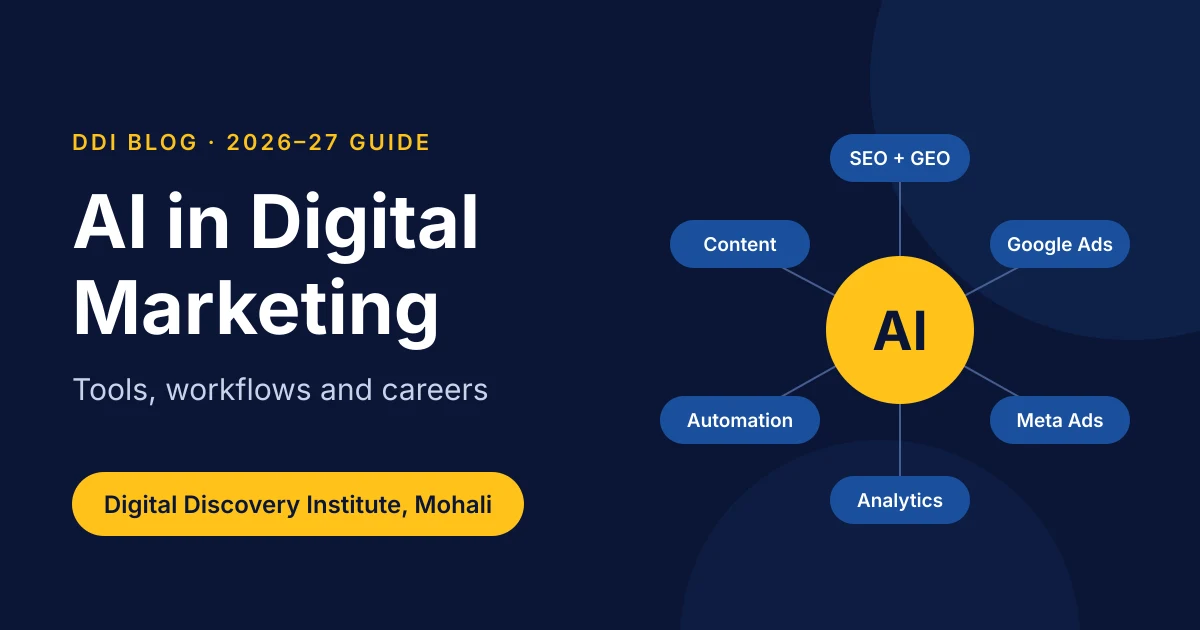
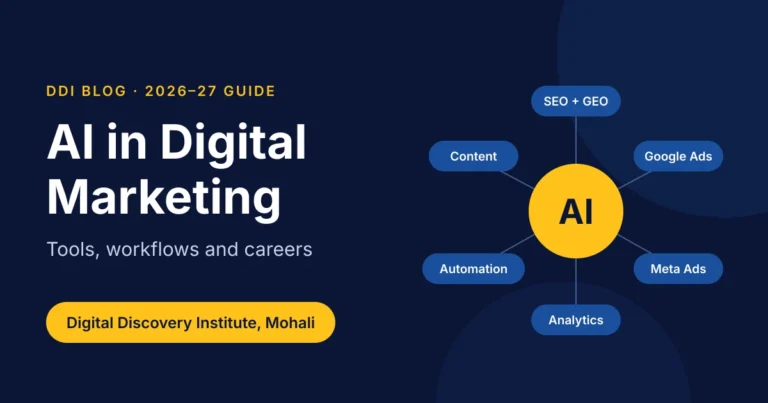
AI in digital marketing means using tools like ChatGPT, Claude and Gemini, plus the AI built into Google Ads, Meta Ads and GA4, to research, create, target and measure marketing faster. However, AI does not replace the marketer. Instead, it speeds up the repetitive work, and the marketer decides what is right for the brand.
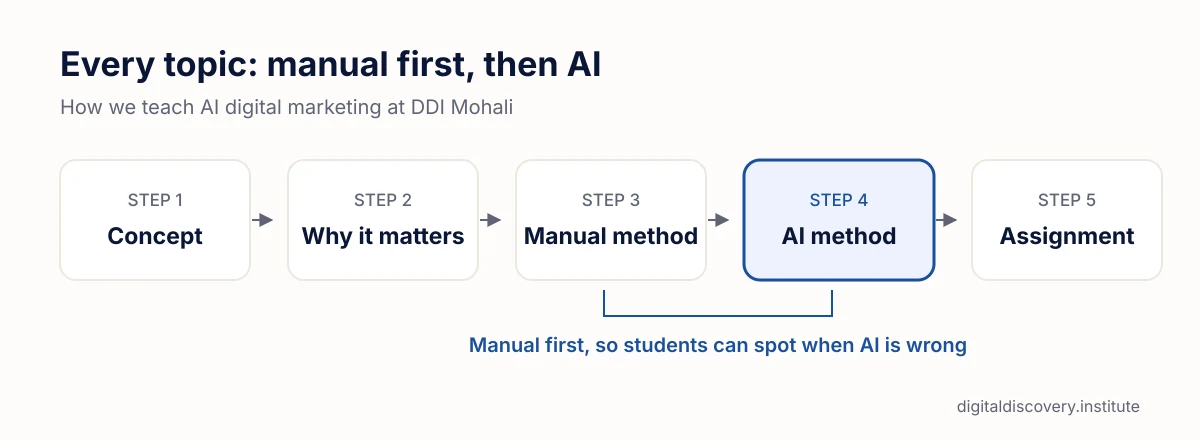
At Digital Discovery Institute in Mohali, we teach every topic in five steps: the concept, why it matters, the manual method, the AI method, and an assignment. We teach the manual way first on purpose, because students who skip it can’t tell when the AI is wrong.
This guide shows how AI is used in each area of digital marketing in 2026–27, the tools we use in class, a real workflow you can copy, and the skills employers now look for.
Key takeaways
- AI is now part of every channel: SEO, Google Ads, Meta Ads, content, email and WhatsApp, and analytics.
- However, Google rewards content with real experience and new information, not text copied out of an AI tool.
- Still, ranking in Google is the main way to get cited in AI Overviews and AI Mode.
- Therefore, the most valuable skill is knowing the manual method well enough to check the AI’s work.
- As a result, employers want marketers who can use AI to deliver results faster, not people who only write prompts.
What is AI in digital marketing?
Simply put, AI in digital marketing is software that learns from data to help marketers write, predict, personalise and automate. In fact, most marketers use four kinds every day, often without calling it “AI”.
| Type of AI | What it does | Where you meet it |
|---|---|---|
| Generative AI | Writes text, makes images and video, and summarises | ChatGPT, Claude, Gemini, Canva AI |
| Predictive AI | Predicts who will click, buy or leave | Google Ads Smart Bidding, Meta Advantage+, GA4 predictive audiences |
| Automation AI | Runs tasks on triggers, without manual work | Email and WhatsApp flows, lead follow-ups, report scheduling |
| AI search | Answers questions directly in search | Google AI Overviews, AI Mode, ChatGPT search, Perplexity |
Traditional vs AI-powered digital marketing
| Task | Traditional way | With AI (2026) |
|---|---|---|
| Keyword research | Export a list and group it by hand for hours | AI clusters 500 keywords by intent in minutes; you check the groups |
| Blog writing | Write from a blank page | AI drafts the outline; you add experience, examples and data |
| Ad copy | Write 3–4 headlines | AI suggests 15 headlines; you pick and test the best |
| Reporting | Copy numbers into a sheet every week | Looker Studio auto-updates; AI writes the first summary |
| Customer replies | Reply to each message by hand | AI drafts replies to reviews and WhatsApp queries for approval |
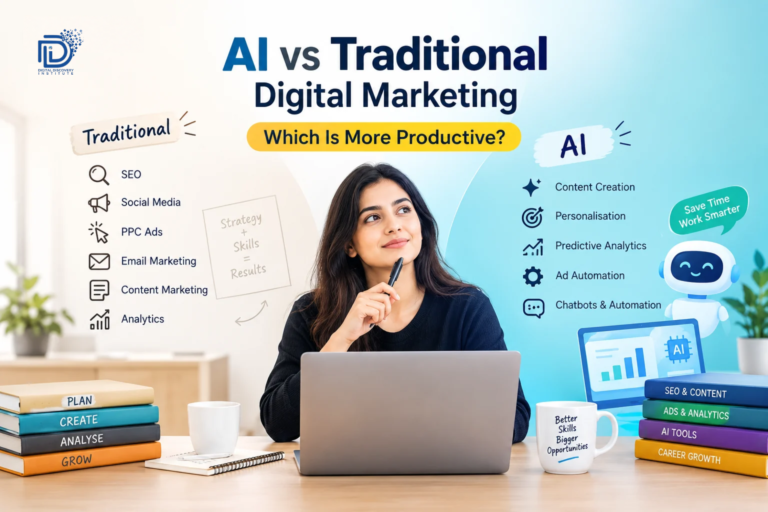
The pattern is the same in every row. First, AI does the first draft and the heavy lifting. Then the marketer sets the goal, checks the facts and makes the final call. We compare results in more detail in AI vs traditional digital marketing.
How AI is used in each area of digital marketing
1. SEO, AEO and GEO
Today, search has two goals: rank on Google, and get cited in AI answers such as AI Overviews, AI Mode, ChatGPT and Perplexity. Pages that rank well are the ones most often cited, so SEO is still the base. Google’s own guide to AI features and your website also says standard SEO practices still apply. For example, AI groups keywords by intent, finds gaps in top-ranking pages, explains Search Console errors and writes schema code for you to test. We teach this hands-on, including GEO and AEO, in our AI SEO course.
2. Google Ads
First, Smart Bidding sets bids for every auction. Then Performance Max finds customers across Search, YouTube, Display and Gmail. AI also writes ad copy options and finds negative keywords, as our guide to Google Ads automation explains. However, your job is to give it good inputs: correct conversion tracking, strong creatives and clear goals. Our AI PPC course trains you on both Google Ads and Meta Ads.
3. Social media and Meta Ads
Similarly, Meta Advantage+ chooses audiences, placements and creative combinations. If you’re new to it, start with what Meta Ads are and why you should learn them. In addition, AI plans content calendars, writes captions, and turns one blog post into reel scripts and carousels, which students practise in our social media marketing course.
4. Content marketing
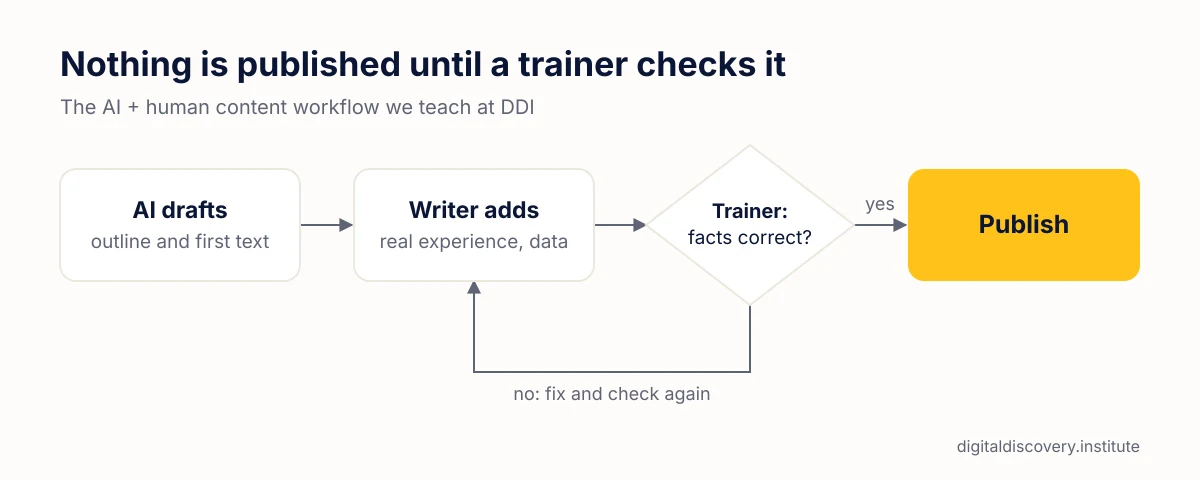
Of course, AI speeds up research, outlines and drafts. However, Google’s 2026 updates lowered mass-produced AI content with no human input. The posts that win add real experience and are easy for AI search engines to understand. Our rule in class (and in our AI content writing course): AI drafts, a human adds experience and examples, and a trainer fact-checks before publishing.
5. Email, WhatsApp and automation
First, automated flows send welcome messages, follow-ups and reminders on their own. AI also writes message variations for A/B tests and sorts leads so sales calls the hottest ones first. Our email marketing guide covers the basics.
6. Analytics and reporting
For example, Looker Studio dashboards update themselves. Similarly, you can paste a GA4 export into Claude or ChatGPT and ask “What changed this month, and why?”, then check the answer against the real data. New to GA4? Read Google Analytics 4 for marketers first.
AI tools digital marketers use in 2026–27
You don’t need 50 tools. Instead, these are the ones we use in class, grouped by job.
| Job | Tools | What we use them for |
|---|---|---|
| AI assistants | ChatGPT, Claude, Gemini, Perplexity | Research, outlines, ad copy, audit summaries, data questions |
| SEO and website | Google Search Console, Semrush, WordPress, Google Business Profile | Keywords, rankings, site fixes, local SEO |
| Ads | Google Ads, Meta Ads Manager | AI bidding, Performance Max, Advantage+ campaigns |
| Creative and social | Canva, Meta Business Suite | Post designs, reels covers, scheduling |
| Analytics and automation | GA4, Google Tag Manager, Looker Studio, email and WhatsApp tools | Tracking, dashboards, automated follow-ups |
Tip: learn one AI assistant deeply instead of trying every new tool. After all, good prompting skills work in all of them, and our prompt engineering course teaches them step by step.
Real workflow: an AI-assisted website audit
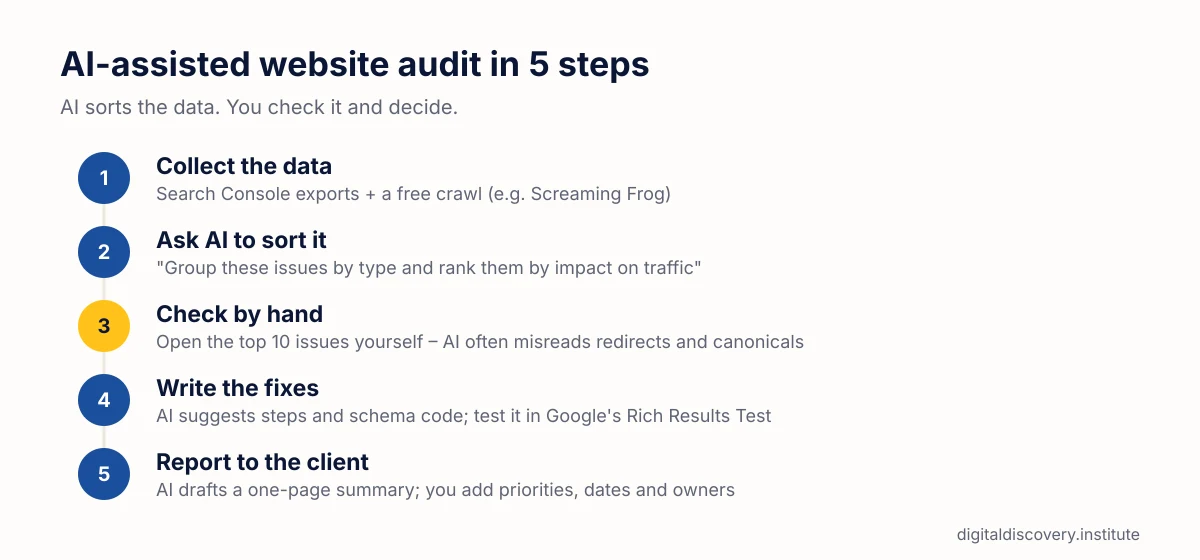
This is the audit workflow our students follow in the Technical SEO & Website Audit module. A manual audit can take a full day. With AI, however, most of the time goes into checking and deciding instead of collecting.
- Collect the data. First, export the Pages and Performance reports from Search Console, and run a free crawl with one of these free website audit tools.
- Ask AI to sort it. Next, upload the exports to Claude or ChatGPT: “Group these issues by type and rank them by impact on traffic.”
- Check by hand. Then open the top 10 issues in the browser and Search Console. That’s because AI often misreads redirects and canonical tags.
- Write the fixes. Next, ask AI for fix steps and schema code, then test the code with Google’s Rich Results Test.
- Report to the client. Finally, AI drafts a one-page summary in plain language. Then you add priorities, dates and who does what.
Benefits and limits of AI in marketing
| AI is good at | AI is weak at |
|---|---|
| First drafts, ideas and variations | Facts, prices and recent changes (it can make things up) |
| Sorting large data such as keywords, reports and search terms | Knowing your brand, customers and local market |
| Repetitive tasks like follow-ups, tagging and reporting | Original experience, opinions and real results |
| Explaining technical errors simply | Judgment on budgets, strategy and ethics |
Three rules we follow: check every fact and number, never paste private client data into public AI tools, and never publish AI text without adding your own experience.
Will AI replace digital marketers?
No. AI replaces repetitive tasks, not marketers who know how to use it. As a result, the job is shifting from “doing every task by hand” to “directing AI and checking its work”. In short, agencies now expect one person to do work that once needed two, and to do it faster.
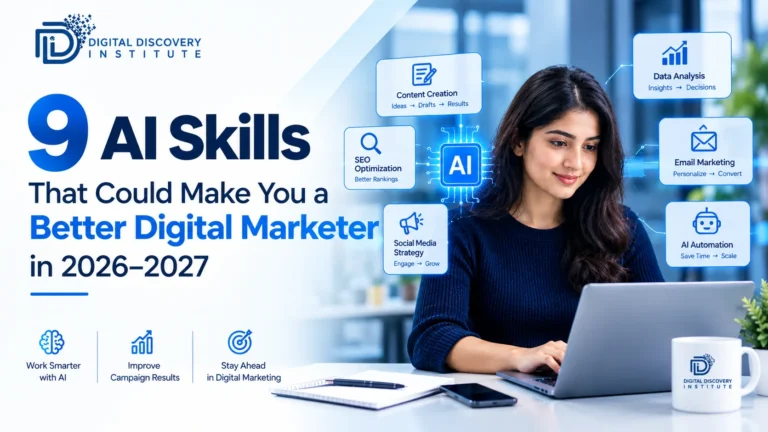
Skills employers look for in 2026–27 (we cover more in 9 AI skills for digital marketers):
- Strong basics in SEO, Google Ads, Meta Ads and GA4. That’s because you can’t check AI without them.
- Prompting and AI workflows for research, content and reporting.
- GEO and AI search visibility.
- Reading data and explaining it to clients.
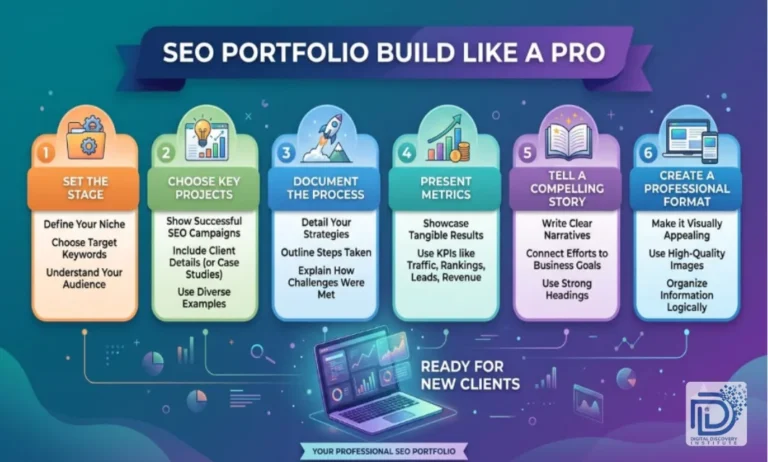
- A portfolio of real work: a live website, campaigns, an audit and reports. Here’s how to build an SEO portfolio.
Career paths: SEO executive, PPC executive, social media executive, content marketer, performance marketer, marketing automation executive, or freelancer. Our digital marketing career guide lists the salary range for each role.
How to learn AI digital marketing: a 90-day roadmap
Learn the channels in the order a real campaign needs them, and then add AI to each step as you go. This is the order we follow at DDI:
- Foundations and website: marketing basics, then build your own WordPress site.
- SEO: keywords, on-page, Search Console, local SEO, a technical audit and GEO.
- Analytics: GA4 and Google Tag Manager, so you can measure everything that follows.
- Paid ads: Google Ads and Meta Ads, with AI bidding and AI creatives.
- Content and automation: social media, content strategy, email and WhatsApp flows.
- AI workflows and job readiness: reporting, a final project, your CV and mock interviews.
Of course, you can learn this on your own with free resources, but most learners get stuck without feedback on real projects.
Learn it with a trainer in Mohali. Our AI Digital Marketing Course in Mohali runs for 90 days, 2 hours a day, Monday to Friday. Also, you complete 12 portfolio projects, including a live website, a Google Ads campaign and an SEO audit, and get placement assistance. Book a free demo class
FAQs about AI in digital marketing
How is AI used in digital marketing?
For example, AI is used to research keywords, write first drafts of content and ads, set bids in Google and Meta ads, automate email and WhatsApp follow-ups, and explain analytics data. However, the marketer checks the work and makes the decisions.
Can I learn AI digital marketing without coding?
Yes. In fact, all the tools in this guide work without code. Instead, you need clear thinking, good prompts and strong marketing basics.
Is AI-written content bad for SEO?
According to Google’s guidance on AI-generated content, Google doesn’t penalise content just because AI helped write it. Instead, it ranks helpful content. However, pages mass-produced with AI, with no human experience or review, lost rankings in Google’s 2026 updates.
What is GEO in digital marketing?
Simply put, GEO (Generative Engine Optimization) means making your content easy for AI tools like Google AI Overviews, ChatGPT and Perplexity to understand and quote. In other words, it builds on normal SEO.
Which AI tool is best for digital marketing?
There is no single best tool, so start with one AI assistant (ChatGPT, Claude or Gemini) and learn the AI features inside Google Ads, Meta Ads and GA4.
Will AI take digital marketing jobs?
AI takes over repetitive tasks. However, marketers who can use AI well are in higher demand, because they deliver more in less time.
About the author