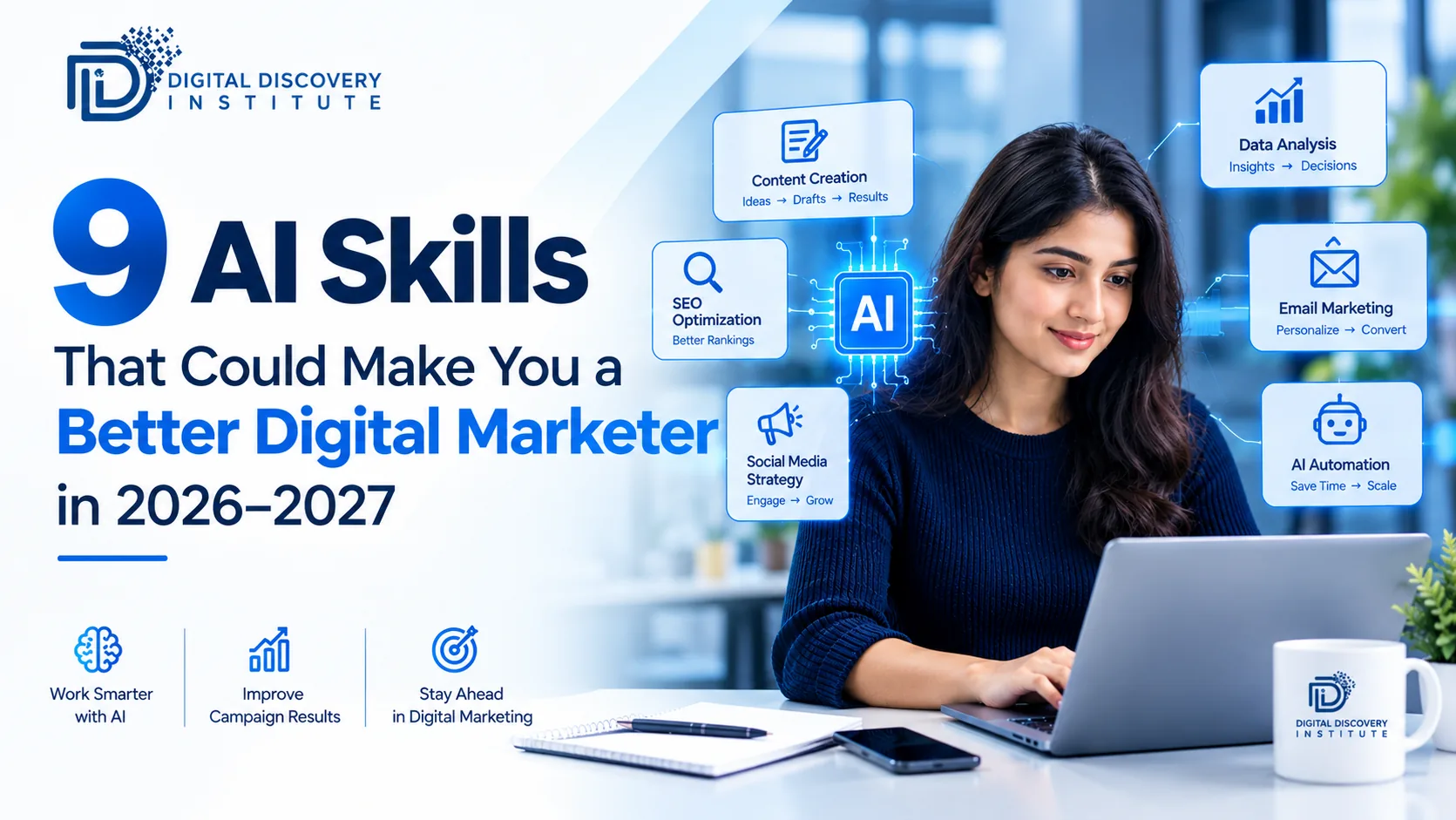
AI has moved from side experiment to everyday marketing equipment. In May 2026, Gartner reported that the marketing leaders it surveyed expect AI-driven automation of marketing work to grow from 16% in 2026 to 36% by 2028.
That is a survey-based expectation, not a guarantee. It does fit the American Marketing Association’s 2026 State of Marketing Careers Report, which describes AI fluency as becoming a baseline expectation rather than a way to stand out.
If everyone can open an AI tool, the advantage moves elsewhere: knowing where AI genuinely helps, what information it needs, and how to judge its output before a customer sees it. The same AMA report highlights judgment, adaptability and quality control as skills that stay valuable.
This guide covers nine AI skills for digital marketers, from prompting and AI-powered SEO to automation, paid ads and responsible use. Each section explains what the skill is, why it matters, which AI marketing tools can help and one small step to try. The examples are hypothetical illustrations, not case studies.
Table of Contents
The 9 AI Skills Worth Developing for Further Opportunities
1. Prompt engineering and context building
Prompt engineering means giving an AI assistant clear instructions: who the audience is, what you need, which limits apply and what format to return. Context building goes a step further. You supply the raw material that makes output sound like your brand, such as top-performing ads, customer questions, call notes and a short voice guide.
This matters because vague requests produce generic copy, and every other skill on this list depends on it. ChatGPT, Claude and Gemini all respond better to specifics.
A freelancer replaces “write a sale email” with a brief containing the brand voice notes, the audience segment and the offer, then asks for three subject lines, each with a one-line rationale and a list of claims to verify. Rewrite one old prompt with a role, audience, goal, constraints and output format, then compare the results.
2. AI-powered SEO and generative search optimisation
Search results now often include AI-written answers. Generative engine optimisation (GEO), sometimes called answer engine optimisation (AEO), means making your content easy for these systems to understand and cite.
Be careful with hype here. Google’s documentation says no special optimisation is required for AI Overviews and AI Mode, and that SEO fundamentals still apply: helpful content, crawlable pages and internal links. Other AI search products publish less guidance, so treat tactics aimed at them as experimental.
AI is most useful for grouping keywords by intent, spotting gaps in competing content and drafting outlines. Pair an AI assistant with Google Search Console, which includes traffic from AI features in its overall search data.
An online shoe store groups “best running shoes for beginners” and “how to choose running shoes” into one strong buying guide instead of several thin pages. Cluster 30 keywords by intent with AI, then check every cluster against real search results.
3. AI-assisted content creation and editing
AI can draft outlines, social posts, email variants and video scripts, and help repurpose one piece across channels. The real skill is managing the whole editorial process, not just generating text.
Google’s guidance says generative AI can help with research and structure, but producing many pages without adding value may break its scaled content abuse policy. AI can also state wrong facts confidently, so human checking is essential.
A content marketer takes one well-researched article containing original data and turns it into a newsletter, five social posts and a short video script, rewriting each for its platform and adding a fresh example. Before requesting a draft, list three things only you can contribute, such as a customer story, your own data or a firm opinion. Then build the draft around them.
4. AI-driven data analysis and marketing analytics
AI can summarise reports, flag unusual changes, compare campaigns and suggest explanations for results. It cannot decide what matters commercially, and a confident explanation can still rest on bad data.
Learn the foundations first: Google Analytics 4, spreadsheets, and metrics such as conversion rate, customer acquisition cost, return on ad spend and customer lifetime value. More advanced options include predictive modelling in BigQuery ML and open-source marketing mix modelling tools such as Meta’s Robyn and Google’s Meridian, which estimate whether ad spend actually caused sales. Those are specialist territory, not a beginner’s starting point.
Traffic rises but sales stay flat. AI suggests lower-quality visitors, a weak landing page or a tracking fault. You test each explanation against the data. You can export one campaign report, ask AI for three questions worth investigating, then answer them yourself.
5. AI personalisation and customer segmentation
Personalisation means adapting messages, offers and timing to what a customer has actually done or said. AI can help group customers and tailor content, but data quality limits the results. Salesforce’s India findings, released in June 2026, reported that 81% of marketers there had adopted AI, yet 98% faced barriers to personalisation, with data problems the most common culprits.
So this skill is partly about tidy data: knowing what your CRM (customer relationship management system) holds, building meaningful segments and respecting consent. Platforms such as HubSpot, Klaviyo and Braze offer AI-assisted features.
A shop builds three email journeys: one for new subscribers, one for past buyers and one for people who browsed a specific category. Create one segment, such as customers who bought in the last 90 days, write one tailored message, and judge it on purchases or replies, not just opens.
6. AI automation and marketing workflow design
Marketing automation connects your tools so repetitive tasks run with less manual effort: weekly reports, lead routing, feedback tagging, content calendars. Newer AI agents can chain several steps towards a goal, but they need clear permissions, monitoring and limits.
This matters because time saved on routine work can go to strategy and creativity. Zapier, Make, n8n and HubSpot’s workflow tools are common starting points.
Every Monday, a workflow pulls campaign metrics into a spreadsheet and has AI draft a summary. An analyst reviews it before anything reaches the client. List your weekly repeat tasks, choose one that is predictable and low-risk, and write out its steps before automating it. Keep a human approval step for anything customer-facing or involving spend.
7. AI-assisted paid advertising and campaign optimisation
Platforms now automate much of bidding, placement and audience expansion, through features such as Google’s Performance Max and Meta’s Advantage+. As a result, your influence moves to the inputs: clear conversion goals, strong creative and good data.
If you optimise for form submissions, the platform finds cheap form submissions. Feeding back which leads became real customers, through offline conversion imports or Meta’s Conversions API, helps steer it toward quality. AI can also help draft headline and description variations.
A shoe retailer tests three messages for one product (comfort, everyday use and durability) with equal budgets over the same period, and judges them by purchases rather than clicks. Write a hypothesis and a success metric for each ad variation before launching, and review platform recommendations before accepting budget changes.
8. AI for creative strategy and visual content
AI can speed up brainstorming, mood boards, storyboards, video scripts and resizing assets for different platforms. Canva’s AI features, Adobe Firefly, Runway and CapCut are examples of tools used for images and short video, a format brands increasingly expect.
Speed isn’t the goal on its own. Check brand consistency, readability, licensing and accuracy. In e-commerce, images must show what customers will really receive, and Google’s Merchant Center policies also ask for AI-generated product images to carry specific metadata. Some teams also experiment with AI-simulated audiences to stress-test messaging. That is an emerging idea, and it cannot replace feedback from real people.
For a footwear launch, AI generates storyboard and hook ideas, while product photos and specifications stay genuine. They ask AI for three visual directions for one past campaign, finish the best one in Canva, and proofread every detail.
9. AI evaluation, fact-checking and responsible marketing
This skill protects all the others. AI can produce fluent text containing invented statistics, fake quotes, outdated facts or biased assumptions. Responsible use means verifying claims, protecting confidential customer data, respecting copyright and knowing when a human expert must decide.
The AMA report lists quality control, discernment and taste among the skills that become more valuable as AI takes over execution. Google also notes that telling readers how content was created can add useful context.
Warning signs include precise numbers with no source, sweeping claims and advice that would fit any business.
Before publishing an AI-assisted article, you trace every statistic to its original report, check each link and ask whether you could defend each claim to a client. Draft a one-page checklist covering sources, calculations, brand voice, confidentiality and disclosure, then use it on everything.
How to Start Learning These Skills
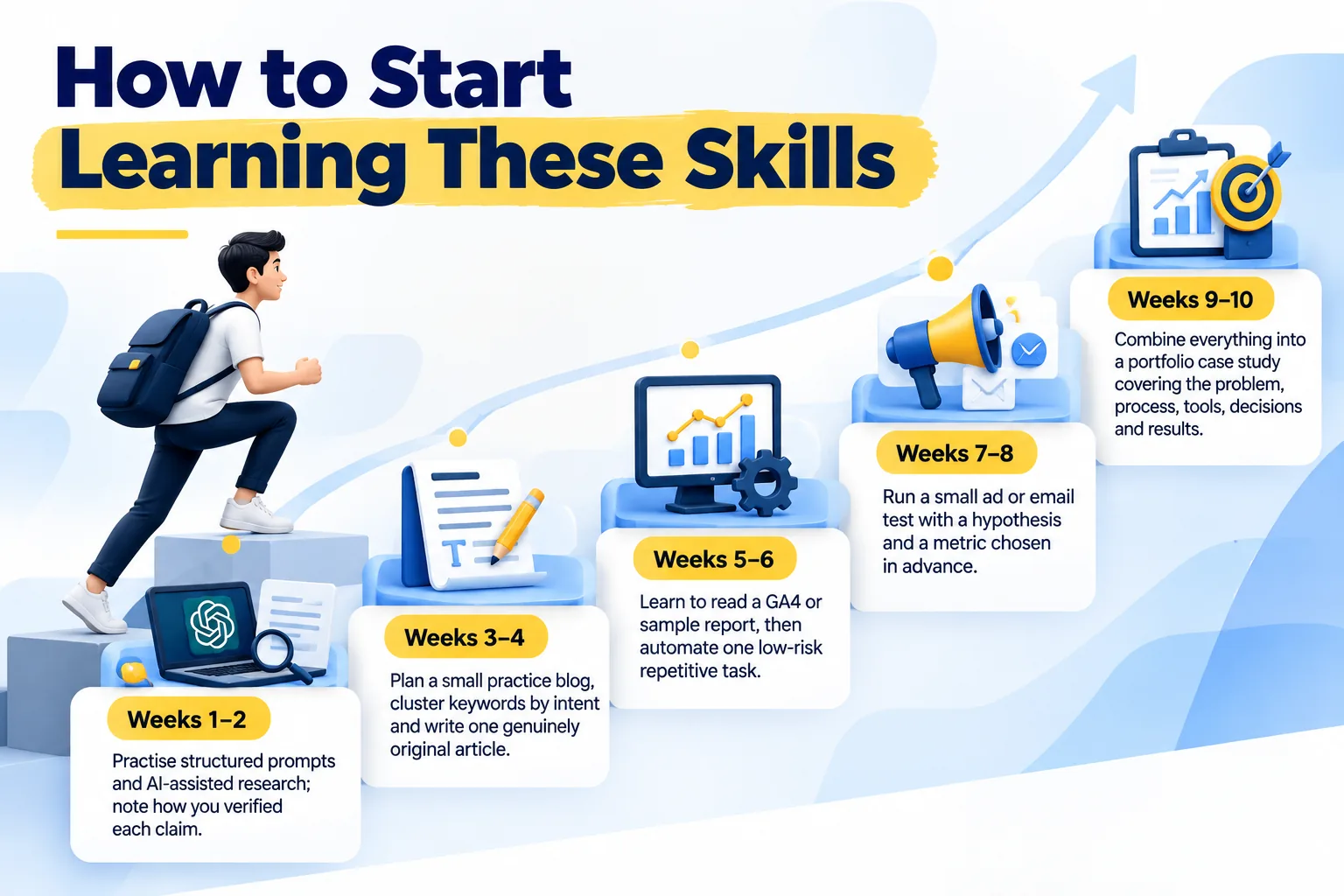
You don’t need all nine at once. Learn through small projects, and treat every AI output as a draft. This timeline is a suggestion, so adjust it to your pace.
- Weeks 1–2: Prompting and research. Practise structured prompts and AI-assisted research, and note how you verified each claim.
- Weeks 3–4: Content and SEO. Plan a small practice blog, cluster keywords by intent and write one genuinely original article.
- Weeks 5–6: Analytics and automation. Learn to read a GA4 or sample report, then automate one low-risk repetitive task.
- Weeks 7–8: Test against real goals. Run a small ad or email test with a hypothesis and a metric chosen in advance.
- Weeks 9–10: Verify and show your work. Combine everything into a portfolio case study covering the problem, process, tools, decisions and results. If you lack live data, use a clearly labelled sample dataset. Never present invented results as real business outcomes.
Digital Discovery Institute offers digital marketing training that covers AI tools, SEO, content marketing, PPC, analytics, and automation. With practical projects and expert guidance, you can work towards building a portfolio that demonstrates your marketing skills. Explore the available courses and take the next step in your digital marketing journey.
Conclusion
AI skills for digital marketers matter most when they are paired with human strengths: understanding customers, creative taste, critical thinking and sound marketing fundamentals. Tools will keep changing, and anything said about 2027 remains a prediction. Clear briefing, careful testing and honest verification will stay useful whichever platforms win.
You don’t need to master all nine. Pick one or two that match your current role, such as prompting plus fact-checking if you’re starting out, or analytics plus automation if you already run campaigns, and practise them on real projects. Small, consistent experiments will teach you more than any list of tools.
Want guidance while you practise? Digital Discovery Institute offers hands-on courses in AI tools and automation, SEO and PPC, with live projects and mentor support. You can also book a free demo class before you commit.
Frequently Asked Questions (FAQs)
Which AI skill should a beginner digital marketer learn first?
Start with prompt engineering and context building, alongside basic fact-checking. Prompting underpins the other skills, and verification stops early mistakes from becoming public ones. The AMA’s 2026 report describes AI fluency as becoming a baseline expectation, so a solid foundation is a sensible first investment. Then add the skill closest to your role: SEO for content work, analytics for reporting or automation for operations.
Do digital marketers need coding skills to use AI?
Not for most everyday work. Prompting, content drafting, SEO research and ad testing need no code, and automation tools such as Zapier and Make are designed for non-programmers. Coding in SQL or Python becomes useful for advanced analytics, such as predictive modelling and marketing mix models, so treat it as an optional specialisation rather than a requirement.
How can AI skills help digital marketers improve their career opportunities?
Employers increasingly expect them. In the AMA’s 2026 report, marketers named AI the most important skill for the next five years, and the report cites PwC research showing a 56% wage premium for AI-skilled workers. AI skills do not guarantee a job or a raise, though. They work best alongside strong marketing fundamentals and a portfolio of real or clearly labelled sample projects.
Does Digital Discovery Institute offer AI-focused digital marketing training?
Yes. Digital Discovery Institute offers AI-focused digital marketing training that covers AI tools, AI-powered SEO, content marketing, social media marketing, and other digital marketing applications. Its curriculum is designed to help learners understand how AI can support everyday marketing tasks and campaigns.
Can I learn AI-powered SEO and content creation at Digital Discovery Institute?
Yes. DDI’s published syllabus covers AI-driven keyword research, on-page and off-page SEO, SEO performance analysis, content strategy, and content creation. These topics are relevant to marketers who want to use AI tools for research, optimisation, and content planning while maintaining quality and accuracy.
Does Digital Discovery Institute provide practical projects to help students apply AI marketing skills?
DDI highlights practical learning through real-time projects, instructor guidance, and hands-on digital marketing training.
Which Digital Discovery Institute course should I consider to develop AI marketing skills?
The best option depends on your goals. DDI’s AI-focused digital marketing training is relevant if you want to explore AI across multiple marketing activities. Its SEO course is also worth exploring for search optimisation with AI, while its performance marketing course focuses on Google Ads, Meta Ads, campaign analytics, and AI-powered automation. Review the syllabus and course details before choosing.