
Table of Contents
- What Is GEO (Generative Engine Optimization)?
- GEO vs Traditional SEO: What's the Difference?
- How AI Search Engines Actually Work
- Why Some Businesses Get Recommended by AI (And Others Don't)
- 10 GEO Strategies That Actually Work in 2026
- GEO for Local Businesses in India
- GEO Mistakes That Are Killing Your Visibility
- Your GEO Checklist for 2026
- The Future of GEO
- Conclusion
- FAQs
Today, many people simply ask ChatGPT.
A student in Chandigarh types: “What is the best digital marketing institute in Mohali with placement support?” And ChatGPT gives them a direct answer with names, descriptions, and reasons why those institutes are best.
But here’s the uncomfortable truth, if your business is not appearing in those answers, you are already losing customers to competitors who figured this out this before you.
This is not a distant future scenario. This is happening right now, in 2026. A growing number of users in India – students, business owners, homebuyers, patients are bypassing Google entirely and going straight to AI assistants for recommendations. According to data from various digital analytics firms, AI search usage has grown by over 300% since 2023.
So the big question is: How do you make sure ChatGPT, Gemini, and Perplexity recommend YOUR business?
That is exactly what GEO – Generative Engine Optimization – is all about.
This guide will not just explain what GEO is. It will tell you exactly why some businesses are getting mentioned by AI while others are invisible, what signals these AI engines actually trust, and what practical steps you can take starting today.
Let’s get into it.
What Is GEO (Generative Engine Optimization)?
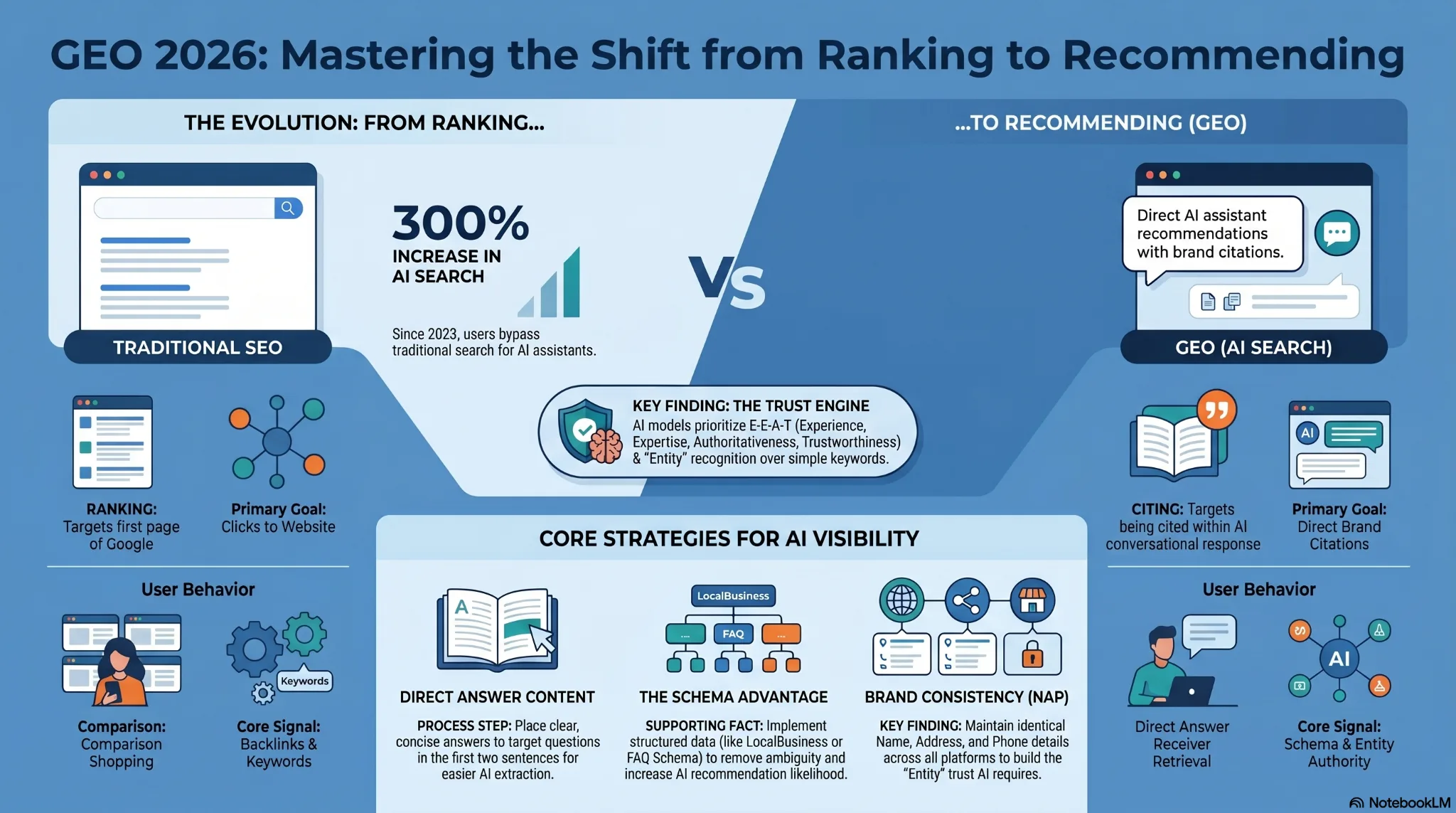
GEO, or Generative Engine Optimization, is the process of optimising your online presence so that AI-powered search engines – like ChatGPT, Gemini, Perplexity, and Microsoft Copilot – recommend your business, products, or content when users ask relevant questions.
Think of it this way.
Traditional SEO helps you rank on the first page of Google. GEO helps you get cited or recommended inside AI-generated answers.
Let’s understand this with an example.
Imagine you own a bakery in Chandigarh. With good traditional SEO, when someone Googles “best bakery in Chandigarh,” your website appears in the top results. The user then clicks your link, visits your site, and hopefully calls you.
With GEO, when someone asks ChatGPT “Where can I find the best custom cakes in Chandigarh?”, ChatGPT might say: “One well-reviewed option is [Your Bakery Name], known for their custom wedding cakes and same-day delivery.”
No clicking required. No comparison shopping. Just a direct recommendation.
That is the power of GEO. And that is why it matters more with each passing month.
Here’s what we have noticed working with businesses across North India, most companies have no idea this optimization gap exists. They are still focused entirely on Google rankings while AI assistants are quietly sending customers to their competitors.
GEO vs Traditional SEO: What's the Difference?
Before you panic and abandon, let me tell you the truth: GEO and SEO work together. But they are different enough that you need to understand both.
The important thing to understand is this: SEO is still important. AI engines like Perplexity and Bing’s Copilot actually crawl and index web pages in real time. Google itself is now powering AI Overviews using indexed content. If your SEO is weak, your GEO will suffer too.
But GEO adds a new layer on top of SEO. It requires you to think about whether your content can be directly cited or quoted by an AI engine, not just ranked.
Most businesses get this wrong – they focus only on ranking but ignore whether their content is structured in a way that AI can actually extract and present.
How AI Search Engines Actually Work
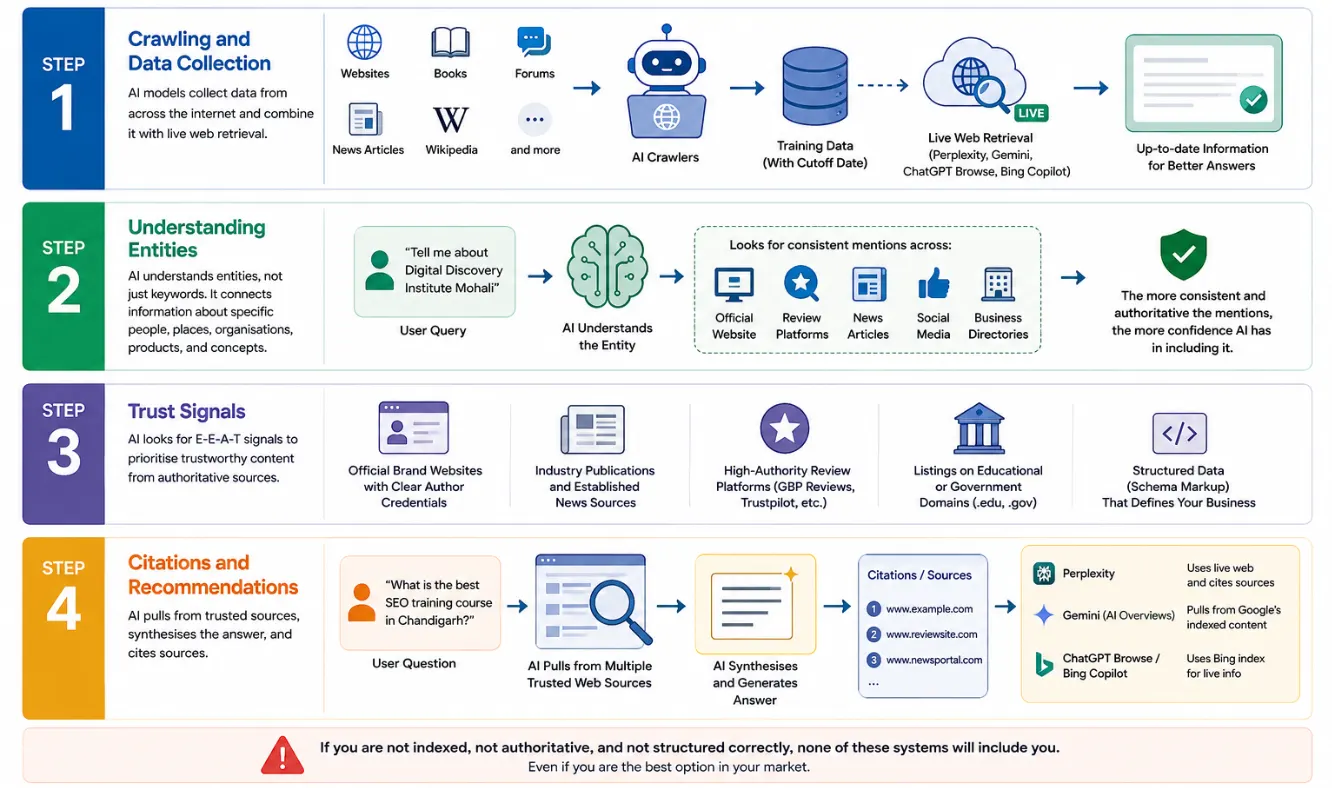
To understand GEO properly, you need to understand how these AI engines process information. It is different from traditional search, and the difference matters a great deal.
Step 1: Crawling and Data Collection
AI models like ChatGPT (GPT-4) were trained on massive datasets scraped from the internet – websites, books, forums, news articles, Wikipedia, and more. This training data has a cutoff date. So anything published after the training cutoff may not be in ChatGPT’s base knowledge.
However, newer versions of ChatGPT, Gemini, and Perplexity now use live web retrieval alongside their trained knowledge. Perplexity, in particular, is essentially a search engine that summarises live web results using AI. Bing Copilot does the same.
This means that your live web presence matters more than ever.
Step 2: Understanding Entities
AI engines do not just read keywords. They understand entities – specific people, places, organisations, products, and concepts.
When ChatGPT processes content about “Digital Discovery Institute Mohali,” it recognises this as a specific educational entity. It looks for consistent mentions of this entity across multiple sources: the official website, review platforms, news articles, social media, and business directories.
The more consistently and authoritatively your entity is described across the web, the more confidently an AI will include it in responses.
Step 3: Trust Signals
AI models are designed to give accurate, trustworthy answers. They look for what SEOs call E-E-A-T signals – Experience, Expertise, Authority, and Trustworthiness. They prioritise content from:
- Official brand websites with clear author credentials
- Industry publications and established news sources
- High-authority review platforms (GBP Reviews, Trustpilot, etc.)
- Listing on educational or government domains
- Structured data like Schema markup that clearly defines what a business does
Step 4: Citations and Recommendations
When a user asks “What is the best SEO training course in Chandigarh?”, Perplexity will pull from multiple web sources and synthesise an answer. It will cite sources – usually with links – showing where the information came from.
Gemini’s AI Overviews work similarly. They pull structured answers from content Google has already indexed and trusted.
ChatGPT with Browse uses Bing’s index as a source of live information.
So if you are not indexed, not authoritative, and not structured correctly, none of these systems will include you. Even if you are the best option in your market.
Why Some Businesses Get Recommended by AI (And Others Don't)
Here’s what separates businesses AI recommends from businesses AI ignores:
1. They Have Clear, Consistent Brand Authority
AI engines look for brand mentions across multiple platforms. A business that is mentioned on its own website, on Google Business Profile, LinkedIn, Justdial, Sulekha, and in press articles is far more trusted than a business that only exists on its own website.
2. Their Content Answers Questions Directly
Most businesses write content about themselves. AI-recommended businesses write content that answers the exact questions their customers ask.
Instead of “We offer the best digital marketing course in Mohali,” the content says: “A digital marketing course in Mohali typically covers SEO, Google Ads, social media marketing, and analytics. Courses range from 3 to 6 months and are suitable for freshers and working professionals.”
That second version is the one AI will pull from.
3. They Use Structured Data (Schema Markup)
Schema.org markup tells AI crawlers exactly what a piece of content is — is it a course, a business, a review, an FAQ, or an article? Businesses that implement proper Schema markup are significantly more likely to appear in AI-generated answers.
For example, adding CourseSchema to a digital marketing course page tells AI engines: this is a structured educational programme, here is its name, duration, provider, and location.
4. They Have Strong, Recent Reviews
Reviews are not just for Google Maps rankings. AI engines treat review data as trust signals. A business with hundreds of detailed, specific reviews is seen as more credible than one with 12 generic five-star ratings.
Detailed reviews that mention specific outcomes – “Got placed at an MNC within 2 months of completing the course” are particularly powerful because they align with what users are actually asking AI about.
5. They Practice Entity SEO
Entity SEO means making sure your brand, products, and people are clearly defined on the web. This includes having a Wikipedia-style presence (even without an actual Wikipedia page), being consistently mentioned with the same name and details across platforms, and having clear author profiles that establish human expertise.
6. Their Technical SEO Is Solid
Fast-loading pages, clean mobile experience, proper indexing – these basics still matter because AI engines that use live retrieval can only cite pages they can actually access and crawl quickly.
10 GEO Strategies That Actually Work in 2026
Strategy 1: Direct Answer Content
What it is: Writing content that answers specific questions clearly and concisely in the first two sentences, before expanding.
Why it matters: AI engines extract the most direct, structured answer they can find. Content that buries the answer in five paragraphs of preamble rarely gets cited.
Example: Instead of a 200-word introduction before explaining what a digital marketing course costs, start with: “A digital marketing course in Mohali typically costs between ₹25,000 and ₹80,000 depending on the duration, curriculum, and whether placement support is included.”
Implementation steps:
- Audit your top pages and identify the core question each one answers
- Rewrite the first paragraph of each page to include a clear, direct answer
- Use H2 headings that are themselves questions (e.g., “How long is a digital marketing course in Mohali?”)
Strategy 2: FAQ Optimization
What it is: Adding properly structured FAQ sections to key pages, with real questions your audience asks.
Why it matters: FAQs are a goldmine for AI citations. Perplexity and Gemini regularly pull from structured FAQ sections because they align perfectly with conversational search queries.
Example: On a course page, add FAQs like “Is this course suitable for someone with no prior experience?” or “What certifications will I receive after completing this digital marketing course?”
Implementation steps:
- Use Google’s “People Also Ask” section to find real questions
- Add FAQ Schema markup (from Schema.org) to every FAQ section
- Keep answers between 50 and 150 words — concise but complete
Strategy 3: Schema Markup Implementation
What it is: Adding structured data code to your website that tells search engines and AI systems exactly what your content represents.
Why it matters: Schema is one of the strongest GEO signals. It removes ambiguity for AI engines — they know whether your page is about a local business, a course, a review, or an article.
Recommended Schema types for educational businesses:
- LocalBusiness Schema for your main business
- Course Schema for each course page
- FAQPage Schema for FAQ sections
- Review / AggregateRating Schema for testimonial pages
- Person Schema for author and faculty profiles
Implementation steps:
- Visit Schema.org and use Google’s Rich Results Test tool (Google Search Central) to validate your markup
- Prioritise LocalBusiness and FAQPage schemas first
- Test every implementation using Google’s Structured Data Testing Tool
Strategy 4: Entity SEO and Brand Consistency
What it is: Making sure your business is consistently described and named across every platform on the internet.
Why it matters: If your business is listed as “Digital Discovery Institute” on your website but “DDI Mohali” on Justdial and “Digital Discovery Mohali” on Facebook, AI engines get confused about whether these are the same entity.
Example: A restaurant called “The Spice Garden” in Sector 17 Chandigarh needs to be consistently named “The Spice Garden” — with the same address, phone number, and description — on Google Business Profile, Zomato, Swiggy, Facebook, and the restaurant’s own website.
Implementation steps:
- Audit your business listings across 20+ platforms
- Standardise your business name, address, phone number (NAP consistency)
- Create a detailed “About” page on your website with entity-defining language
Strategy 5: Building Brand Mentions Across the Web
What it is: Getting your business name mentioned on other websites, blogs, and platforms — even without a direct backlink.
Why it matters: AI models are trained on large swaths of the internet. If your brand name appears in multiple credible contexts — a news article about top digital marketing institutes in Chandigarh, a student blog comparing courses, a review on a popular forum — the AI sees you as an established, real entity.
Implementation steps:
- Reach out to local education blogs and news portals for features or mentions
- Encourage students to write about their experience on their personal blogs and LinkedIn
- Publish guest posts on education and career platforms with your brand name naturally mentioned
- Get listed on authoritative education portals like Shiksha, CollegeDekho, and CourseReport
Strategy 6: Hyperlocal SEO Signals
What it is: Giving AI engines and search engines extremely specific, verifiable local information about your business.
Why it matters: When someone asks Gemini “Which digital marketing institute near Mohali Phase 7 offers weekend batches?”, the AI needs granular local data to answer confidently. Vague location information will not cut it.
Example: Instead of just saying you are located in Mohali, specify: “Located in Phase 8, Mohali, near the ISBT Chandigarh, easily accessible from Sector 17 and Zirakpur.”
Implementation steps:
- Update your Google Business Profile with detailed service areas, business categories, and post updates regularly
- Add hyperlocal keywords naturally in your content (area names, landmarks, nearby localities)
- Get listed on local directories specific to your city (Chandigarh-specific portals, Punjab education directories)
For a deeper understanding of how local search interacts with AI, check out our Digital Marketing Course in Mohali page where we cover local digital strategies in detail.
Strategy 7: Review Generation and Management
What it is: Actively collecting, managing, and displaying detailed customer reviews across multiple platforms.
Why it matters: Reviews act as third-party validation — exactly what AI engines need to feel confident recommending a business. Quantity matters, but quality matters more. A review that says “The SEO module was very detailed and the trainer explained Google Search Console step by step” is worth ten generic “Great institute!” reviews.
Implementation steps:
- Set up a simple review collection process: send WhatsApp messages to recent students or customers with a Google Review link
- Ask for specific feedback: “Please mention what module you found most useful and what outcome you achieved”
- Respond to every review — positive and negative — as this signals active management
- Display reviews on your website using Review Schema markup
Strategy 8: Thought Leadership Content and Case Studies
What it is: Publishing detailed case studies, original research, or strong opinion pieces that other websites reference and AI engines use as authoritative sources.
Why it matters: AI systems prefer citing sources that demonstrate genuine expertise — not just information, but insight. Case studies that show real outcomes (“Our student Priya increased website traffic by 340% using the SEO strategies she learnt in our course”) are highly citable.
Implementation steps:
- Publish at least two case studies per quarter
- Include specific, quantifiable results
- Write opinion pieces on trends in your industry (e.g., “Why Traditional SEO Is Not Enough for Indian Businesses in 2026”)
- Promote these pieces so they get mentioned and shared, creating the citation chain AI engines look for
Strategy 9: Author Authority and E-E-A-T Signals
What it is: Making sure the people behind your content are clearly identified as real, credible experts.
Why it matters: AI engines trained on E-E-A-T principles (a framework championed by Google Search Central) give significantly more weight to content written by identifiable experts. Anonymous blog posts are far less trustworthy than posts written by “Rajesh Sharma, 12 years of SEO experience, former digital marketing manager at [Company Name].”
Implementation steps:
- Create detailed author profile pages for every content contributor
- Include credentials, experience, and a professional photo
- Link author profiles to their LinkedIn pages
- Add Person Schema markup to author pages
Strategy 10: Technical SEO as a GEO Foundation
What it is: Ensuring your website is technically healthy so AI crawlers and search engines can access and process your content without friction.
Why it matters: It does not matter how good your content is if the page takes 8 seconds to load, is not mobile-friendly, or has crawl errors blocking indexing.
Implementation steps:
- Run a Core Web Vitals audit using Google Search Console (Google Search Central documentation provides the full guide)
- Ensure every important page is indexed — check via Search Console
- Fix broken internal links and redirect chains
- Make sure your sitemap is updated and submitted to Google, Bing, and other crawlers
Our SEO Training Course covers technical SEO in depth — including how to audit and fix the most common issues we see on Indian business websites.
GEO for Local Businesses in India
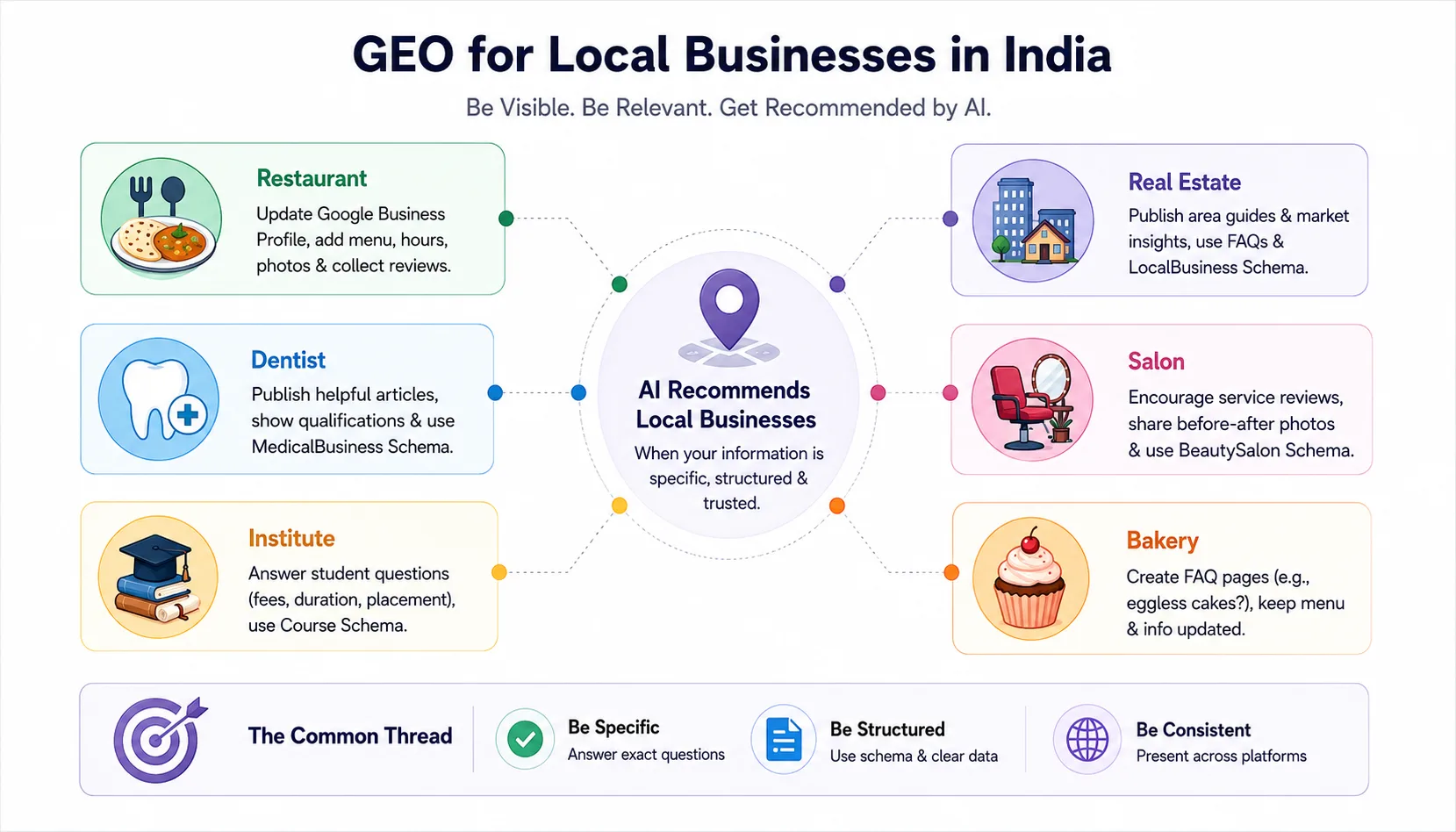
One of the most exciting opportunities in GEO is for local businesses. AI search is particularly powerful for local queries — and many local businesses have very little competition in this space because most have not started optimizing for it yet.
Let’s look at some practical examples:
Restaurant in Chandigarh:
When someone asks ChatGPT “Best North Indian restaurant in Sector 26 Chandigarh open for Sunday lunch,” the AI needs specific, structured data. Make sure your Google Business Profile includes your cuisine type, opening hours, popular dishes, and recent photos. Add Restaurant Schema to your website. Collect reviews that mention specific dishes and occasions.
Dentist in Mohali:
A dentist clinic that publishes detailed articles like “How much does a root canal cost in Mohali?” or “What to expect during a teeth cleaning procedure” is far more likely to be cited by AI when someone asks these exact questions. Add MedicalBusiness Schema and make sure your qualifications and certifications are clearly listed.
Digital Marketing Institute:
For any educational institute in Mohali or Chandigarh, the GEO opportunity is enormous. Publish content that answers the exact questions students ask AI: fees, duration, placement rates, batch timings, curriculum details. Use Course Schema on every course page. Build brand mentions through alumni networks and education portals.
Speaking of which, if you’re a student exploring your options, our Diploma in Digital Marketing page covers everything you need to know about course structure, fees, and placement support.
Real Estate Agent in Punjab:
A real estate agent who publishes detailed area guides — “Property prices in Mohali Phase 10 in 2026” or “Is it worth buying property near the IT Park in Chandigarh?” — builds exactly the kind of authoritative, locally relevant content that AI engines will cite.
Salon in Chandigarh:
A salon that has detailed Google Reviews mentioning specific services (“excellent balayage work,” “best keratin treatment in Sector 35”) and publishes before-after content with proper structured metadata is far more likely to be recommended by AI than a salon with only basic contact information.
Bakery in Mohali:
An FAQ-rich bakery website that answers questions like “Do you offer eggless customised cakes in Mohali?” with a clear, direct answer will appear in AI responses to those exact queries.
The common thread across all these examples: be specific, be structured, and be consistently present across multiple platforms.
GEO Mistakes That Are Killing Your Visibility
Most businesses are making the same mistakes. Here are the most damaging ones:
- Keyword Stuffing Instead of Answering Questions Stuffing “digital marketing course in Mohali” seventeen times into a page does not help with GEO. AI engines care about whether your content actually answers what users are asking. Stuffed content reads as low quality to AI models.
- Publishing Thin AI-Generated Content Here’s the irony: using AI to bulk-generate generic blog posts and publishing them without human editing is one of the fastest ways to destroy your GEO potential. AI engines are increasingly good at identifying low-quality, non-expert content. It adds noise to your website without adding genuine authority.
- No Schema Markup This is the number one missed opportunity we see on Indian business websites. The structured data layer is invisible to users but enormously important to AI engines. Skipping Schema is like having a great product but no label on the packaging.
- No Author Profiles Publishing anonymous content in 2026 is a trust liability. If AI engines cannot identify who wrote your content or verify their credentials, that content is significantly less likely to be cited.
- Weak or Missing Local Signals Vague location information is a major GEO weakness for local businesses. If your website only says “We are located in Chandigarh,” that is not enough for hyperlocal AI queries. Be specific: address, nearby landmarks, service areas, local contact numbers.
- Ignoring Reviews Many businesses in India still treat reviews as an afterthought. For GEO, this is a serious mistake. Reviews are third-party trust signals that AI engines use to validate recommendations. A business with 200 detailed reviews is inherently more recommendable than one with 12.
- Focusing Only on Your Website GEO requires a presence across the web, not just a great website. If your business only appears on its own domain, AI engines have nothing to cross-reference for trust.
Your GEO Checklist for 2026
Use this checklist to audit your current GEO readiness:
Content & Structure
- Every key page starts with a direct, clear answer to the main question it targets
- FAQ sections are present on all service/course/product pages
- Content is written by identified authors with credentials
- Author profile pages exist with proper credentials and Person Schema
- At least 2 detailed case studies or outcome-based articles are published
Technical & Schema
- LocalBusiness Schema is implemented on the homepage and contact page
- Course, Service, or Product Schema is on relevant pages
- FAQPage Schema is on all FAQ sections
- Review / AggregateRating Schema is on testimonial pages
- All Schema is validated using Google’s Rich Results Test
Local & Brand Signals
- Google Business Profile is complete with all categories, services, photos, and regular posts
- Business name, address, and phone number are identical across all platforms (NAP consistency)
- Business is listed on 15+ relevant directories (Justdial, Sulekha, Shiksha, etc.)
- At least 50 recent, detailed Google Reviews are present
- Brand is mentioned on at least 5 external websites
Technical SEO Foundation
- Core Web Vitals are passing (use Google Search Console)
- Website is fully mobile-optimised
- All important pages are indexed and crawlable
- XML sitemap is updated and submitted
- No major crawl errors or broken links
Content Promotion & Mentions
- Recent blog content has been shared on LinkedIn and other relevant platforms
- Guest posts or features have been published on external platforms in the last 6 months
- Alumni or customers are encouraged to mention the brand in their own content
The Future of GEO
GEO is still in its early days. Here is what is coming and why you should start building your foundation now.
- AI Agents Will Make Purchase Decisions Within the next 2-3 years, AI agents will not just recommend businesses they will actively book appointments, compare prices, and complete purchases on behalf of users. If your business data is not structured for AI readability, agents cannot work with you. This is a fundamental shift in how customers interact with businesses.
- Voice Search Will Amplify GEO Importance Voice search queries are, by nature, conversational and question-based exactly the kind of content GEO optimizes for. As smart speakers and voice assistants become more deeply embedded in Indian households, businesses that have answered common voice queries in structured content will have a significant advantage.
Our Voice Search Optimization guide goes deeper into how voice search is changing content strategy.
- Personalized AI Results Are Coming AI search engines are moving toward personalized recommendations based on user history, location, and preferences. Businesses that have built strong local signals and consistent entity profiles will be better positioned for personalized AI recommendations.
- Conversational Commerce The line between AI chat and e-commerce is blurring fast. Imagine a user asking Gemini: “Order a customised birthday cake from a highly-rated bakery near me in Chandigarh for Saturday.” The bakery in that AI recommendation will get the order. The ones that have not done their GEO work will not even be considered.
- AI Literacy Will Become a Core Marketing Skill Understanding how AI models process, trust, and cite content is already becoming a required skill for marketing professionals. If you are in digital marketing, SEO, or content creation, understanding GEO is no longer optional — it is foundational.
Our Artificial Intelligence and Machine Learning guide is a good starting point if you want to understand the underlying technology driving these changes.
Conclusion
Here is the honest reality: most businesses in India have not started their GEO journey yet. That is actually good news if you start now.
GEO is not some technical black box that only large corporations can afford. A local dentist in Mohali, a digital marketing institute in Chandigarh, a restaurant in Sector 17 — any of these businesses can start winning AI recommendations with the right strategy.
Start with the basics. Answer questions directly. Implement Schema markup. Build reviews. Establish author authority. Create consistent brand signals across the web. And make sure your technical SEO foundation is strong enough to support everything above it.
One thing we tell every client we work with: do not wait to be perfect before you start. GEO is cumulative — the authority you build today compounds over months. A business that starts its GEO strategy in 2025-26 will be significantly ahead of one that starts in 2027.
The businesses that become trusted sources of information today will become the businesses AI recommends tomorrow.
Frequently Asked Questions (FAQs)
What is GEO and how is it different from SEO?
GEO (Generative Engine Optimization) is the practice of optimising your online presence to be recommended or cited by AI-powered search engines like ChatGPT, Gemini, and Perplexity. Traditional SEO focuses on ranking in Google’s blue-link results. GEO focuses on appearing inside AI-generated answers. Both are important in 2026 GEO builds on top of a strong SEO foundation.
Does GEO replace traditional SEO?
No. GEO complements SEO rather than replacing it. Many AI search engines like Perplexity and Bing Copilot use live web indexing, which means your SEO directly supports your GEO performance. Think of GEO as a new optimization layer on top of your existing SEO work.
How do I know if my business is being mentioned by ChatGPT or Gemini?
You can test this by asking relevant questions directly to ChatGPT, Gemini, or Perplexity — questions your target customers would ask. For example: “What is the best digital marketing institute in Mohali?” or “Which bakery in Chandigarh offers custom cakes?” If your business does not appear, that is a GEO gap to address.
Is Schema markup really necessary for GEO?
Yes. Schema markup (structured data from Schema.org) is one of the strongest technical signals for AI engines. It removes ambiguity and tells AI systems exactly what your content represents — a business, a course, a review, an FAQ. Without it, AI engines have to guess, and they will often get it wrong or skip your content entirely.
How long does GEO take to show results?
GEO is not instant, just like SEO. Building brand mentions, authority content, and review volume takes time. Most businesses see meaningful improvement in AI citations within 3 to 6 months of consistent GEO work. The earlier you start, the stronger your position becomes.
Can small local businesses do GEO?
Absolutely in fact, local businesses often have a significant GEO advantage because hyperlocal AI queries are very specific. A well-optimized small business in Mohali or Chandigarh can outperform a large national brand for local queries if their GEO signals are stronger.
What is the most important GEO action I can take today?
If you had to pick one: update your Google Business Profile to be completely filled, accurate, and keyword-rich and then request detailed reviews from your recent customers. This single action improves both local SEO and GEO signals simultaneously, and it takes less than a day to implement.
How does E-E-A-T relate to GEO?
E-E-A-T (Experience, Expertise, Authority, Trustworthiness) is a framework that Google uses to evaluate content quality, and AI engines have adopted similar principles. Content that demonstrates real experience, is written by credible authors, is supported by external authority signals, and comes from a trustworthy source is far more likely to be cited by AI. Building E-E-A-T is foundational GEO work.