
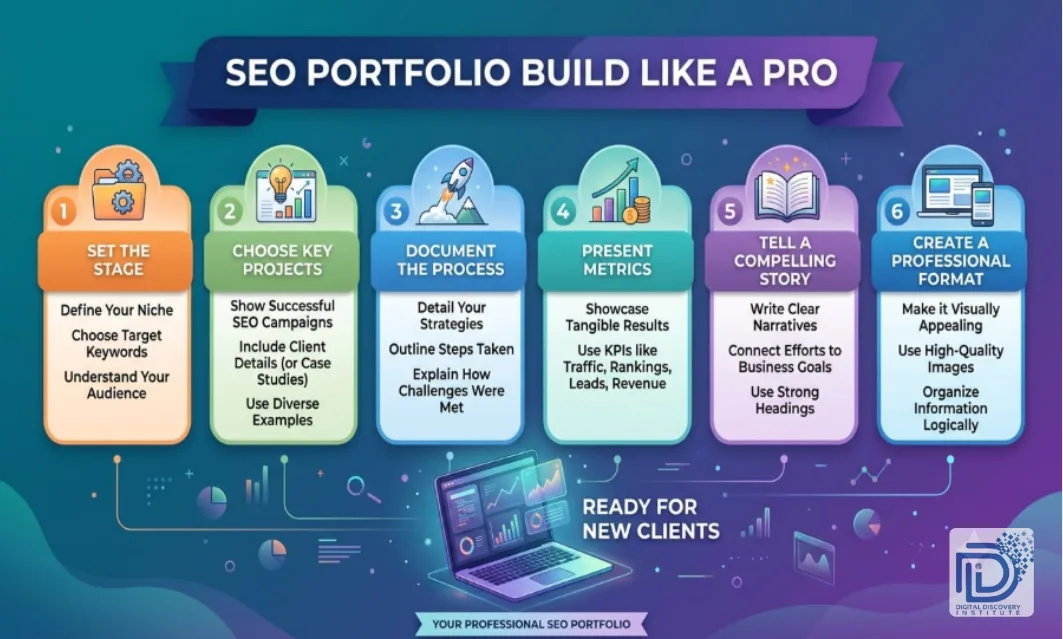
An SEO portfolio should do more than show that you know how to use a keyword tool. It should help a hiring manager answer a more important question: Can you diagnose search problems, make sound decisions, and produce measurable business results?
A strong portfolio is not a gallery of screenshots or a list of rankings. It is a concise body of evidence showing how you think and what changed because of your work.
Whether you are new to SEO or an experienced practitioner, you can build a credible portfolio by presenting projects clearly, explaining your contribution honestly, and connecting your work to outcomes that matter.
1. Start with the role you want
SEO covers a wide range of work, including technical audits, content strategy, digital PR, local search, ecommerce optimization, and analytics. A portfolio that tries to demonstrate all of it can feel unfocused.
Choose the roles you are targeting, then prioritize evidence that matches them. For technical SEO roles, show how you investigated crawling, indexing, site architecture, or structured data. For content SEO roles, explain how you researched topics, mapped search intent, or improved existing pages. Ecommerce and local SEO portfolios should show relevant experience with product or category pages, location pages, or local search visibility.
If you’re building foundational skills, DDI’s SEO training course covers practical SEO learning and project work.
2. Choose projects that prove your judgment
Your projects can come from a job, freelance engagement, internship, volunteer work, personal website, or realistic practice exercise. What matters is that they show relevant skills and that you describe them accurately.
Choose projects where you can explain the business or site’s need, what you investigated, what actions you recommended or completed, why you chose them, and what happened afterward. A modest project with a clear diagnosis and thoughtful execution is more convincing than an impressive-looking result with no explanation.
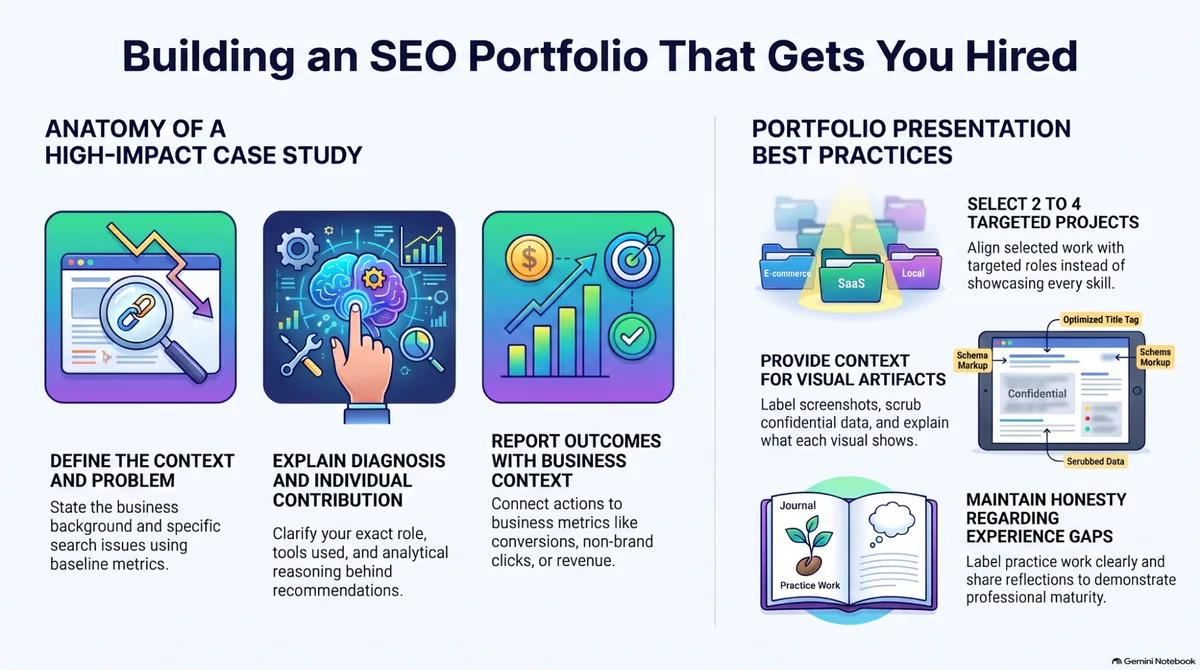
If you do not yet have professional SEO experience, work on a site you own or have permission to review. You might improve a local organization’s service pages, audit an ecommerce site, or build a focused content hub. Label practice work clearly. Never present another person’s work as your own or imply that you caused results you only observed.
3. Turn each project into a concise case study
A hiring manager should be able to understand a case study quickly. Use a consistent structure that provides context without burying the work in detail.
Set the scene
Briefly describe the site, audience, business model, and challenge. Include only the context needed to understand your decisions.
For example: “A regional home-services company relied on paid leads and had service pages that received little non-brand organic traffic.”
Define the problem
Be specific about what was not working. “The site needed better SEO” is too vague. A useful problem statement might identify pages that were not indexed, category pages competing for the same queries, or content that attracted impressions but few qualified visits.
Support your diagnosis with a baseline where possible. This could include affected URLs, query groups, crawl findings, conversion data, or a clearly defined measurement period.
Explain your findings
Show how you moved from symptoms to possible causes. Describe the evidence you reviewed, such as Search Console data, analytics, a site crawl, search results, or customer research, and explain what it revealed.
A tool export is not a diagnosis. Tell the reader why the evidence mattered and how it influenced your next step. If you’re reviewing a site’s technical health, DDI’s technical SEO guide offers context on crawling, indexing, sitemaps, and audit checks.
Describe your contribution
Be clear about your individual role. Did you conduct the analysis, write recommendations, make changes, work with developers, edit content, or report results? If the project involved a team, say so. Precise attribution makes your case study more credible.
Report the outcome with context
Choose metrics that connect to the project’s goal. Depending on the work, these might include qualified organic leads, non-brand clicks, indexed pages, revenue, or conversions.
Include the comparison period and relevant context. “Organic clicks increased 32%” is incomplete without a time frame and starting point. Avoid implying that SEO work alone caused a change when you cannot establish that.
When data is confidential, use approved anonymized descriptions or percentages. If you have no results yet, present the work as a recommendation or implementation project and label expected impact as a hypothesis.
Share what you learned
Briefly note what you would continue, change, or investigate next. This shows that you understand SEO as ongoing work rather than a one-time fix.
4. Show the work, not just the result
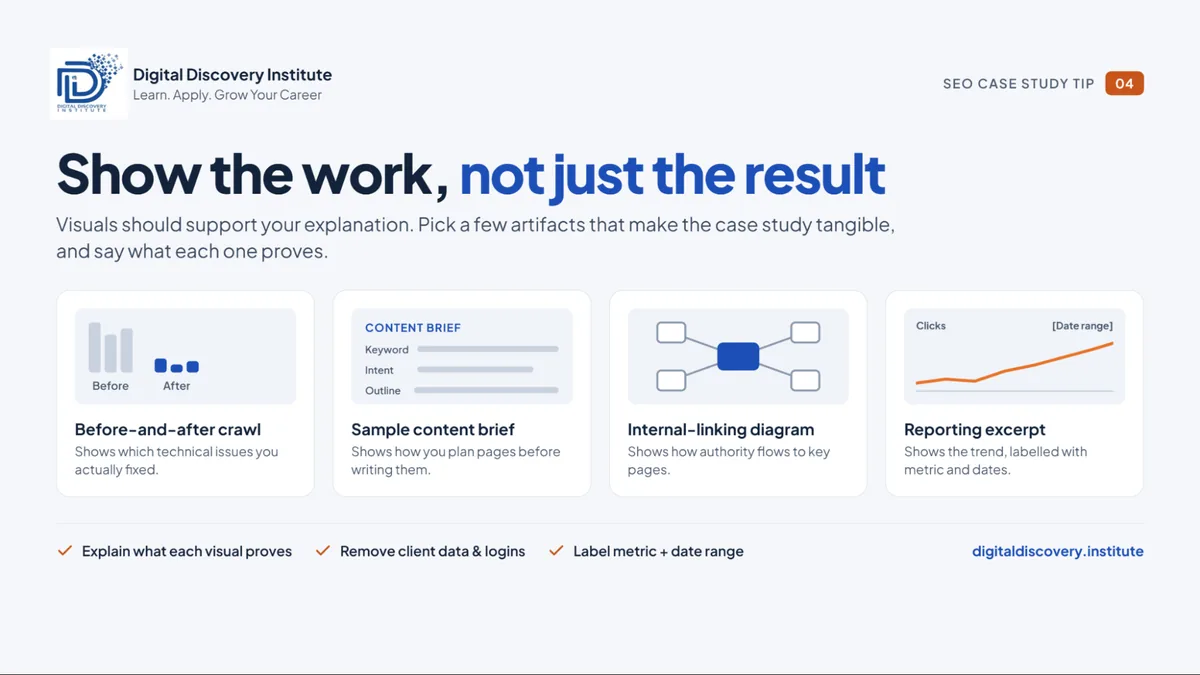
Screenshots and charts can help, but they should support your explanation. A before-and-after crawl summary, a sample content brief, an internal-linking diagram, or a short reporting excerpt can make a case study more tangible.
For each artifact, explain what it demonstrates. Remove confidential information, personal data, and access credentials. Label charts with the metric and date range. A visual without context can confuse readers more than it helps.
You can also include a short audit sample or strategy excerpt. Keep it focused: a few prioritized findings with rationale are more useful than a long list of generic recommendations. For a sample audit, DDI’s on-page SEO checklist can help you review page structure and optimization.
5. Show how you approach keyword and content work
If your portfolio includes keyword research, show how you grouped topics and connected them to suitable pages. A long keyword list rarely demonstrates strategy on its own. Explain how you interpreted search intent, checked the results, and decided what content would help the intended reader.
DDI’s guide to keyword research for beginners provides a step-by-step overview. For content planning, include a brief that identifies the audience, the question the page should answer, useful sections, related pages to link to, and facts that need verification.
6. Make your portfolio easy to review
Your portfolio does not need a custom website. A simple personal site, clean document, or well-organized public workspace can work. Include a short introduction that states your SEO focus, two to four strong case studies, your role and tools for each project, and contact information.
Put your most relevant project first. Use descriptive headings, readable text, and links that work without special access. Check the portfolio on a phone as well as a desktop.
7. Address gaps directly
If you are early in your career, do not inflate a practice project into client experience. Explain the assumptions and how you would validate recommendations with real data.
If performance data is limited, emphasize the quality of your diagnosis, prioritization, implementation plan, and measurement approach. If a project did not succeed, explain what happened and what you learned. Honest reflection often demonstrates more maturity than a collection of flawless success stories.
Avoid using rankings as the sole proof of success. Rankings fluctuate and do not always represent business impact. Where possible, connect visibility to relevant traffic, leads, revenue, or another meaningful objective.
8. Keep it current and specific
Review your portfolio before applying. Remove outdated examples, update results where you can, and confirm that each claim has supporting evidence.
Bring the most relevant work forward for each application. A technical SEO hiring manager may want to see audit and implementation experience first; a content lead may care more about intent research and editorial collaboration. Adjusting the order can make the fit clear without rebuilding the portfolio.
9. A portfolio is evidence of how you work
The strongest SEO portfolios show a clear line from business need to investigation, decision, action, and outcome. They also explain where the evidence has limits.
Build a small collection of well-explained projects, be precise about your contribution, and connect your work to results that matter. When a hiring manager can see not only what you did but why you did it, your portfolio becomes a practical demonstration of the judgment they are looking to hire.
At Digital Discovery Institute, Mohali, we go beyond teaching digital marketing. We help students turn their skills into real career opportunities through practical training, hands-on projects, portfolio building, and interview preparation.
Ready to turn your learning into a career? Explore our Digital Marketing Course and take your first step toward becoming job-ready.
Frequently Asked Questions (FAQs)
How can beginners build an SEO portfolio without experience?
Start with your own website or practice projects. Include keyword research, SEO audits, on-page optimization, and screenshots showing your work.
What should I include in my SEO portfolio to get hired?
Include 2-4 SEO projects, audit reports, keyword research, optimization examples, and measurable results where available.
Can I get an SEO job without experience?
Yes. Practical SEO skills, a strong portfolio, and interview preparation can help you qualify for entry-level SEO jobs.
Which SEO tools should beginners learn?
Start with Google Search Console, Google Analytics 4, Google Keyword Planner, and Screaming Frog. Learn how to use them on real projects.
Does Digital Discovery Institute help students build SEO portfolios?
Yes. Digital Discovery Institute, Mohali provides hands-on SEO training, practical projects, portfolio-building guidance, and interview preparation. Explore our SEO Training Course in Mohali to get started.