
Table of Contents
- Why 105,000 People Saw You and Only 378 Clicked
- Clicks: The Visitors Google Actually Sent You
- Impressions: Your Digital Billboard on Google
- CTR: The Metric Most Beginners Ignore
- Average Position: Where You Actually Rank
- How the Four Metrics Work Together (The SEO Funnel)
- What To Do When Your Numbers Don't Add Up
- Common Mistakes Beginners Make in Search Console
- Why Students Must Learn This on Real Dashboards, Not Slides
- Learn SEO With Real Data at Digital Discovery Institute (DDI), Mohali
- FAQs
Why 105,000 People Saw You and Only 378 Clicked
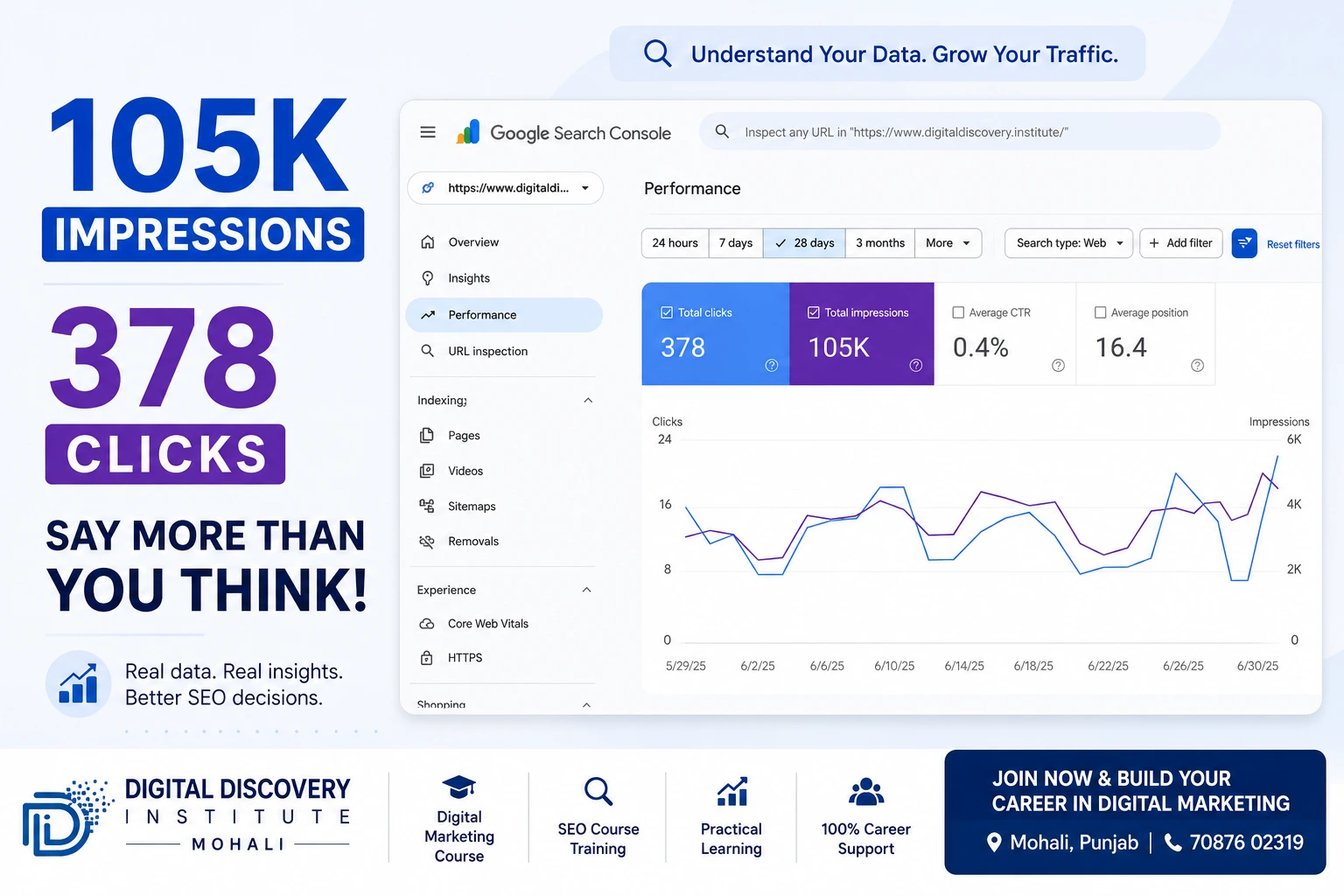
Open Google Search Console, and it tells you something like 105,000 impressions this month. Feels like a win, right?
Then you check your analytics and find only 378 people actually visited your website. Suddenly the excitement turns into a question every SEO beginner asks sooner or later:
“If Google showed my website 1 lakh times, why did almost nobody visit it?”
The answer sits inside four numbers that every SEO dashboard shows and almost every beginner misreads: Clicks, Impressions, CTR, and Average Position. Once these four make sense together, SEO stops feeling like guesswork and turns into a measurable, improvable system.
Quick Answer Clicks are visitors. Impressions are visibility. CTR (Click Through Rate) tells you what percentage of people who saw your listing actually clicked it. Average Position tells you where you typically rank. Read together, these four numbers tell you exactly which part of your SEO funnel needs work. |
1. Clicks: The Visitors Google Actually Sent You
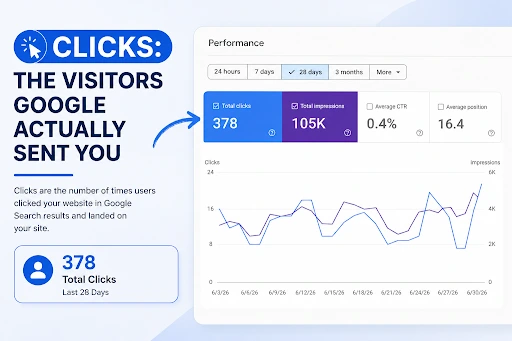
A click is counted every time someone sees your page on Google and taps through to your website. This is the number that turns into real business.
Take our example: 105,000 impressions, 378 clicks. That means Google displayed your pages in search results 105,000 times, and out of all those views, 378 people decided your result was worth opening.
Clicks are the metric that directly feeds:
- Leads and enquiries
- Sales and conversions
- Brand awareness that compounds over time
- Email signups and consultation bookings
More clicks, generally, means more business opportunity. But clicks alone don’t tell the full story. You need to know how many people saw you in the first place to judge whether that number is good or bad.
2. Impressions: Your Digital Billboard on Google
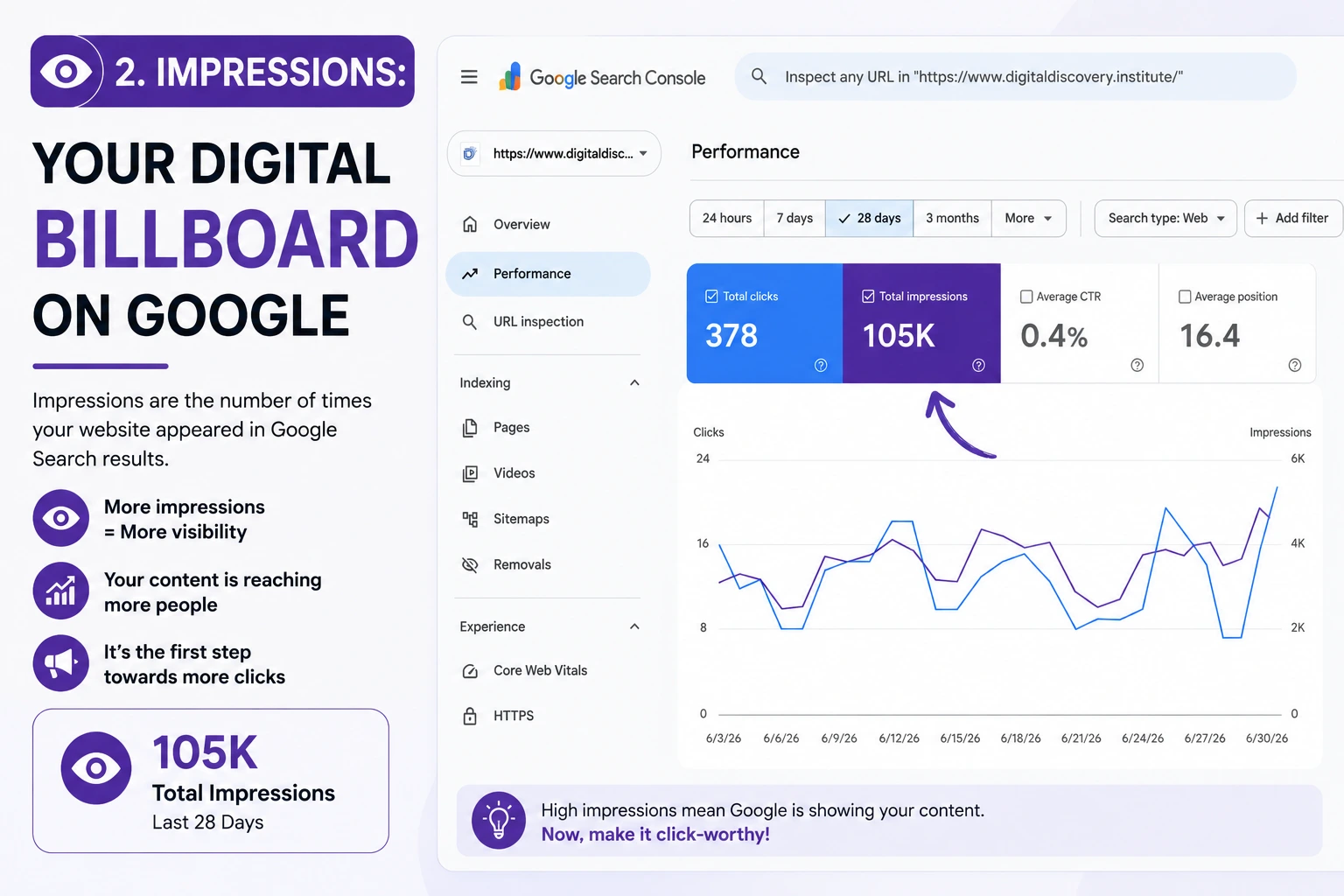
clicks it. Think of it as a free billboard on Google’s highway that runs 24×7.
Rising impressions are usually the first sign that your SEO is working, well before rankings or traffic visibly move. Google’s own Performance report documentation confirms this is exactly what the impressions metric is designed to show how often your pages appeared, not just how many people clicked. When impressions climb, it usually means:
- Google is indexing and trusting more of your pages
- You’re now showing up for a wider spread of keywords
- Your topical authority in that niche is growing
In our example: previous 28 days, 70,300 impressions. Last 28 days, 105,000 impressions. That’s nearly 50% growth in visibility in a single month, even before clicks caught up.
3. CTR: The Metric Most Beginners Ignore
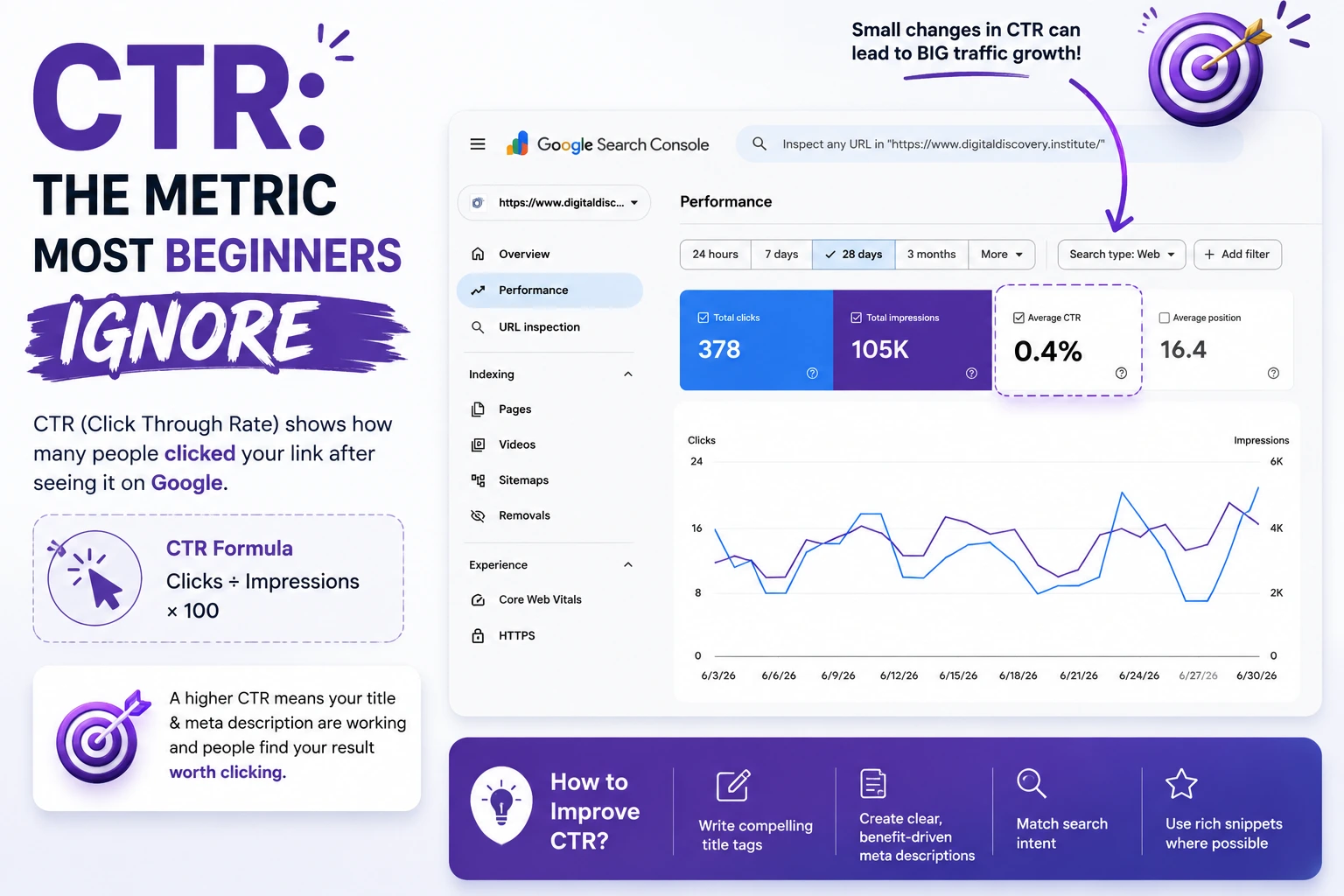
Click Through Rate (CTR) tells you what percentage of people who saw your result actually clicked on it. It’s the bridge between impressions and clicks, and it’s where most beginner-level SEO analysis stops short.
Formula =
CTR = (Clicks / Impression)*100
Using our numbers: 378 clicks ÷ 105,000 impressions × 100 = 0.4% CTR. In plain language, out of every 1,000 people who saw the listing, only 4 clicked.
CTR is shaped by things that have nothing to do with your actual ranking position:
- Title tag — does it match what the searcher typed?
- Meta description — does it promise a clear benefit?
- Search intent match — is this the result they expected?
- Rich snippets — star ratings, FAQs, sitelinks
- Brand recognition — known names get clicked more, all else equal
A low CTR does not automatically mean your SEO is failing. More often, it means your headline and description need rewriting which starts with knowing what your audience is actually typing into Google. That’s really a keyword research problem before it’s a copywriting one, and it’s something we break down in detail in our guide to using Google Ads Keyword Planner for content research.
4. Average Position: Where You Actually Rank
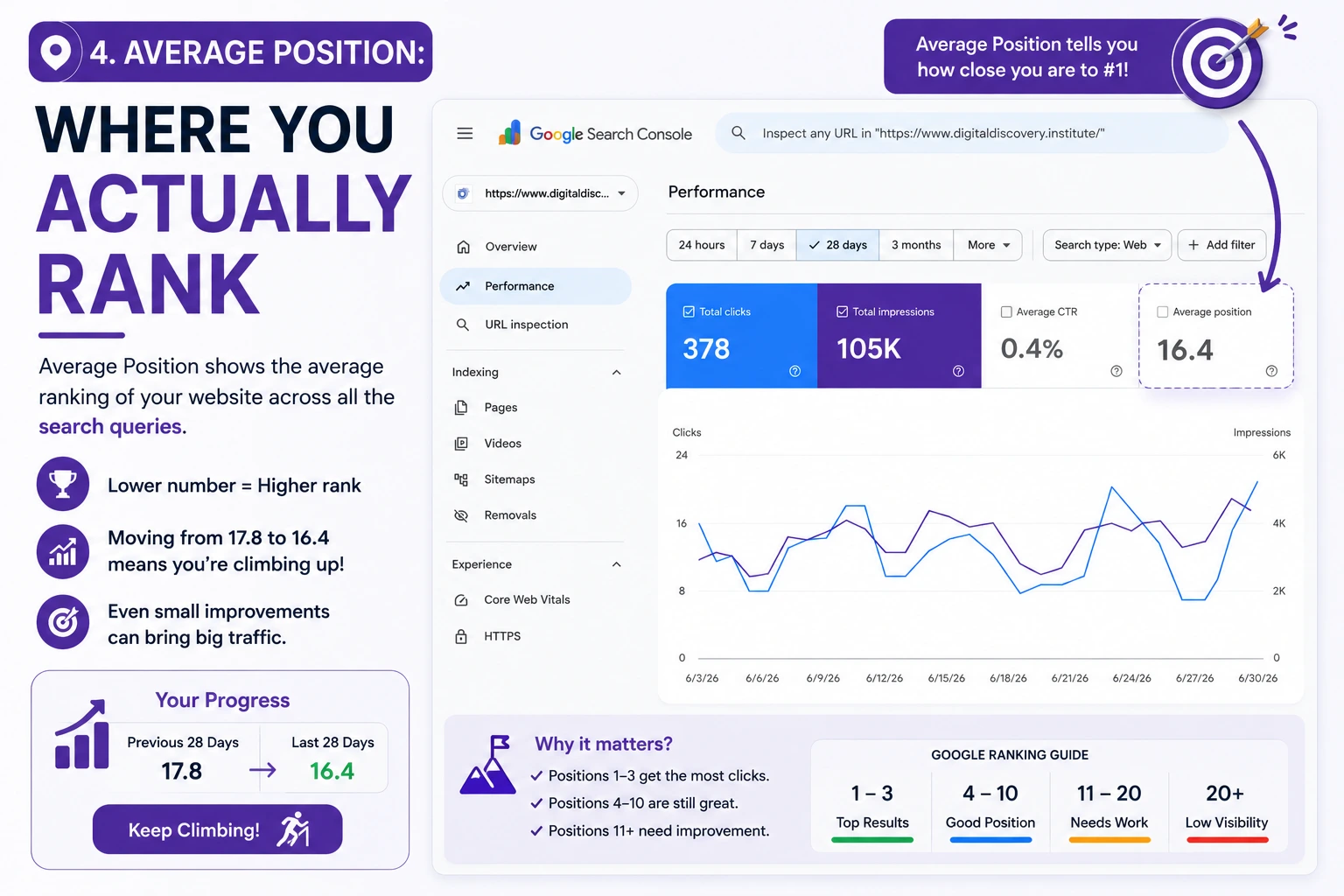
Average Position is the average ranking spot your pages hold across every search query they appear for. In our example, current position is 16.4, up from 17.8 the previous period a real move toward page one
| Position Range | What It Means |
|---|---|
| 1 – 3 | Highest visibility, top of page one |
| 4 – 10 | First page results, strong visibility |
| 11 – 20 | Second page, most users won’t scroll here |
| 20+ | Low visibility, rarely seen by searchers |
Even a small shift matters. Moving from position 18 to position 12 can meaningfully increase impressions and clicks, because you cross from page two into page one, where the vast majority of clicks happen. This is exactly the kind of movement students track hands-on in our SEO training course in Mohali, where every batch works on live ranking data instead of screenshots.
5. How the Four Metrics Work Together (The SEO Funnel)
Think of SEO as a funnel: Impressions lead to Clicks, Clicks lead to Leads, Leads lead to Customers. A healthy SEO campaign improves each stage, not just one.
| Metric | What It Measures | Goal |
|---|---|---|
| Impressions | Visibility on Google | Show up for more relevant searches |
| Clicks | Actual traffic | Convert visibility into visitors |
| CTR | Attractiveness of your listing | Get a higher share of people who see you to click |
| Average Position | Ranking strength | Move up toward page one, positions 1–10 |
When impressions, clicks, CTR, and position all improve together, growth becomes sustainable — not a one-time spike. Search Console only tells half this story though; pairing it with Google Analytics 4 shows what a visitor actually does once they land, which is why our Google Analytics course is usually taught right alongside Search Console fundamentals.
6. What To Do When Your Numbers Don't Add Up
Impressions rising, clicks flat
Your titles and meta descriptions aren’t compelling enough. Rewrite them to match search intent and add a clear benefit.
Clicks rising, leads flat
The problem has moved off Search Console and onto your website. Check your conversion tracking and landing page experience.
Rankings improving, impressions flat
You’re ranking well for too few keywords. Target more search terms and publish more supporting content including content built around how AI-driven search is changing discovery, a shift we cover in our piece on AI-focused SEO in India.
Rankings falling
Time for a technical SEO audit check site speed, mobile usability, broken links, and recent Google algorithm updates.
7. Common Mistakes Beginners Make in Search Console
- Judging SEO success on impressions alone, ignoring CTR and clicks
- Never checking Average Position by individual query, only the site-wide average
- Rewriting content when the real problem is a weak meta title
- Ignoring mobile vs desktop performance splits inside GSC
- Not connecting Search Console data with GA4 to see what happens after the click
8. Why Students Must Learn This on Real Dashboards, Not Slides
Most SEO beginners can recite the definition of CTR in an interview. Far fewer can look at a real Search Console property and answer the questions that actually matter to an employer or a client:
- Why did traffic drop last week?
- Why is CTR low for our highest-ranking page?
- Which pages need a title and meta rewrite?
- Which keywords are trending up, and which are losing ground?
- Which pages are generating leads, not just visits?
These are judgment calls that only come from reading live data, again and again, until the patterns become second nature. That’s the whole philosophy behind how our Digital Marketing Course Syllabus is structured: dashboards first, theory second.
Expert Insight Working with SEO learners over the years, the pattern is consistent: students who spend their first month inside a real Search Console property, not a screenshot in a slide deck develop dashboard instincts far faster than those who only study theory. Reading a dip in CTR and knowing whether to touch the title, the meta, or the content itself is a skill built entirely through repetition on live data. |
9. Learn SEO With Real Data at Digital Discovery Institute (DDI), Mohali
At DDI, students don’t just learn what CTR stands for, they work on live client and demo dashboards across Google Search Console, Google Analytics 4, Google Tag Manager, Google Ads, and emerging AI search platforms. It’s the same hands-on approach that’s made us one of the more recognised names among digital marketing institutes in Mohali over the years.
The training covers:
- Technical SEO and On-Page SEO
- Off-Page SEO and Local SEO
- Conversion tracking and GA4
- AI SEO & GEO (Generative Engine Optimization)
- Performance Marketing
- Reporting and client-ready analytics
With over 10,000 students trained and placement support through SEO Discovery and many others, learners at DDI get exposure to real agency workflows instead of theory-only classroom sessions. If you’d rather go broader than SEO alone, our Diploma in Digital Marketing folds Search Console, GA4, and Google Ads into a single career-track program.
Whether you’re a fresher building your first resume line, a business owner who wants to understand your own website’s numbers, or a working professional planning a switch into digital marketing, you can read more about Digital Discovery Institute or simply book a free counselling session to see which course fits where you are right now.
Frequently Asked Questions (FAQs)
What is a good CTR in Google Search Console?
There’s no single universal number CTR varies heavily by position and industry. As a rough benchmark, page-one results often see CTRs between 2% and 30% depending on position, with position 1 typically earning the highest share. Google’s own guidance on the Performance report notes that a persistently low CTR on a well-ranking page usually signals a title or description mismatch, not a ranking problem. Anything under 1% for a page ranking on page one is usually worth investigating.
Why are my impressions high but clicks low?
This almost always points to a CTR problem: your titles or meta descriptions aren’t compelling searchers to click, even though Google is showing your page often. Rewrite them to match what the searcher is actually looking for.
How often should I check Google Search Console?
Weekly is enough for most small business sites. For active SEO campaigns or larger sites, checking every few days helps you catch ranking drops or technical issues early.
Does Average Position include page two and beyond?
Yes. Average Position is calculated across every impression, including queries where your page ranks far down the results. That’s why a single average number can hide strong page-one rankings mixed with weak page-three ones always check position by individual query too.
Is Google Search Console free to use?
Yes, completely free for any website owner who verifies ownership of their domain or URL prefix.
Can I learn Google Search Console without a coding background?
Yes. Search Console is a reporting dashboard, not a coding tool. Anyone students, business owners, or career switchers can learn to read and act on it with the right guided training.