If you are planning a career in digital marketing, you have probably heard the same question again and again, should you learn traditional digital marketing, or jump straight into AI digital marketing?
It is a fair question, and the answer is simpler than it looks. In this guide we explain what each approach means, where each one saves or wastes time, and what you should actually learn in 2026.
AI digital marketing is more productive for repetitive, high-volume work such as drafts, ad variations, reporting and customer replies. Traditional digital marketing skills are what make that output correct, on-brand and profitable. The most productive marketers in 2026 learn the fundamentals and use AI tools from day one.
What is traditional digital marketing?
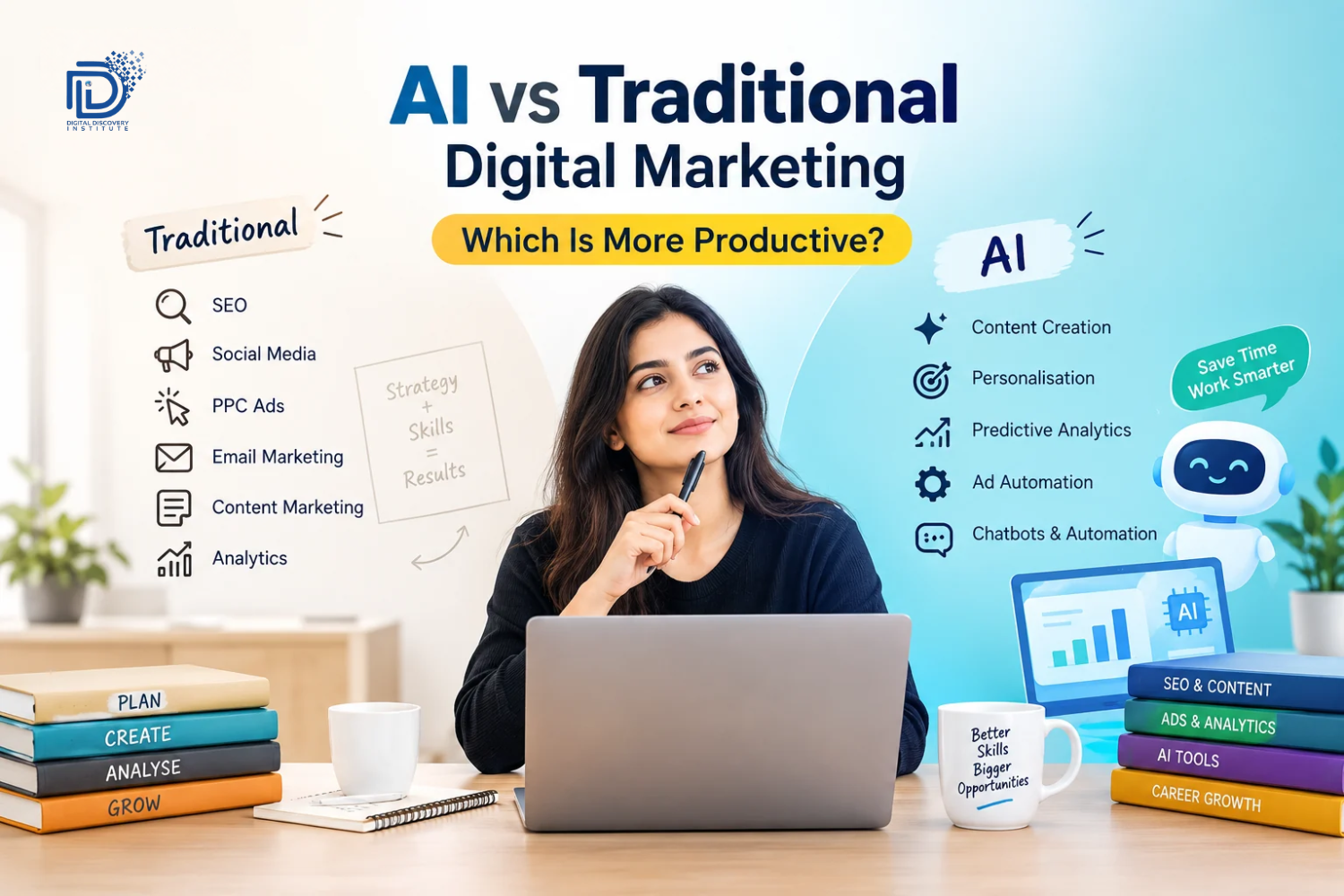
Traditional digital marketing is the set of core online channels businesses have relied on for roughly two decades:
- SEO (Search Engine Optimisation): helping a website rank on Google through keywords, useful content, technical fixes and links.
- Social media marketing: building a brand on Instagram, Facebook, LinkedIn and YouTube.
- Pay-per-click (PPC) advertising: running paid ads on Google and Meta platforms.
- Email marketing: newsletters and automated email sequences.
- Content marketing: blogs, videos, guides and other useful resources.
- Analytics: measuring what works with tools like Google Analytics 4 (GA4).
New to these terms? Read our guide to common digital marketing terms.
In the traditional workflow, the marketer does most of the research, planning, writing, design and reporting by hand. Tools support the work, but the human does the heavy lifting.
What is AI digital marketing?
AI digital marketing does not replace these channels. It uses artificial intelligence to do the same work faster and at a larger scale. For example:
- Content creation: AI assistants can draft blog outlines, ad copy, captions and email subject lines in minutes.
- Personalisation: AI can show different offers to different people based on their behaviour.
- Predictive analytics: instead of only reporting what happened, AI helps estimate what is likely to happen next.
- Ad automation: Google’s Performance Max and AI Max for Search, and Meta’s Advantage+ campaigns, use AI to adjust bids, audiences and creatives automatically. Google says advertisers who switch on AI Max typically see 14% more conversions at a similar cost per acquisition. Our performance marketing course covers both platforms.
- Chatbots and automation: AI assistants can answer customer questions and follow up with leads around the clock, including on WhatsApp.
Search itself has changed too. At Google I/O 2026, Google said AI Overviews now reach more than 2.5 billion people a month and that its conversational AI Mode has crossed 1 billion monthly users. Marketers now have to think about being cited inside AI answers, not just ranked on a results page.
In short, AI digital marketing is digital marketing with a very capable assistant sitting beside you.
AI vs traditional digital marketing: side-by-side
| Task | Traditional Approach | AI-Assisted Approach |
|---|---|---|
| Keyword Research | Manual research in SEO tools | AI groups keywords by intent and suggests topics; you verify volumes in real tools. |
| Blog Writing | Research, outline and write from scratch | AI drafts an outline and first draft; you add expertise, examples and facts. |
| Ad Copy | A few variations written by hand | Dozens of variations to test, filtered by you. |
| Campaign Optimisation | Manual bid and audience changes | Platform AI adjusts bids and audiences; you set goals, budgets and exclusions. |
| Reporting | Exporting data and building reports by hand | AI summarises GA4 and Search Console data; you decide what to do next. |
| Customer Queries | Replied during office hours | Chatbots reply instantly; humans handle complex cases. |
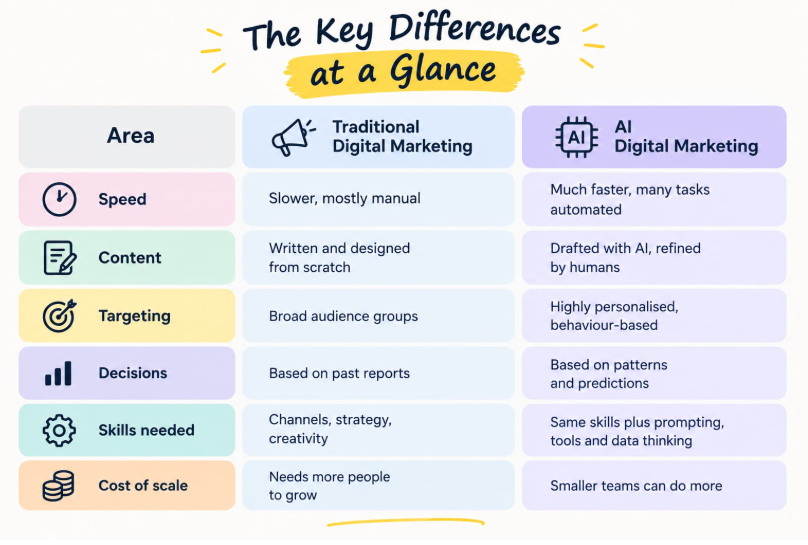
The pattern is clear: AI speeds up the doing, while human skill decides the direction and checks the quality.
Strengths and limits of each
Traditional digital marketing
- Strengths: It teaches you how people search, what makes a message persuasive, how a sales funnel works and how to read data. These ideas do not go out of date.
- Limits: On its own it can be slow. Businesses now expect faster output, and manual-only workflows are hard to justify when a tool can produce a first draft in seconds.
AI digital marketing
- Strengths: It saves time, removes repetitive work and helps you test more ideas. One marketer with strong AI skills can often handle work that once needed a small team.
- Limits: AI can be wrong, generic or repetitive, and it does not know your brand the way you do. If you do not understand marketing basics, you cannot tell whether AI output is good. This is the biggest trap for beginners.
So, which is more productive?
AI is more productive for speed and volume. Traditional skills are more productive for accuracy and results. A campaign that launches fast but targets the wrong audience is not productive, it is just fast.
That is why you should not choose one over the other. Think of it like learning to drive: even as cars get smarter, you still need to understand the road, the signals and the rules. AI is the smart car; marketing fundamentals are your driving knowledge.
What should you learn?
If you are a beginner
Start with the fundamentals: SEO, social media, ads, email and analytics, but practise them with AI tools from the very first week. Use AI to brainstorm, get feedback on your work and speed up assignments. You build both skill sets together instead of treating them as separate courses. A good first read is our beginner’s guide to local SEO.
If you already work in marketing
You have the foundation. Your best move is to upskill in AI: prompt writing, AI content workflows, automation, and AI-assisted analytics and reporting. This makes you more valuable, not replaceable.
If you are a business owner
Learn enough of both to guide your team or agency. Know what good SEO and good ads look like, and know which tasks AI can safely handle and which need a human check.
AI Is Changing Digital Marketing. Are Your Skills Ready?
Don’t just learn marketing. Learn how to use AI to research smarter, create better campaigns, and make data-driven decisions.
SEO & AI Search
Learn modern SEO and AI-assisted content strategies.
Google Ads & Social Media
Learn to plan, manage, and improve marketing campaigns.
Live Projects & Mentorship
Build practical skills with real project work and one-to-one guidance.
Turn Your Marketing Skills Into Career Opportunities
Learn digital marketing with AI tools at Digital Discovery Institute (DDI), Mohali.
Book Your Free Demo Class →Explore the training before you decide.
Frequently Asked Questions (FAQs)
What is the difference between AI digital marketing and traditional digital marketing?
Traditional digital marketing relies on manual research, content creation, campaign management and reporting. AI digital marketing uses artificial intelligence to automate repetitive tasks, analyse data, personalise campaigns and speed up execution. The channels are the same; the workflow is different.
Is AI digital marketing better than traditional digital marketing?
AI is better for speed and volume, such as drafting content, testing ad variations and summarising reports. Traditional skills remain essential for strategy, creativity, audience understanding and checking quality. The best results come from combining both.
Will AI replace digital marketers?
AI is replacing repetitive tasks, not the need for marketers. Businesses still need people who can set goals, understand customers, judge whether AI output is right and take responsibility for results. Marketers who use AI well are becoming more valuable.
How long does it take to learn AI digital marketing?
It depends on your starting point and how much you practise. Most beginners can learn the core channels and everyday AI tools within a few months of structured training, then keep improving through real projects.
Why learn AI digital marketing at Digital Discovery Institute?
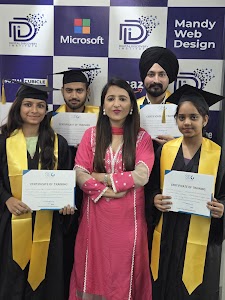
At DDI, Mohali, you learn by doing: live projects, hands-on assignments, mentorship from working marketers and regularly updated modules on SEO, Google Ads, social media and AI tools. We also offer career guidance, internships and placement support; contact us for current batch details and placement terms.