Every digital marketer in India is talking about ChatGPT right now – but most are still using it like a glorified Google search. They type a question, get an answer, and stop there. That’s leaving an enormous amount of value on the table.
ChatGPT, developed by OpenAI, is a large language model that can write, research, strategize, analyze, and brainstorm in seconds. For digital marketers, it’s not just a productivity tool. It’s a competitive advantage. Brands and agencies using ChatGPT effectively are creating content faster, running smarter campaigns, and delivering better results for clients, all without hiring more people.
In this guide, you’ll learn exactly what ChatGPT is, how it works, and most importantly, how to use it practically across SEO, content marketing, social media, email, paid ads, and more. Whether you’re a student just starting or a marketer looking to level up, this is your complete, no-fluff introduction to ChatGPT for digital marketing.
Table of Contents
- Why 2026 Is the Right Year to Start (and the Wrong Year to Wing It)
- The SKILL-TO-JOB Stack: A 5-Phase Framework for Beginners
- Can You Learn Digital Marketing Without a Degree?
- Mistakes That Slow Beginners Down
- Career Paths and Salary Data
- How to Choose the Right Digital Marketing Course
- Who Can Learn Digital Marketing?
- Frequently Asked Questions (FAQs)
Most people who want to learn digital marketing do not fail because the subject is too hard.They fail because they start in the wrong place.
They watch an SEO video one day, a Google Ads tutorial the next, then spend a week trying to decode Instagram algorithms. Three months later, they have a folder of notes, four half-finished courses, and nothing concrete to show a hiring manager or a client.
The problem was never a lack of content. It was a lack of sequence.
Digital marketing is one of the most learnable career skills in 2026. You do not need an engineering degree, expensive software, or years of experience to begin. What you need is a structured path that builds on itself – the right skill, at the right depth, practiced on real projects, with the right tools.
This guide gives you that path. Not a list of channels to “explore” – a concrete, phase-by-phase framework for going from complete beginner to genuinely job-ready.
Why 2026 Is the Right Year to Start (and the Wrong Year to Wing It)
The numbers behind digital marketing demand in India are not estimates or projections from course providers with a financial stake in the answer. They come from neutral industry bodies and research firms.
According to NASSCOM, India’s digital marketing sector already has over 1.5 million available jobs – and LinkedIn separately reported a 40% increase in job postings for digital marketing roles in a single year.
The Dentsu e4m Digital Advertising Report projects India’s digital ad market will reach ₹69,856 crore by end of 2026, growing at a 19.09% CAGR. DataReportal’s Digital 2026 India report puts the country’s internet user base at over 1.03 billion – the second-largest online market in the world.
Every business trying to reach those users needs digital marketing professionals.
But here is the part that matters for beginners specifically: the bar for “entry level” has risen. Companies hiring in 2026 are not looking for people who watched tutorials.
They want candidates who have run a real campaign, read an analytics dashboard, and made an actual decision based on data – even if the project was their own blog or a small freelance account.
AI has raised this bar further. Tools like ChatGPT, Google AI Overviews, and Perplexity now answer basic marketing questions instantly. A beginner who only knows definitions is easily replaceable. A beginner who knows how to use AI in digital marketing tools, interpret real campaign data, and solve actual business problems is not.
The good news: if you learn the right way, that is exactly who you can become – in under a year.
The SKILL-TO-JOB Stack: A 5-Phase Framework for Beginners
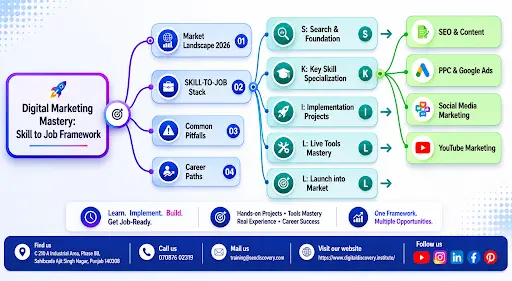
Phase 1 (S): Search and Foundation
Digital marketing makes sense the moment you stop thinking about it as a collection of platforms and start thinking about it as a customer journey.
A business has a problem: people who need their product cannot find them. Digital marketing solves that problem at every stage – attracting strangers, converting them into leads, and turning leads into paying customers. Every channel is just a different tool for moving someone along that journey. SEO and content bring people in organically over time.
Paid ads like Google Ads bring them in faster but stop when the budget stops. Email and social media keep them engaged after they arrive.
Understanding this system first prevents the most common beginner mistake: learning tactics without knowing why they work.
Spend the first two to three weeks covering:
- How search engines rank pages and why most websites never get traffic
- How the digital marketing funnel works from awareness to conversion
- What paid advertising actually buys (it buys attention, not results – results come from everything that happens after the click)
- Why SEO and content compound over time while ads do not
- How AI search tools like Google AI Overviews and ChatGPT are changing where people find answers
Do not obsess over certifications here. The goal is understanding, not badges.
Phase 2 (K): Key Skill Specialization
The most common mistake at this stage is trying to become a “full-stack digital marketer” from day one.
Employers do not hire generalists at entry level. They hire SEO executives, PPC specialists, social media managers, and content writers. Your first role will be a specialization – so your first skill should be one too.
Here is how to choose:
- Choose SEO if you enjoy writing, research, and playing a long game. SEO results take three to six months to build, but they compound. A page that ranks today can send traffic for years without additional spend. SEO knowledge also transfers directly into content strategy, e-commerce, and AI search optimization.
- Choose Google Ads / PPC if you are analytical and want faster feedback loops. PPC training teaches you to manage campaigns where every click is tracked and every rupee is accountable. The pressure is higher but so is the salary ceiling – and Google Ads certification is one of the most recognized credentials in the industry.
- Choose Social Media Marketing if you think instinctively about audiences, content formats, and what makes people stop scrolling. Social media marketing has evolved well beyond posting – it now includes creator strategy, community management, short-form video, and influencer collaboration.
- Choose Content Writing if you write well and want to build authority for brands over time. A content writing course combined with SEO fundamentals produces one of the most consistently in-demand skill sets in the market. According to industry hiring data, content strategist roles are growing 30% annually.
- Choose YouTube Marketing if you are comfortable on camera or behind production. YouTube marketing combines video strategy, SEO, and community building in a format that is growing faster than most text-based channels.
A note on AI and content: Most marketers now use tools like ChatGPT for marketing to write faster. That has not reduced demand for good content professionals – it has widened the gap between mediocre and excellent. AI produces volume. It cannot produce judgment, voice, or the kind of specific insight that makes a reader trust a brand.
Pick based on genuine interest, not assumed demand. You will practice more, go deeper, and build a stronger portfolio in a skill you actually enjoy.
Phase 3 (I): Implementation Projects
This is where most learning plans collapse. People finish a course, feel ready, and start applying for jobs. Then every posting asks for “1-2 years of experience.” They have no projects, no measurable results, nothing to show. They feel stuck.The fix is to create experience before you need it.
You do not need a client or a job to build a portfolio. You need a project. Here is what that looks like across specializations:
SEO: Start a niche blog on a low-competition topic. Write 10 to 15 optimized posts. Track rankings in Google Search Console. Screenshot your traffic growth over 60 to 90 days. That is a portfolio piece – especially if you can show which keyword you targeted, how you structured the post, and what happened after it was indexed.
Google Ads / PPC: Run a small campaign with a ₹500 to ₹1,000 budget. Document your targeting logic, match types, ad copy decisions, and what you changed after reviewing the first week’s data. The budget does not matter. The decision-making process does.
Social Media: Build a brand page from zero. Run it for 60 days with a clear content strategy. Show follower growth, engagement rate, and reach in a before-and-after format.
Content Writing: Publish a series of articles on a personal site. Optimize each for a specific keyword. Show which ones got indexed, earned impressions, and generated clicks.
E-commerce Marketing: Build a mock or real product store. Run a small campaign. Track add-to-cart rates and conversion. E-commerce marketing is one of the fastest-growing specializations in India – a project here is worth significantly more than theory.
The portfolios that lead to interviews share one thing: they show decisions, not just tasks. Not “I wrote blog posts” – but “I identified this keyword gap, wrote this post, and it ranked in the top 20 within 60 days.” Your results do not have to be impressive. They have to be real.
Phase 4 (L): Live Tools Mastery
Knowing digital marketing theory without tool experience is like knowing how to drive without ever sitting in a car.
Employers assume you know these tools from day one. If you do not, your first month on any job will be spent catching up instead of contributing. Learn them during Phase 4.
Google Analytics 4 – the backbone of every marketing team’s reporting. Understand sessions, users, conversion events, acquisition channels, and how to build custom reports. A Google Analytics certification is one of the most practical credentials a beginner can hold.
Google Search Console – tracks keyword impressions, click-through rates, and indexing status. Every SEO training course and content role uses this daily.
Google Ads – even if PPC is not your primary focus, understanding campaign structure helps every other channel.
Meta Ads Manager – Facebook and Instagram advertising. Used across social media, performance marketing, and e-commerce roles.
Canva – for social media graphics, ad creatives, and presentation decks. Graphic designing skills matter even for non-designers in marketing roles.
Semrush or Ahrefs – keyword research, competitor analysis, backlink tracking. One paid tool trial is worth more than three more certificates.
ChatGPT and AI writing tools – for content drafting, keyword research support, ad copy, and workflow efficiency. AI-powered marketing tools are now standard in every marketer’s toolkit – knowing how to use them well is a baseline expectation.
Email marketing platforms (Mailchimp or similar) – for understanding automation flows and campaign setup. Email marketing remains one of the highest-ROI channels for businesses of every size.
Affiliate marketing tools – if you plan to pursue affiliate marketing as a channel or monetization path, understanding tracking platforms and commission structures is essential.
A word on tool overload: the goal is not to know every feature of every platform. It is to run a real process – a keyword research workflow, a campaign setup, an analytics report – that would hold up in front of a client or hiring manager.
Phase 5 (L): Launch into Market
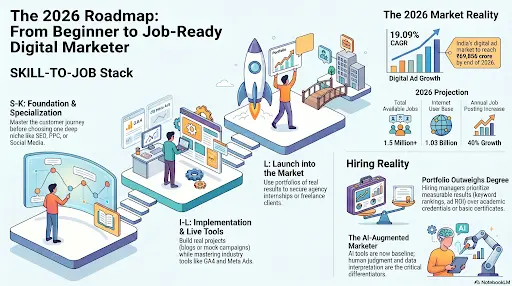
By this point you have foundational knowledge, a specialization, at least one real project, and working tool experience. That combination puts you ahead of most people applying for the same entry-level roles. Here is how to use it.
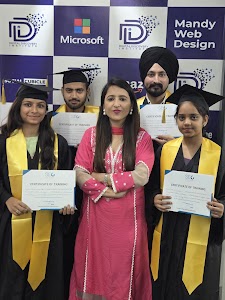
Internships: The fastest path to employment for freshers in India is an internship, not a job application. DDI’s internship program places students directly into live campaign environments – the kind of exposure that turns learners into professionals faster than any course can. Internships give you client communication experience, real reporting practice, and a reference that genuinely opens doors. When you apply, lead with your project work, not your certificates.
Industrial Training: For students and final-year graduates, industrial training in digital marketing provides structured, real-project experience that many companies explicitly ask for. It bridges the gap between classroom and workplace faster than generic internships.
Freelancing: Local outreach to small businesses, coaching institutes, and startups is a real starting point – especially in a city like Mohali where the startup ecosystem is growing. Your first freelance client does not need to pay well. They need to give you a real brief, a live account, and a measurable result you can document. One well-documented freelance project is worth four certificates on a resume.
Job applications: Target agencies first. Agency roles expose you to multiple clients, multiple channels, and faster decision cycles than most in-house roles. The learning velocity is significantly higher. Digital marketing jobs in Mohali span agencies, IT companies, e-commerce brands, and digital-first startups – with DDI’s placement cell having placed 10,000+ students across the region.
What most candidates get wrong: They apply with certificates and course completions. Hiring managers have seen hundreds of those. What gets you an interview is a portfolio link, a specific result, and a sentence about what you learned from a campaign that did not work. That combination shows you have actually done the work.
Can You Learn Digital Marketing Without a Degree?
Yes – and the evidence is unambiguous.
Digital marketing is one of the few professional fields in India where your portfolio actively outweighs your degree in hiring decisions. Every metric you produce – keyword rankings, ad ROI, follower growth, email open rates – is concrete, measurable proof of ability that no degree certificate can replicate.
Continuous learning matters more than credentials here.
Algorithm updates, new AI tools, platform changes, and shifting consumer behavior mean the marketer who stops learning stops growing. That is not a drawback. It is what makes this career genuinely interesting over the long term.
The marketers who build the best careers are rarely the ones who knew the most at the start. They are the ones who built the habit of learning continuously.
Mistakes That Slow Beginners Down
Collecting certificates instead of building projects:
A digital marketing certification signals you completed a course. A real project signals you can do the work. Hiring managers care about the second one.
Trying to master every channel simultaneously:
Depth in one skill is worth more than surface knowledge across ten. Go deep first. Expand later.
Depending entirely on AI:
Digital marketing with AI tools is faster and more efficient – but AI cannot replace strategic judgment, audience understanding, or the ability to diagnose why a campaign is underperforming. Use it to work faster, not to think less.
Expecting results immediately:
SEO takes three to six months for meaningful results. Even paid campaigns need testing cycles before they optimize. Patience combined with consistent improvement is a genuine competitive advantage in a field full of people expecting shortcuts.
Learning in isolation:
The students who grow fastest get feedback from mentors, peers, and actual campaign data. A structured training environment accelerates this significantly compared to self-study alone.
Career Paths and Salary Data
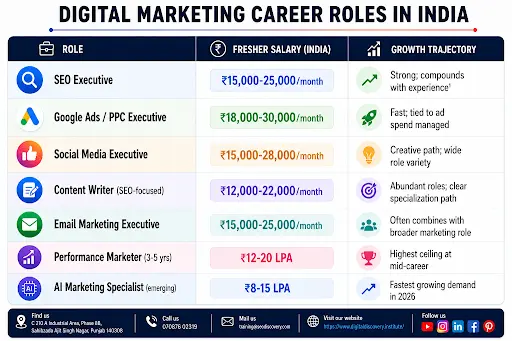
Digital marketing is not one job. It is a family of roles that suit different working styles and pay differently at every level.
Based on industry data from ET-Ipsos, LinkedIn, and Naukri:
According to NASSCOM, digital marketing roles in India have seen a 40% year-on-year increase in job postings. The Dentsu e4m report places India’s digital advertising market growth at 19.09% CAGR – a structural shift that is creating openings faster than trained professionals can fill them.
The gap between a generalist fresher and a specialized, portfolio-ready candidate is where the real salary difference lives. A fresher who knows performance marketing and joins a funded startup can start at ₹40,000+ per month. A generalist at a non-marketing-led SME might start at ₹15,000. The difference is skills that produce measurable results – not certificates on a wall.
How to Choose the Right Digital Marketing Course
Not all training is equal. Here is what actually separates Digital Discovery Institute, Mohali courses worth your time from those that are not:
- Live project work is the single most important factor. A program that does not put you on real campaigns, real accounts, and real data is preparing you for more theory – not for a job.
- Mentorship quality matters more than curriculum length. Ten hours of guidance from an experienced practitioner is worth more than a hundred hours of recorded video you watch alone.
- Placement specifics separate real programs from vague promises. Ask how many students were placed, in what roles, and at what companies. DDI has placed 10,000+ students through its placement cell and offers 100% placement support through SEO Discovery, one of the most established digital marketing agencies in the region.
- Updated curriculum is non-negotiable in 2026. Any program that does not cover AI tools, Google AI Overviews, and digital marketing with AI is already behind.
- Scholarship access can significantly reduce the financial barrier. DDI’s scholarship program makes professional training accessible to students who qualify – worth checking before assuming cost is a barrier.
The best question to ask any institute: “Can I see the portfolio of a student who completed this course six months ago?” The answers will tell you everything.
Who Can Learn Digital Marketing?
One of the genuine advantages of this field is how wide the entry points are.
Digital marketing works for students after 12th, college graduates, working professionals making a career switch, business owners who want to grow without depending entirely on agencies, freelancers building a remote income, and entrepreneurs scaling a personal brand.
The field combines creativity, communication, psychology, analytics, and technology – which means different strengths lead to different specializations. Analytical people often gravitate toward SEO and PPC. Creative people toward social media and content. Data-oriented people toward analytics and performance marketing. There is a real path for each.
Frequently Asked Questions (FAQs)
How long does it take to learn digital marketing for beginners?
Most beginners become job-ready in 6 to 12 months with consistent, implementation-focused learning. Basic channel awareness comes faster – in 2 to 3 months – but practical confidence takes longer. The speed depends almost entirely on how much real project work you do alongside your studies.
Which digital marketing skill should beginners learn first?
SEO is the most recommended starting point for most beginners. It builds foundational understanding of how online visibility works, has abundant entry-level openings, and transfers directly into content strategy, e-commerce, and AI search roles. Start with DDI’s SEO training course if you want a structured entry point.
Can I learn digital marketing without a degree?
Yes. Your portfolio and measurable results matter far more than your degree in hiring decisions. Digital marketing is one of the few professional fields where demonstrated skills outrank academic credentials consistently.
Is digital marketing a good career in India in 2026?
Yes – and the independent data confirms it. NASSCOM projects 1.5 million+ available jobs in the sector. LinkedIn reports a 40% year-on-year jump in job postings. The Dentsu e4m report puts India’s digital ad market growth at nearly 20% CAGR. The demand is structural, not speculative.
What is the difference between SEO and digital marketing?
SEO is one channel within digital marketing. Digital marketing also includes paid advertising, social media, email, content, affiliate marketing, analytics, and increasingly AI-powered automation. Most SEO specialists benefit from understanding the broader picture – but specializing first is still the smarter path for beginners.
Does DDI offer placement assistance?
Yes. DDI has placed 10,000+ students through its placement cell and offers 100% placement support through SEO Discovery. View placement details and student outcomes here.
What courses does DDI offer beyond digital marketing?
DDI offers specialized training in SEO, Google Ads, social media marketing, content writing, YouTube marketing, email marketing, affiliate marketing, e-commerce marketing, website development, and a diploma in digital marketing for students wanting a comprehensive qualification.
Digital marketing is not a skill you finish learning. It is a career you build by doing the work – consistently, deliberately, and with enough real-world exposure to develop the judgment that separates people who understand marketing from people who can actually practice it.
If you are starting from zero, the SKILL-TO-JOB Stack gives you the sequence. Start with foundations. Specialize and build real projects before you need them. Master the tools the industry uses. Then take every opportunity to work on live campaigns – even if the pay is small, even if the project is your own website.
The first project is always the hardest. After that, everything compounds.
If you want a structured path with live project experience, AI-integrated curriculum, and a clear route to placement, explore the digital marketing course in Mohali at Digital Discovery Institute. If you would like to speak to an advisor before enrolling, book a free demo here.