Since its inception as an image sharing application, Instagram has developed into a powerful advertising platform in India. Having over 230 million users in India, small companies in Mohali and large brands such as the ones in Delhi and Mumbai are using instagram ads and targeting their target customers. You might be about to launch a product, or it could be an effort to increase web traffic, or a greater brand recognition, whatever is it, it is important to find out how to advertise on Instagram in the digital era.
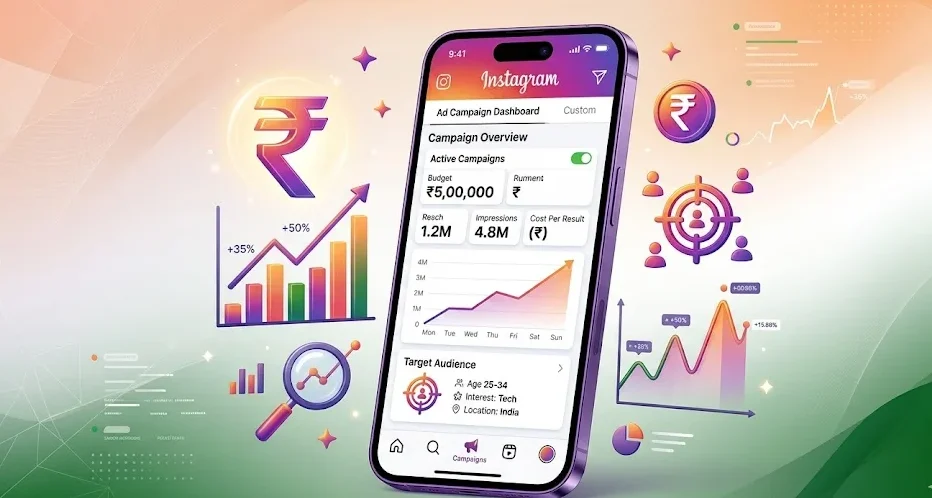
This guide is the step-by-step guide you will need to know how to create and run successful Instagram ad campaigns in India, including how to set up an account and how to optimise your campaign to achieve a high return on investment (ROI).
Table of Contents
- Instagram Adverts: Why Indian Businesses Need Them
- Types and Formats of Instagram Ads
- Requirements: Set Up Your Business
- Create Ad Creative
- Write Convincing Ad Copy
- Add Call-to-Action and Landing Pages
- Launch and Monitor Campaign
- Optimizing Instagram Ads for Maximum Performance
- Common Mistakes to Avoid
- Conclusion
- Frequently Asked Questions
Instagram Adverts: Why Indian Businesses Need Them
India is a country with a great inclination towards visual media and thus, Instagram is the perfect choice particularly due to the fact that over 18-34 years aged group has over 70 percent users of Instagram. The data-driven advertising solutions provided by the platform can help companies communicate with their target audience in the most accurate most data-driven way possible, taking into consideration demographics, interests, behavioural aspects and life events.
In case of marketing the digital marketing certification in Chandigarh or SEO training in Mohali it is through the Instagram ads that the people who are interested in networking socially and professionally will be specifically target. The interrelation of Instagram and Facebook in terms of the advertisement system can lead to more sophisticated ad control without ruining the intuitive engaging platform.
Instagram has a variety of ad formats (Stories, Reels, Feed posts, Shopping ads) in India and gives businesses an option to customize their ads to fit their marketing objectives. And at ₹0.5-3.00 per-click (CPC) in India, various types of Instagram ads are a bargain when compared to traditional media.
Types and Formats of Instagram Ads
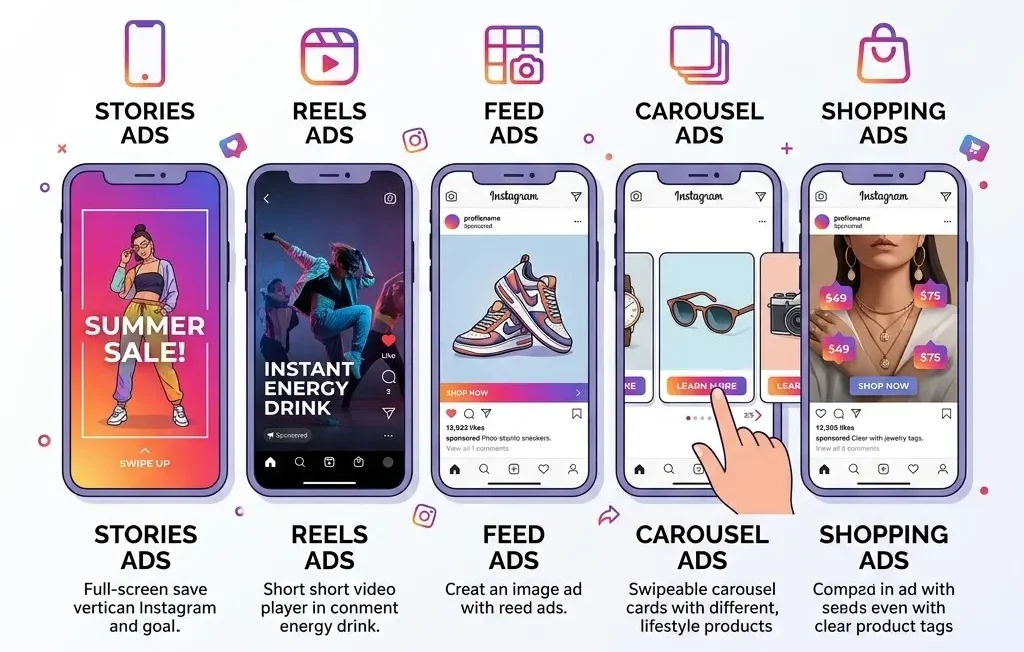
Besides the usual image-only advertisements, Instagram offers a number of different ad types:
Still Image Ads include individual images and text, which are best to use when advertising a product, posting customer reviews, or advertising a general message. It adds to the feeds of the users and sends them without having to interfere with the presentation style of the application.
Video Ads may range in length between 3-60 seconds, which is best used to promote the services like social media marketing courses or student testimonials. Actually, the video advertisements on Instagram are engaged 38 percent higher as compared to photo ones.
Carousel Ads allow marketers to display 10 photos or videos in a swiping format, which is ideal when presenting various sections of the course, student success stories and/or a variety of online marketing niches.
Stories Ads are interpositions between Stories content, and vertical full-screen content. As 500 million people around the globe watch Stories every day, this format offers immersive, time-limited advertising opportunities.
Reels Ads get access to the most engaging content on Instagram in between the organic content on the Reels. The full screen version of these vertical videos capitalizes on the move towards media consumption based on entertainment rather than information and those videos are ideal as behind-the-scenes content or as educational snacks.
Collection Ads include video or image and product catalogs, allowing users to see and shop all in Instagram, which is perfect when a retailer wants to advertise.
Shopping Ads allows stores to shop in the Instagram app, allowing customers to shop, browse, and purchase products in the app.
Requirements: Set Up Your Business
In advance of developing Instagram advertisements, you will need to establish your online framework:
Instagram Business Account: Use the current personal account in Instagram change it to Business/Creator. Click on Settings and then Account and Switch to Professional Account. You are able to see insights, place contact buttons and place ads.
Facebook Page: Instagram ads are operated with the help of Facebook Ad Manager, and there, you will need a Facebook Business Page. Create one at facebook.com/pages/create (where needed) – this may be a duplicate of the business that your Instagram account is.
Get Ready with Visual Media: Prepare good images (not less than 1080×1080) and video to be consumed using a mobile device. Great shots and Reels are tailored to vertical (9:16) format image, whereas square (1:1) or vertical (4:5) format images would work in the feed.
Unique Selling Proposition: Explain the uniqueness of your offer. This would be something such as industry approved instructors, career guidance or projects in the case of the Google Ads course providers.
Landing Page Optimization: Ensuring that destination pages take less than 3 seconds to load on mobile devices; having a workable value proposition and displaying call-to-action buttons. Poor experiences with landing pages are synonymous with wastage of advertising budgets regardless of the effectiveness of advertisements.
Step 1: Establish Facebook Business Manager
Facebook Business Manager is an advertising, asset and personnel management platform:
- Visit business.facebook.com and choose “Create Account”
- Enter your business name, business email address and name
- Insert business data: address and web site
- Verify via email on your business email address
- Attach your Facebook Page (Business Settings→ Accounts→ Pages→ Add)
- Add users (Admin, Advertiser, Analyst) with the given right
Business Manager is a barrier between personal and business property, which is necessary in multi clients business. This will enable role-based security, protection of business information, and collaborative efforts.
In the case of institutes that have a diploma course in digital marketing, a Business Manager should be properly put in place to monitor various courses and campaign types.
Step 2: Interconnect Instagram Business Account
Linking to Instagram: You can manage Instagram ads in Business Manager:
- Business Manager Choose Business Settings – Accounts – Instagram Accounts
- Choose Add and add your Instagram account
- Insert Instagram user name and password
- Grant the application access to your account
- Log in by selecting your Instagram account as the list
It will allow you to base your ads on your Instagram profile, you will be notified by Ads Manager and you will see combined Facebook and Instagram statistics.
Test the integration, by posting and verify that the test post shows under your linked Facebook Business Manager account. This makes sure that all is working before you initiate ad campaigns.
Step 3: Install Facebook Pixel
To facilitate conversion tracking, optimization and remarketing, Facebook Pixel measures the behaviors of people on your site:
- It can be found in Events Manager under Business Manager
- Make a choice of Connect Data Sources and Web
- Choose Facebook Pixel and connect
- Name your Pixel (e.g. DDI Website Pixel)
- Duplicate Pixel code
- Copy the code and paste it to the <head> of your site, just before the </head> tag
To use WordPress: You can use the Facebook for WordPress Plugin or customize a theme. For custom sites, liaise with your developer to make sure Pixels is installed correctly.
Create simple events (PageView, Lead, Purchase, CompleteRegistration) of user interaction. To SEO courses in Chandigarh set submission Inquiry form and enrolment events named Lead and CompleteRegistration, respectively.
Install Pixel with Facebook Pixel Helper Chrome extension. It authenticates the set-up and real-time monitoring of actions on your site.
Step 4: Select an Objective
The objectives of a campaign tie the delivery of ads to your marketing objectives. Facebook plans to send campaigns according to your selected goal:
Awareness Objectives (Brand Awareness, Reach) expand the awareness of target audiences – these are appropriate when a new digital marketing institute in Mohali wants to enjoy brand awareness.
Consideration Objectives lead to taking certain actions:
- Traffic: Refer people to your webpage or introduction page
- Engagement: Share, spark off, or comment on events, or post likes and shares
- App Installs: Advertise the mobile app installs
- Video Views: Make more video views
- Leads: Leads through Lead Forms
- Messages: Share the use of WhatsApp, Messenger or Instagram Direct messages
Conversion Objectives (Conversions, Catalog Sales, Store Traffic) improve events, which are monitored by the Facebook Pixel – e.g., course registrations, purchasing an e-book or making an appointment.
Select a goal that will be the most pertinent to your main goal. Lead Generation and Lead Conversions are usually the most suitable options in the field of education in order to generate qualified leads and monitor the enrolments into the courses.
Step 5: Develop Targeting for India
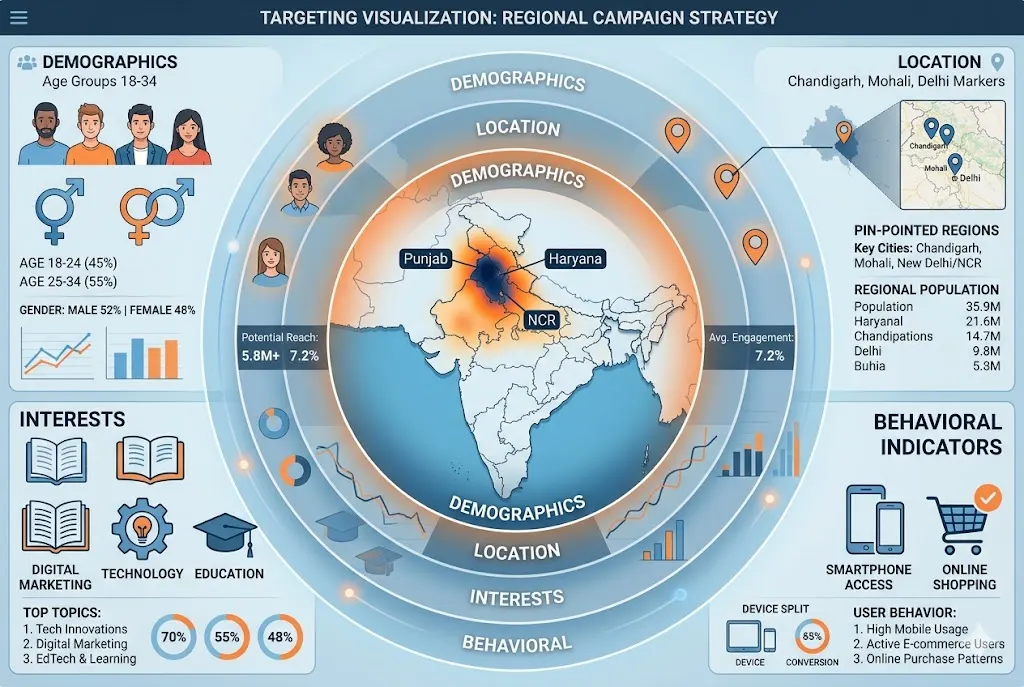
Specific audience: the audience will reach its maximum advertising effect and involvement:
Location Targeting: Target India then refine by states (Punjab, Haryana, Delhi NCR), or cities (Chandigarh, Mohali, Panchkula), or preferences based on radius interests at specific address. When targeting course of hyper local digital marketing in Mohali, select 25km radius of your institute.
Demographic Targeting: Age (18-35 years fresh graduates, 25-45 years career changers), gender (all or particular) and language (Hindi, English, Punjabi). Instagram users in India are young and highly populated in urban centers with 62 percent of them being between the 18-34 years old.
Interest Targeting: Include interests to your service including: digital marketing, online education, entrepreneurship, career building, technology, business, or competitors. Facebook has their interests founded on the behaviour of their users, their likes and consumption of content.
Behavioral Targeting: Target users based on device (iOS users tend to be richer), travel (people in the Metro station, commuters), or purchase (online purchasers, education seekers).
Industry and Educational Targeting: Target users based on the industry, job titles (marketing managers, business owners), degree level (bachelor degree), or w/education programs (marketing, business administration).
Custom Audiences: Import app or web visitors (via Pixel) or email addresses. Get numbers of users that saw specific pages like courses in content writing, but did not sign up.
Lookalike Audiences: Instagram identifies users similar to your best customers in terms of interests, demographic and behaviours. Form lookalike audiences of your email list/ past students to most conceivable prospects.
Combine a few targeting options – do not be too specific (under 50,000 people will not allow optimisation of delivery) or too broad (will spend too much money on ads that go to non-qualified people). Select 3-5 variations of the audience that one can use within a certain campaign to find the most suitable targeting.
Step 6: Choose Ad Location and Budget
Focused placements/ budget: The impact and cost of the campaign are influenced:
Automatic Placements are based on Facebook algorithm to deliver ads in Instagram Feed, Stories, Reels, Explore and Facebook ads placement to maximize delivery. This is most efficient (minimum cost-per-result) and not controlled.
Manual Placements include control:
- Instagram Feed: In-feed advertisements seen between non-advertisements
- Instagram Stories: There is a full-screen vertical advertisement between the Stories
- Instagram Reels: In-feed, full-screen vertical ads in the Reels section
- Instagram Explore: Ads between the Explore content
When you are selling affiliate marketing courses, then Stories and Reels should be your first places to place your ads – these are the most popular types of placements among the youth that seek out information.
Budget Options:
Average daily budget: Allocates average spending, which is best when having the same message across a campaign. Set a budget- budget 50-100% of what you would like to spend at the most to make changes to spend more on carrying out deliveries- Facebook will not charge you above what you have allocated every month be able to make daily changes.
Lifetime Budget: Allocates budget per the campaign length as is appropriate in short term campaigns or events. This enables Facebook algorithm to apportion the spend among days, and give precedence to the higher performing days.
India Budget Recommendation:
- Test campaigns: ₹500-1,000 daily for 7-10 days
- Small businesses: ₹2,000-5,000 daily
- Established institutions: ₹10,000-25,000 daily
- Competitive markets: ₹25,000+ daily
Start with tighter budgets, when experimenting, scale-up budgets when you start seeing what works and in which areas. Budget every week 20% to ensure a steady increase – fast increases result in learning difficulties.
Bidding Strategies:
- Lowest Cost: Provides the lowest cost (best in case of new advertiser) results
- Maximum Cost: Maintains average cost-per-result at some level
- Bid Cap: Cap on each bid in each auction (expert targeting)
Want to Master Instagram Ads for your Business?
Learning Instagram advertising is just one module of our comprehensive
Digital Marketing Course in Mohali. Get hands-on training in Facebook
Ads, Google Ads, SEO, Social Media Marketing, and 10+ other high-demand
skills.
- Live Projects & Real Campaign Management
- Industry-Expert Trainers from Top Agencies
- 100% Placement Assistance Guaranteed
- Google & Facebook Certified Curriculum
View Digital Marketing Course Details:
Call Now: +91-70876 02319
Or book a free consultation to discuss your career goals:
Create Ad Creative
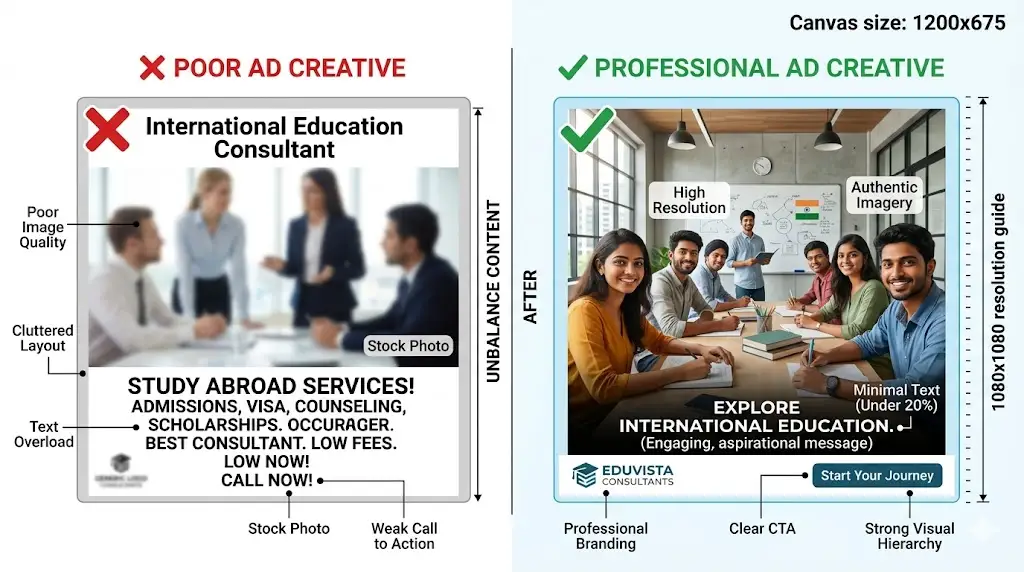
The quality of the image plays a decisive role in the success of ads: users of Instagram are fond of skimming, and attracting attention with bright images is necessary:
Image Best Practices:
- Use sharp images (at least 1080×1080, preferably 1200×1200 pixels)
- Maintain brand consistency when using colours, fonts and style
- Use actual people when possible – stock photography is not as effective
- Not over 20% of image is used in text (good practice of delivery)
- Highlight the advantages of the course: learning, using laptops, rewards
- Games with heavy, vivid on simple designs
Video Best Practices:
- Thump in first 3 seconds – begin with your best angle
- Incorporate captions – 85 percent of the content of videos is not watched with sound
- Be lengthy (feed) 15-30; (Stories) 60
- Vertical (9:16, 4:5) and square (1:1) (for Stories and Reels, feed)
- Provide examples (before and after, student stories or stories of success)
- 1st to use your brand logo within 5 seconds
- Conclude with calls to action (clickthrough, message, learn more)
Stories and Reels Creative Pronunciation:
- Made to play maximum screen (1080 x 1920 pixels) video
- Put valuable material in the middle ‘safe area’ – UI items on the screen edges (top and bottom, 250 pixels 250 pixels)
- Make use of rapid editing, up-beat content
- Add polls/questions or a swipe up end
- Provide insider’s looks, student profiles or teacher bio
In the case of product sellers offering YouTube marketing, use student-made videos as word-of-mouth-marketing. UGC is more effective than other content 4.5 times.
Mobile Optimization Checklist:
- View all mobile ads
- Ensure readability of text at mini fonts
- Remember to adhere to hierarchy to access message
- Ensure that page loads within 2 seconds or less
- Make sure text colour contrast is legible in the outside
Write Convincing Ad Copy
Selling ad copy sells, creates urgency, and calls of action:
Primary Text (recommend 125 characters):
- Write promotional headlines supporting changes
- Add power words – certified, proven, guaranteed, expert, advanced, exclusive
- Include numbers and hard facts – Learn 14 digital marketing tools in 90 days
- Consideration – Think Pain points – “Sick of your dead-end job? Learn high-demand skills”
- Inspire curiosity “What is the Top skill that employers will be seeking in?”
Paper headline (under image, 40 characters):
- Restatement of key message and call to action
- An ask format: Would you like to 10x your career income?
- Call out scarcity – “Space is small in the class” or “Classes start May 15”
Description (directly under the headline, 30 characters limit):
- Disclose offer information – “100 percent job guarantee is guaranteed”
- Focus on advantages – “Work on real clients live projects”
- Give social demonstration – Become one of the 5,000 successful students
Copy Formulas, Which Transform:
Problem Question Answering: “Unable to get marketing jobs? [Problem] The old-fashioned courses use obsolete approaches. [Agitate] Our Google Ad course focuses on the effective marketing strategies that are applied by the best agencies. [Solve]”
Before-After-Bridge: “Before: 100 applications to jobs and nothing. After: 2 or more job offers within 60 days. Bridge: The program we tested results in employment with companies interested in hiring marketers.”
Feature-Advantage-Benefit: “Feature: Live instructor led course. Advantage: Q&A with the instructor. Benefit: Learn difficult topics 3 times faster than online courses.”
India Localization of language:
- The resonant English most prevalent in Indians
- Take culture-neutral words – Starting your career, Securing your future
- Include local case studies- “How Priya of Chandigarh secured a 6 LPA job”
- Local: Use Hindi keywords
- Use metric measurements, ₹ prices and Indian dates
A/B test vary the ad set with 3-5 variations of copy, altering the headline, main text and/or description to identify the most positive solution. This is automatic with Facebooks dynamic creative feature which suggests optimum matches of copy and creative to consumers.
Add Call-to-Action and Landing Pages
The selection of the appropriate CTA and landing pages will convert ad clicks into leads:
Call-to-Action Button Options:
- Learn More: CTAs that describe general content and course descriptions
- Register: Diplomas registration or application
- Apply Today: Admission and scholarship applications to competitive application
- Download: E-books, PDF course brochure or syllabus
- Book Now: Demo-class or bookings in an online appointment
- Send Message: WhatsApp or Instagram Direct messages immediate help
- Call Now: Highly qualified prospective customers to make direct calls
In line with intent of the user and the campaign objective. The words called-out in the top-of-funnel campaigns are Learn More versus a bottom of the funnel campaign of Apply Now or Sign Up.
Landing Page Essentials:
Headline Match: Headlines and call-to-actions are a match with the ad. When the advertisement claims to have a Free SEO Masterclass then the landing page must state the same (Free SEO Masterclass) and not View Our SEO Courses.
Quick Load Times: Load within 3 seconds on mobile. Optimise code and images, deploy a content delivery network and caching. You will have a 7 per cent decrease in the conversion rate given each second that your site loads.
Mobile-First Design: Instagram has a high number of mobile-only users (more than 80%). Ensure that forms are mobile friendly, buttons should be big (not less than 44×44 pixels) so that thumbs can easily click and make sure that the content on the forms is mobile friendly.
True Value Proposition: Have a 3-second explanation of the value proposition. Employ benefits-oriented headings and subheadings and layout in a way that attracts attention to key message.
Social Proof Elements: Prepuse reviews, placement statistics, nominal credits or Google reviews. Numeric descriptions (94% placements) are preferable to descriptive terms (excellent placements).
Trust Indicators: Display security badges, industry certifications, media logos or association logos. In the case of educational institutions, exhibit associations in certifications and accreditation.
Reduced Friction Forms: Keep forms concise – at least at first conversion it is necessary to have just a name, phone and email. Use auto-fill, error messages and mobile responsive text field sizes. The conversion is reduced by 5-10 in each new field.
Above-the-Fold CTA: Have primary CTA button above the fold. Put CTA buttons between scrolls in pages that are longer.
Exit Intent Pop-ups: Show pop ups that have free downloadable materials, or discounted offers to show and go users.
In the case of e-commerce marketing courses, do not use homepage to promote specific type of course but use dedicated pages. The 2-5 landing pages will perform 2-5 times better compared to irrelevant pages.
To make decisions about the target audience and the placements, track the campaign data in Google analytics to identify the most effective version of the ad, the target audience, and placements.
Launch and Monitor Campaign
There should be scrutinous verification and observation of the campaign that needs to be launched:
Pre-Launch Checklist:
- ✓ Inspections on brand and quality on the assets
- ✓ Check targeting is goal oriented
- ✓ Test plan is in line with check budgets
- ✓ Make sure the URLs are functional
- ✓ Conversion tracking or test lead forms
- ✓ Tracking Conversion in Ads Manager
- ✓ Create retargeting audiences (custom audiences)
- ✓ Configure ads to run at the best times (dayparting)
Facebook Review Process: Ads reviewed automatically and manually and are reviewed in up to 24 hours. Reasons of rejection are numerous with:
- Excessive text (more than 20) in pictures
- False or exaggerated statements
- Deficiency of good landing page
- Prohibited material (tobacco, guns, adult)
- Poor audience plucking (age, gender, race)
Why is ad disapproved? Review advertising policies with Facebook, edit ad and resend. Appeal apparent errors with the review decision screen.
First 48 Hours Monitoring:
The format of Instagram advertising undergoes learning time during the delivery of the advertisement, with altered ads to different target groups of people to become aware of the best combinations. Limit the amount of changes made in this learning stage – with every edit you have to re-learn.
Monitor the initial symptoms:
- Impressions: Make sure you are attracting your audience
- Reach: Check to verify that you are reaching the appropriate number of users
- CPM (Cost Per 1,000 Impressions): Compare to industry average (₹50-200 in India)
- Frequency: Keep track of how many times your ad is shown to users (optimal: 1.5-2.5)
- CTR (Click-Through rate): This is a measurement of how relevant the ad is (optimally: 0.5-1.5% new audiences)
Ongoing Optimization Schedule:
- Daily: Pacing of checks, seek out blatant problems
- After 3 days: Evaluate the performance of ad, discontinue unsuccessful ads
- Weekly: Categorize audience, divertiate budget to the most prolific ones
- Bi-Weekly: Update ad creative to counteract ad fatigue
- Monthly: Monthly review and strategy meetings
Stop campaigns with high cost-per-result (CPR) or campaigns that cease to perform use the rules of the Ads Manager. Create your own dashboards and concentrate on the metric based on targets – leads, cost-per-lead, and conversion rate when running lead generation campaigns.
Optimizing Instagram Ads for Maximum Performance
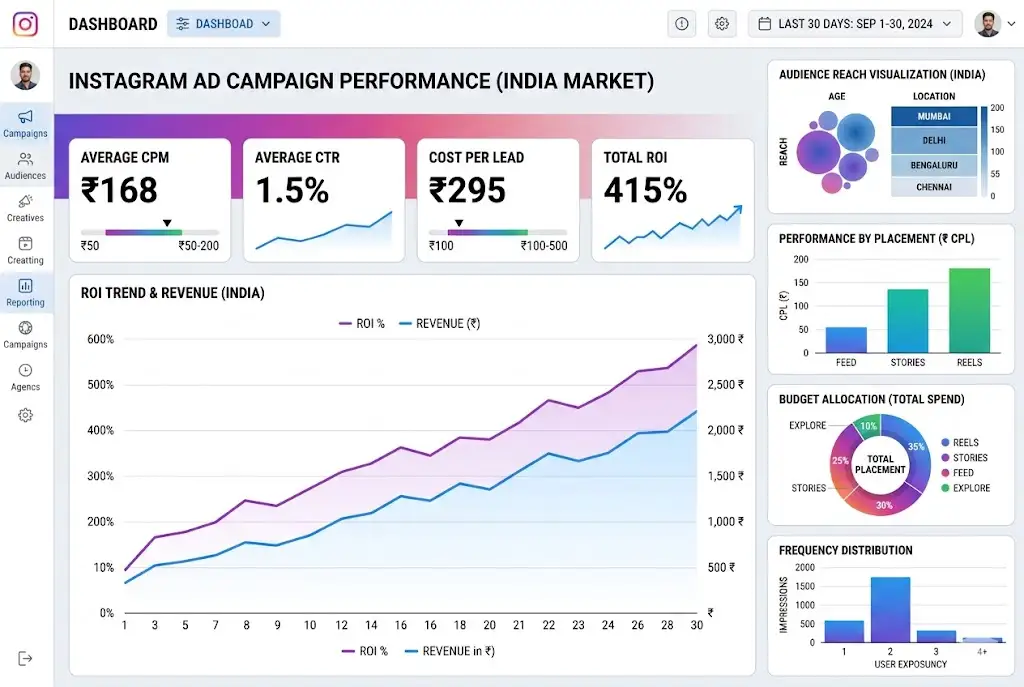
The secret to profitable vs. money-losing campaigns is endless optimization:
Creative Refresh Cycles: Creative fatigue occurs when your target audience is repeatedly presented with the same creativity. Track frequency – rotate creative upon frequency of 3.0+. Insert or overwrite pictures, instructions or body text, preserving the message.
A/B Testing: Attribution test single variables:
- Creative Testing: Test various images, video formats or designs
- Copy Testing: Test alternative headlines, main body (primary) writing or propositions
- Audience Testing: Test behavioral audiences vs. interest-based testing or geographic testing
- Placement Testing: Performance of Tests in Feed vs. Stories vs. Reels
- CTA Testing: Test Learn More vs. Test Apply Now vs. Test Download
Test over an adequate number of variations (minimum of 1,000 impressions). Repeat the process: Implement the successful variations in all campaigns.
Weekly Budget Distribution: Give increased budget to best achievers:
- Optimize the 20% of advertisements (cost-per-conversion)
- Report as winners in case you cut budget by 20%
- Reduce expenditure of losers by 20%
- Stop ad sets that are 3 times less than campaign average, in 7 days of learning
Refined Bidding: Invoking automatic bidding: Bid in ways as you learn with your campaigns:
- Use in learning stage: Lowest Cost
- Go to Cost Cap with a cost-per-result budget
- Change to “Bid Cap” when campaigns are doing good
Day of Week Optimization: Compare findings by the Day of Week and Hour. The calls to action can be posted any time but conversions are more frequent at specific times. Evening hours (7-10 PM) on weekdays and mornings (10 AM-1 PM) on weekends are likely to be the busiest time of online advertising of industrial training courses as workers seek training courses.
Negative Audience Refinement: Filter out possible clicks that do not convert: too young/old; outside the country (when local is available); or competitors that are searching your ads.
Optimization on the Landing Page: The more successful the conversion rates, the more efficient the advertising. Test:
- Headline variations
- Form field reduction
- Copy and colors of CTA buttons
- Trust indicator placement
- Mobile vs. desktop design
- Improved Page load speeds
A converting page (of 5 percent) will be better than the converting page (of 2.5 percent) providing a 2 fold higher ROI to the advertising campaign at no additional dime.
Common Mistakes to Avoid
Also, knowledge on typical pitfalls accelerates success in campaigns:
Error 1: Not considering Mobile Instagram: It is a mobile-friendly application. Less than good mobile ad and/or landing page designs mean that 80% + of the impressions are wasted. Begin on mobile and go big to desktop.
Mistake 2: Reaching Target Audience: The minimum size of the audience is less than 50,000, which limits the Facebook algorithms. Such a large number of users (>5 million) dilutes the relevance. Aim for 100,000-1,000,000 user audiences for optimal balance.
Mistake 3: Not configuring Facebook Pixel: You cannot report, optimise or retarget campaigns without Facebook Pixel set up. Advertisers must install the Pixel.
Mistake 4: Repeated Changes of Campaign: Every change that is substantial (audience, budget and creative) is re-setting learning. Lower the number of edits you do at most every 3-4 days so optimizations can take place.
Error 5: Bad Ad Creative: Poor-quality pictures, low-budget video or stock advertorial photos kill conversions. Get improved photos, enlist professional photographer or used UGC.
Mistake 6: Sending Visitors to Homepage: Homepages (Mail) transforms 50-70% of less than targeted landing pages of fitting nature that are directed to the home page. Landing pages on all promotions.
Error 7: Forgetting Ad Fatigue: Weeks of rotating advertisements will reduce ad memorability. Monitor frequency and turn creative.
Mistake 8: Misaligned Budgeting: The minimum budgets in the fields like digital advertisement in Mohali are ₹1,000 to ₹2,000. Minimal budgets decrease outreach and optimisation.
Mistake 9: Incorrect Objectives: Picking the objective Brand Awareness and lead generation as the goal, creates an algorithm data vs business result misalignment. Choose objectives in correspondence to goals.
Mistake 10: Not Testing: Not testing ad variations and running indefinitely restricts performance. The results of testing improve by 2-5x.
Conclusion
Instagram advertisements provide a powerful business prospects of the Indian companies to create market worthy leads, brand awareness and outcome monitoring. Its high-level targeting, deep ad formats and integrative ecosystem with Facebook advertisement gives it a chance to target its audiences without the infrastructural and financial limitations that are inherent to traditional advertisement.
An effective and efficient approach to the use of Instagram advertising requires planning, testing, and measuring and orientation on quality of creative, copy and conversion procedures. A step-by-step strategy as outlined in this guide, including setting up accounts and optimising in the Facebook advertising ecosystem, along with advanced retargeting strategies can provide a better return on ad spend (ROAS) to companies providing digital marketing course in Chandigarh,SEO courses, or other services serving the ever more digitally aware consumer market of India.
Start with targeted testing phase, mobile-first creativity, and accept data to optimize. It may have a steep learning curve upfront, but the information acquired via learning how to work Instagram advertising can provide a sustainable growth opportunity, which will increase exponentially as you build retargeting lists, explore new avenues and develop an increasingly accurate understanding of your target market.
Instagram advertising will provide the targeting, creative execution and analytics to build to a sustainable and profit breaking increases in customer base, whether you are selling a full-scale digital marketing degree or offering reliable niche training such as in content writing, YouTube marketing, affiliate marketing, and more.
It has a lot to lose: the Indian market has been expanding recently in terms of the digital advertising sector, and even more so is the audience on Instagram, which is becoming more advanced and commercial in its prospects. Those companies that are able to harness the power of Instagram advertising today will be able to lead a life with an advantage years later in an online future.
Start Your Transformation at Digital Discovery Institute, Mohali
- Comprehensive Curriculum: SEO, PPC, Social Media, Content Marketing,
Analytics, Email Marketing & More
- Industry Certifications: Google Ads, Analytics, Facebook Blueprint
& HubSpot Certified Training
- Live Campaign Experience: Manage Real Client Projects & Build
Portfolio During Training
- Placement Support: 94% Placement Rate | Interview Prep | Resume
Building | Job Referrals
LIMITED SEATS AVAILABLE
Special Offer: Enroll now and get ₹10,000 scholarship + Free Advanced SEO Masterclass
Call: +91-70876 02319
Book Free Demo Website: www.digitaldiscovery.institute
Location: Digital Discovery Institute, C 210 A Industrial Area, Phase 8B, Sahibzada Ajit Singh Nagar, Punjab 140308
Frequently Asked Questions
How expensive are Instagram advertisements in India?
The average cost of a Instagram advertisement in India is between ₹3-15 per click, ₹50-200 per 1000 impressions, ₹100-500 per lead depending on your audience, competition and the relevancy of your advertisement. The expense that colleges ought to allocate to the campaigns within a crowded market is at least ₹30,000-50,000 per month.
Should I have Instagram ads that have a Facebook page?
No, you’ll have to do this through Ad Manager on Facebook to place ads in Instagram which requires Facebook Business Page. Instagram requires a Facebook page in order to carry out advertisement programs.
What is the time lag to see the Instagram ad results?
The results will begin to be seen after 24-48 hours of starting a campaign, yet you will require 7-14 days to optimise accordingly since the algorithm of Facebook is learning. Scalable, Long-term, the ad campaign may require 30-60 days to complete long-term results, as it passes through multiple testing and optimization cycles.
Do we have a distinction between boosting a post and making an ad?
Simple promotion where there is minimum targeting and optimisation is referred to as post boosting. The Ads Manager sits at the heart of creating ads, providing full audience-targeting, dual goals, improved creative capabilities, conversion tracking and more complex audience building which, of course, is essential to first-rate marketers.
Automatic and manual placements - so which placement?
When just starting advertising, you should start with automatic placements and allow Facebook algorithm to decide where to place your advertisements on Instagram and Facebook. After receiving some feedback on the campaigns performance, attempt manual placements and focus prior on the most effective ones (they are most likely to be instagram stories and feed in case the campaign is focused on engagement).
What do I do to measure conversions of Instagram ads?
Install Facebook Pixel to make conversions. Facebook Pixel monitors visitor actions (page views, lead form, purchase) once they have your advertisements and enables you to optimise, measure the return on investment (ROI) and create your retargeting audience.
Can it be directed to Mohali or Chandigarh?
You can target various countries, states, cities or radius (10-25km) around an address. To advertise locally training institutes in Mohali, establish radius targeting (10-25km) about your address.
What size of image is the best?
Facebook feed (book size 1080×1080), Instagram stories and reels (vertical 1080×1920), and multi-platform campaigns (horizontal 1200×628). Images should be large resolution (at least 1080 pixels) to be clearly shown on any device.
At what time should I update the ad creative?
Monitor your ads frequency – 3 or more different users will view your ad, this will make your ads performance decline. Routine campaigns: campaigns should be run every 7-14 days to maintain interest with differing imagery, video content or copy in the advertisements.
Do Instagram ads work as an educational tool?
The Instagram adverts are, indeed, very effective in terms of education, on courses targeting young professionals and graduates. In this case, targeting is done though creative and strategic landing pages, the price-per-lead is always between ₹100-500 when going to educational institutions, and the ROI on investment is very high, since the education costs are ₹25,000-75,000 per course.