Table of Contents
- Introduction — Google Ads vs Facebook Ads
- What is Google Ads and How Does it Operate?
- What is Facebook Ads and How Does it Work?
- Google Ads vs Facebook Ads — 7 Major Differences
- When Should You Choose Google Ads?
- When is Facebook Ads the Right Choice?
- The Funnel Lens — Where Each Platform Fits
- Comparison of Cost — Google Ads vs Facebook Ads in India
- Evaluation of Success — Key Metrics on Every Platform
- Typical Pitfalls Made by Marketers on Every Platform
- Fast Judgment by Business Type
- The DDI Viewpoint — What We Instruct Our Learners
- Conclusion
- FAQs — Google Ads vs Facebook Ads
The question nearly all marketers ask when it comes to running paid advertising for your business is: Google Ads or Facebook Ads? The two platforms generate annual billions of ad spend throughout the world. Both of them can provide quantifiable ROI. However they are applied in radical contrasts to each other – and then will endeavour to work to your purpose, misjudged, like leeching your budget when dry.
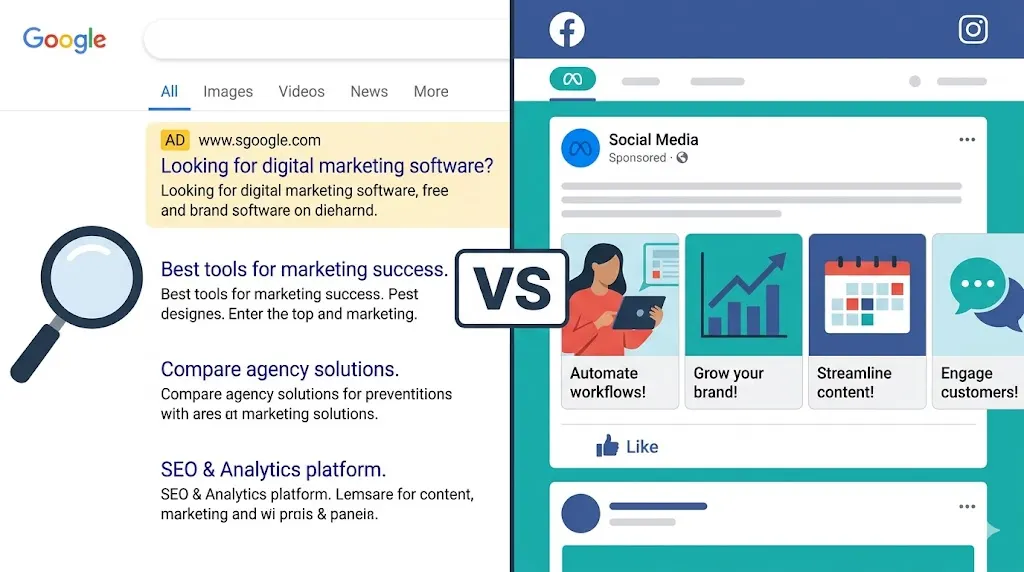
This guide dissects the functionality of each platform, where each platform will be successful, and how to make the ultimate decision as to which platform should be part of your strategy. To become a professional in each and graduate to paid ads, our PPC course in Mohali teaches you how to live-manage campaigns on both and set them with real budgets.
What is Google Ads, and how does it operate?
Google Ads (previously known as Google AdWords) is a pay-per-click (PPC) type of Internet advertising tool that serves your advertisements to users or customers who are actively looking to use your products or services on Google Search, Google Maps, YouTube, and as part of Google Display Network.
The fundamental algorithm is matching of key words. A customer enters best digital marketing course in Mohali in Google – your advert is at the top of the page as you have bid the keyword. Only when a person clicks you pay.
Major formats of Google Ads
The primary types of campaigns are namely Search ads (text ads on the top of SERP), Display ads (banners on 2M+ partner sites), Shopping ads (e-commerce product listing), YouTube video ads, and Performance Max – Google artificial intelligence-driven type of campaign, which runs across all inventory at once.
Google Ads is based on Quality Score + CPC bid auction. The more similar is your keyword, ad message and landing page, the less it costs you to get a click and the more ad placement you will have.
What is Facebook Ads and how does it work?
Facebook Ads (formerly Meta Ads) is an interest based and behaviour based advertising tool which will position your content in front of users on Facebook, Instagram, Messenger, and the Meta Audience Network even when the users are not actively seeking out your product.
The fundamental one is audience targeting. You specify the audience you want to reach, who is in that audience, by age, location, interests, job title, purchasing behaviour and even the number of followers of your competitor page, and the Meta algorithm will offer your advert to the most likely people in that target group.
Some of the most important Meta Ads
Meta serves in-feed image and video advertisements, full-screen Stories and Reels advertisements, swipeable Carousel advertisements, Lead Generation advertisements (instant forms that drive contacts in the app) and potent Custom Audiences to take advantage of website traffic and already established customers.
Meta Ads is an auction-based CPM (cost per one thousand impressions) service, which optimises towards your own goal of reach, or link clicks, conversions, video views or generating leads.
Google Ads vs Facebook Ads — 7 Major Differences
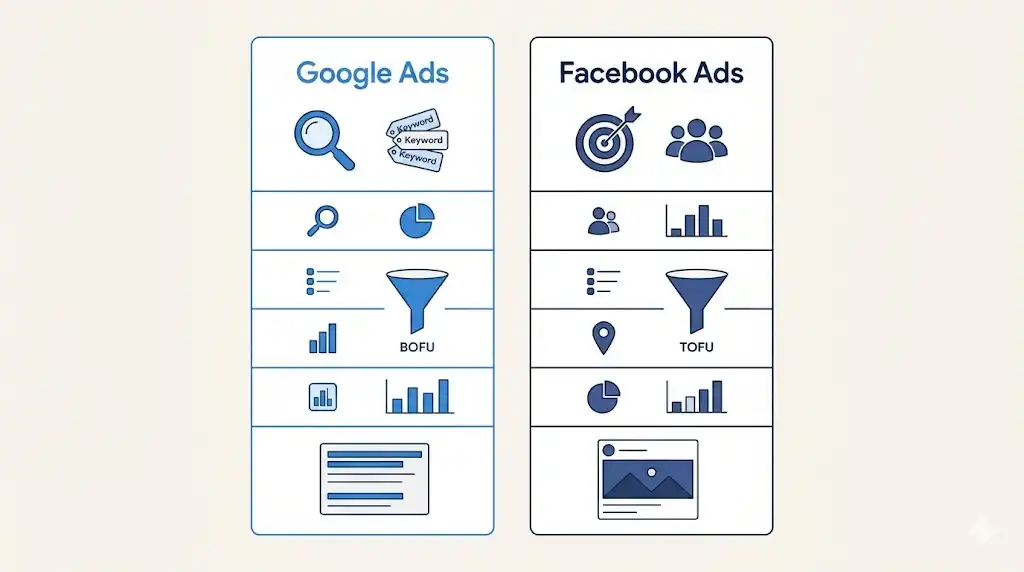
Factor | Google Ads | Facebook Ads |
User intent | High (active search) | Low to medium (browse only) |
Targeting basis | Keywords + context | Demographics + interests + behaviour |
Best funnel stage | BOFU (bottom-of-funnel) | TOFU / MOFU |
Ad format | Primarily text-based | Image, video, carousel (visual-first) |
Average CPC India | ₹10–₹100 (niche dependent) | ₹2–₹30 |
Lead quality | Higher purchase intent | Requires nurturing |
Audience building | Limited | Excellent (lookalike, custom) |
In the case of Google Ads being the choice
Google Ads will always perform better when:
- Your audience is searching by search. When they are already aware they require your product or service and are already Googling the product or service, Google Ads harness that form of demand and does so at the most appropriate time. Natural fits to search ads include a plumber, a digital marketing institute, or an e-commerce store that delivers certain products.
- You must have high-purchase-intent traffic. A prospective customer, who types in a query about the cost of a digital marketing course in Mohali, will be much closer to making the purchase decision, compared to a passive customer who sees an advertisement via Instagram. Google traffic is faster with transactional query.
- What you are selling is something that people seek. Google Ads fits your case as long as your customers are searching a particular set of terms to narrow down to what you are selling courses, services, local businesses, software. The types of campaigns offered by Google are discussed in our performance marketing course.
- You would like to dominate local search. Google Ads combined with Google Maps Ads, including strong local SEO results in a business (such as a digital marketing institute in Mohali or Chandigarh) in a particular city give extremely relevant leads.
Facebook Ads are appropriate when
Facebook Ads (Meta Ads) is always successful when:
- You have to create recognition of a new brand. In case no one is typing your brand name but, then there is Facebook that assists you to intervene by targeting the appropriate group of individuals and layering the image of your product to them in front of purchase intention.
- Your commodity is aesthetically motivated. Fashion, food, beauty, interior design, courses anything where the visual content motivates the interest, works exceptionally well on the visual-first type of content that is provided by Instagram and Facebook. Our social media video trends guide covers how visual content drives results across platforms.
- You would like finer targeting in the demographic method and psychographic targeting. Interested in reaching 22-28 year old college graduates in Chandigarh with interest in careers in digital marketing? That granularity is possible by targeting audiences with Meta. That is why it is a career strength to read about social media marketing along with paid social.
- You must create retargeting funnels. The Custom Audiences of Facebook also allow you to retarget anyone who has been to your site, viewed 75 percent of your video or even your lead form. This, along with lookalike audiences, makes it an effective full-funnel. Understanding what is a landing page is essential to making these funnels convert.
- You have a tight budget on CPC. Compared to competitive search terms offered by Google, Facebook CPCs are usually cheaper and hence it can be used by a company with a low advertising budget.
The Funnel Lens — The Place of Each Platform
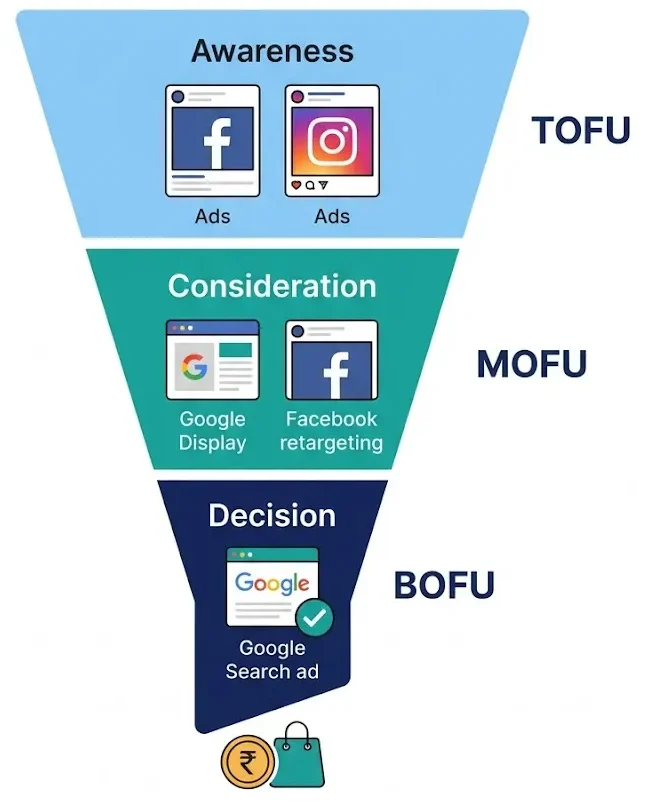
Consider the customer experiences in three steps:
Recognition (TOFU): The customer is unaware of your presence. Facebook/Instagram advertisements do well in this. It is your task to break, captivate, and generate lusty looks and words.
Consideration (MOFU): Customer is weighing the alternatives. These platforms collaborate in this aspect: Google Display remarketing, as well as Facebook retargeting, help you remember warm audiences. You could have an Instagram ad that was viewed by a user, hence will Google your brand name.
BOFU Decision: It is the ready-to-buy customer. Here, Google Search ads prevail since they have explicit purchase intents at the point of search. This is the place where one will find the greatest conversion rates.
The best paid ads are not the ones that choose the platform but those that combine them. Facebook develops the audience and provides awareness. Google wins over that audience once they are ready to convert.
Comparison of Cost — Google Ads vs Facebook Ads in India
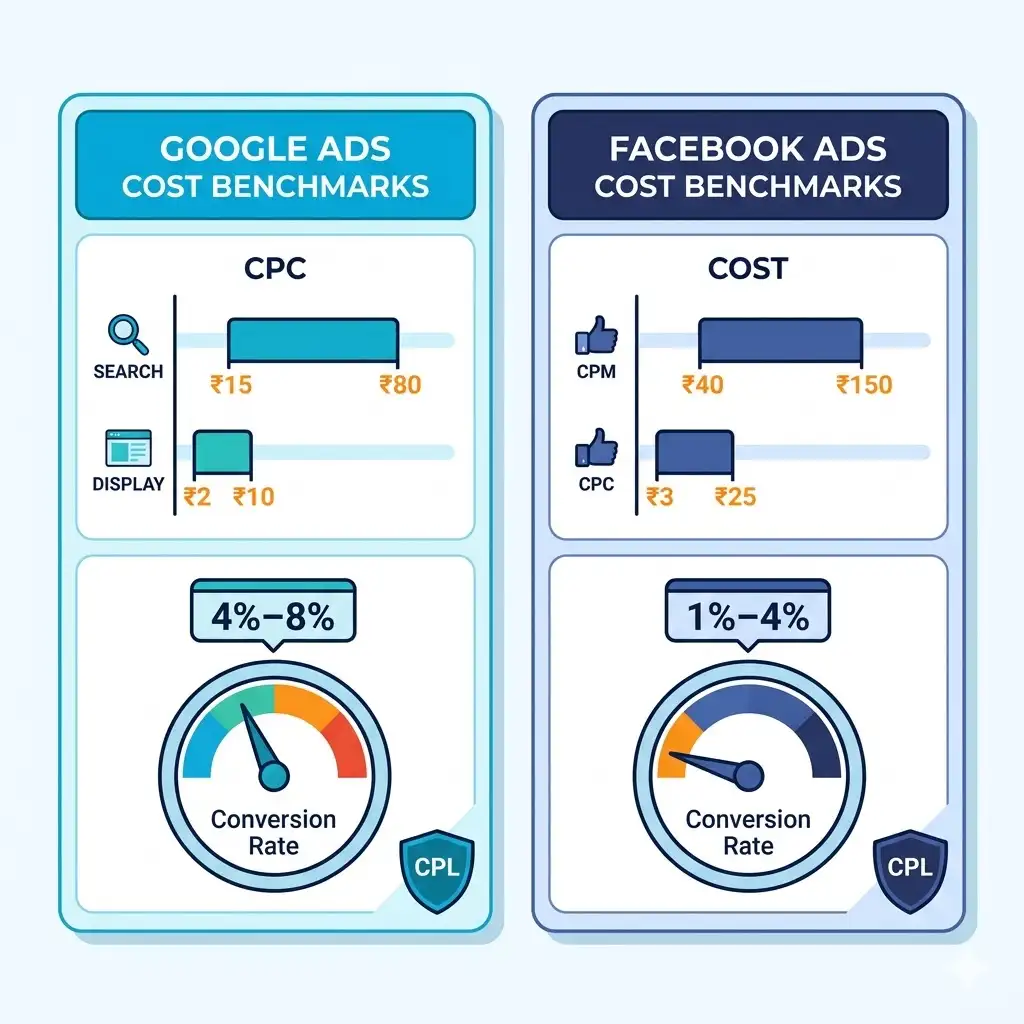
Platform cost is done by understanding your cost per lead (CPL) and return on ad spend (ROAS). The following is what common advertisers in India view:
The benchmark of Google Ads in India:
- Average CPC (Search): ₹15–₹80 in competitive sectors (education, finance, legal)
- Average CPC (Display): ₹2–₹10
- Mean conversion rate (Search): 4–8%
- CPL range: ₹200–₹2,000 depending on niche
Facebook/Instagram Ads — India standard:
- Average CPM: ₹40–₹150
- Average CPC: ₹3–₹25
- Average conversion rate: 1–4%
- CPL range: ₹150–₹1,500 based on quality of targeting
Relevance of the audience with Google (visitor) and quality (Google) is essential factors of cost efficiency. Deplorably constructed campaigns on either platform will waste money. That is the reason why real practice in campaigns, such as the one provided in our Google Ads certification program at DDI Mohali, has so significant an impact on the real performance of ads.
Google Ads and Meta Ads: Learn Live Campaigns
Wish to be a master of both platforms using real ad cost? The PPC course fees in Mohali and Google Ads automation training by DDI Mohali educates you on live campaigns, and not simulation. You will guide real Google Search, Display, and Meta campaigns within a professional guidance.
📞 Call/WhatsApp: +91-70876 02319 🌐 Reserve Your Free Demo Class → www.digitaldiscovery.institute
Evaluation of Success — Indicators of Importance on Every Platform
In the case of Google Ads, Quality Score (keywords-ad-landing page relevance (grade 1-10)) and CTR, conversion rate, cost per conversion, and impression share. In the case of Facebook Ads, make relevancy ranking, ad frequency (fatigue occurs after 3 to 4 occasions), cost per result, ROAS and thumb-stop rates on video advertisements a priority.
These metrics are central to digital marketing analytics that any performance marketer should have an understanding of. Our Google Analytics 4 for marketers guide takes you deeper into tracking and attribution across platforms.
The Typical Pitfalls Made by Marketers on Every Platform
Generally, the worst mistakes made on Google Ads are broad match key-words, omission of a negative keyword list, failure to distinguish between a Search and Display campaign and redirecting all clicks to a generic homepage, instead of a conversion-focussed landing page. Some typical Facebook traps include audiences that are too small (less than 100,000), a lack of idea to keep the algorithm innate but silent, and focusing on reach at the expense of leads.
Both groupings of errors share one common element: a lack of knowledge of how the algorithm used in the platform operates. In our diploma in digital marketing course, we have whole modules dedicated to paid marketing, analytics, and the audit of the campaigns in both platforms.
Facebook Ads vs Google Ads — A Fast Judgment by the Type of Business
Business Type | Recommended Platform |
Local service business (institute, clinic, agency) | Google Ads (Search + Maps) |
E-commerce / fashion / lifestyle | Facebook + Instagram Ads |
SaaS / B2B software | Google Ads + LinkedIn |
EdTech / training courses | Both (Google for intent, Meta for awareness) |
Real estate | Both (Google for leads, Meta for retargeting) |
Restaurant / café | Facebook / Instagram (visual + local targeting) |
Launch Your Career in Paid Digital Advertising
Indian digital advertisement professionals receive an average of ₹3–12 LPA. Some of the more demanded specialisations within the field of digital marketing include PPC and paid social skills. Being a fresher or a working professional, the performance marketing course and social media marketing course fees in Mohali at DDI Mohali are your best bets at a paid ads career.
🌐 Check out All the Courses at DDI Mohali → www.digitaldiscovery.institute/our-syllabus.php
The DDI Viewpoint — What We Instruct Our Learners
We do not teach Google Ads or Facebook Ads on its own at Digital Discovery Institute in Mohali. We instruct on the strategic thinking of campaign choices – the platform is only a means. An excellent performance marketer understands:
- What platform is appropriate to what business goal.
- The art of reading data and optimisation in real-time.
- The need to develop complete funnel advertisement systems on various platforms.
- Which way to write an ad copy that gets clicks and which way to create a landing page that gets conversions.
Since the first day, our students develop live projects with real ad budgets as part of thriving digital marketing firms: campaigns including SEO Discovery, one of the most successful digital marketing firms in Mohali, and the parent company of DDI. It is that agency exposure that distinguishes between theory and practice of DDI graduates. You can continue to read more regarding what the real training of a campaign is like in our post about digital marketing industrial training at DDI Mohali.
Conclusion
Use Google Ads when your target market is actively searching and you want to reach high-intent customers that have shorter conversion times, your target market is geographically localized (e.g. Mohali, Chandigarh, Panchkula), and you want direct response (strategy) – e.g. calls, form fills, purchases.
Use Facebook Ads when you are creating awareness of a brand, the product is well-illustrated visually, when you have a demographic profile of the target audience or you have a limited budget and desire lower CPCs.
Apply both when full-funnel strategy is desired, the market operates on a small competitive niche (such as education or real estate), or wishes to be retargeted inside multiple touchpoints after visit to the site.
The dichotomy between good and bad is not the question to ask. The correct question is; where is my customer at the present, and what do they require me at the present time? Respond to that, and the platform selection is self-evident.
Free Demo Class at DDI Mohali
Feel insecure and concerned because of digital advertising? Register a free sample course at Digital Discovery Institute and talk to one of our skilled faculty members. We will demonstrate real time campaigns, how budgets are distributed across platforms, and guide you to chart a course of learning that suits your career objectives.
Call: +91-70876 02319 | 💬 WhatsApp: +91-70876 02319 🌐 Book Your Free Demo Class → www.digitaldiscovery.institute
Frequently Asked Questions
Which is less expensive, Google Ads or Facebook Ads?
The Facebook Ads is normally cheaper in terms of cost-per-click (between ₹3 and ₹25 vs between ₹15 and ₹80 with Google Search in India). Nonetheless, the lower the clicks do not necessarily imply the lower the leads. Google has a larger, the intent audience, which has a higher conversion rate, and the cost-per-lead competition is still greater at a higher CPC.
Am I able to utilize Google Ads and Facebook Ads at the same time?
Yes – and to most businesses this is the suggested practice. Facebook creates awareness at the top-of-funnel; Google, at the bottom-of-funnel search intent. These two platforms are complementary as opposed to being competitive.
Which platform is more beneficial to a small company that has a scarce budget?
Begin with Google Ads when there are already people searching your product/service. Facebook Ads would be a good place to start on the need to first develop awareness. Facebook tends to provide better coverage with less than ₹5,000/month, whereas Google Search generates better leads with ₹10,000 or higher.
Do I have to be in possession of a site to be able to operate Facebook Ads?
Not necessarily. The Lead Ads format of Facebook lets you get in touch without going into a landing page, and it stores contact data directly within the Facebook app. But, with a site that has the Meta Pixel positioned on it, you have a much better shot at retargeting and tracking conversion numbers.
What is the time frame in which Google Ads results are experienced?
Clicks can be generated by Google Ads within the first day of launching. Nonetheless, significant optimisation data is generally built up at 2–4 weeks. Provide at least 30 days notice to start a new campaign before making any major structural changes.
What is a viable ROAS of Facebook Ads in India?
The industry average ROAS is 3:1 (₹3 revenue / ₹1 spent). This however greatly depends on the industry in question; e-commerce ventures tend to achieve 4–8x ROAS, whereas lead generation campaigns are gauged by cost per lead as opposed to actual revenues. Our marketing metrics guide for performance marketers covers ROAS benchmarks in detail.
Does Google Ads prove challenging to learn?
It can be learned in a few days, however, to conduct profitable campaigns, one will need to know about Quality Score, bidding strategy, negative keywords, extensions of ads, and conversion tracking. Introduction to such learning is through structured training such as the Google Ads course at DDI Mohali which aids this learning process in a shorter time.
Which is a superior platform to use when doing B2B advertising?
Google Ads (Search) performs well in B2B since deciding executives do extensive research. Facebook is also not favored in senior B2B targeting by LinkedIn Ads. Facebook is stronger as a B2B brand awareness and retargeting. Read our AI applications for digital marketing guide to understand how AI is reshaping B2B ad targeting.
Does the Meta Pixel support Facebook and Instagram ads?
Yes. The Meta Pixel (formerly Meta Pixel / Conversions API) logs events on both Facebook and Instagram, providing single data of the two properties to optimise, retarget and lookalike audiences with whichever property you advertise on.
What are the career opportunities in paid digital advertising in India?
One of the highly sought-after digital marketing professionals in India is paid advertising specialists. The most common ones are PPC Executive, Performance Marketing Manager, Media Buyer and Paid Social Specialist with a salary of 3 LPA (freshers) to 15 or more LPA (senior position). The Tricity job market is featured in our digital marketing jobs in Chandigarh career guide.