
If you have ever checked your website in an SEO tool and seen a number such as DA 12, DA 35, or DA 70, you may have wondered:
What does Domain Authority actually mean? Is a higher score always better? How can you improve it? And does Google use Domain Authority as a ranking factor?
These are important questions for anyone who owns or manages a website.
Whether you are an SEO student, a small business owner, a blogger, or an e-commerce website owner, understanding Domain Authority can help you evaluate your website’s backlink profile, compare your website with competitors, and build a more effective SEO strategy.
In this guide, you will learn what Domain Authority is, how it works, why it matters, how to check it, and what you can do to improve your website’s overall authority naturally.
Table of Contents
- What Is Domain Authority?
- How Does Domain Authority Work?
- What Factors Influence Domain Authority?
- Why Is Domain Authority Important?
- What Is a Good Domain Authority Score?
- Domain Authority vs. Domain Rating vs. Authority Score
- How to Check Your Domain Authority
- How to Increase Domain Authority
- Want to Learn SEO and Digital Marketing Practically?
- Frequently Asked Questions About Domain Authority
What Is Domain Authority?
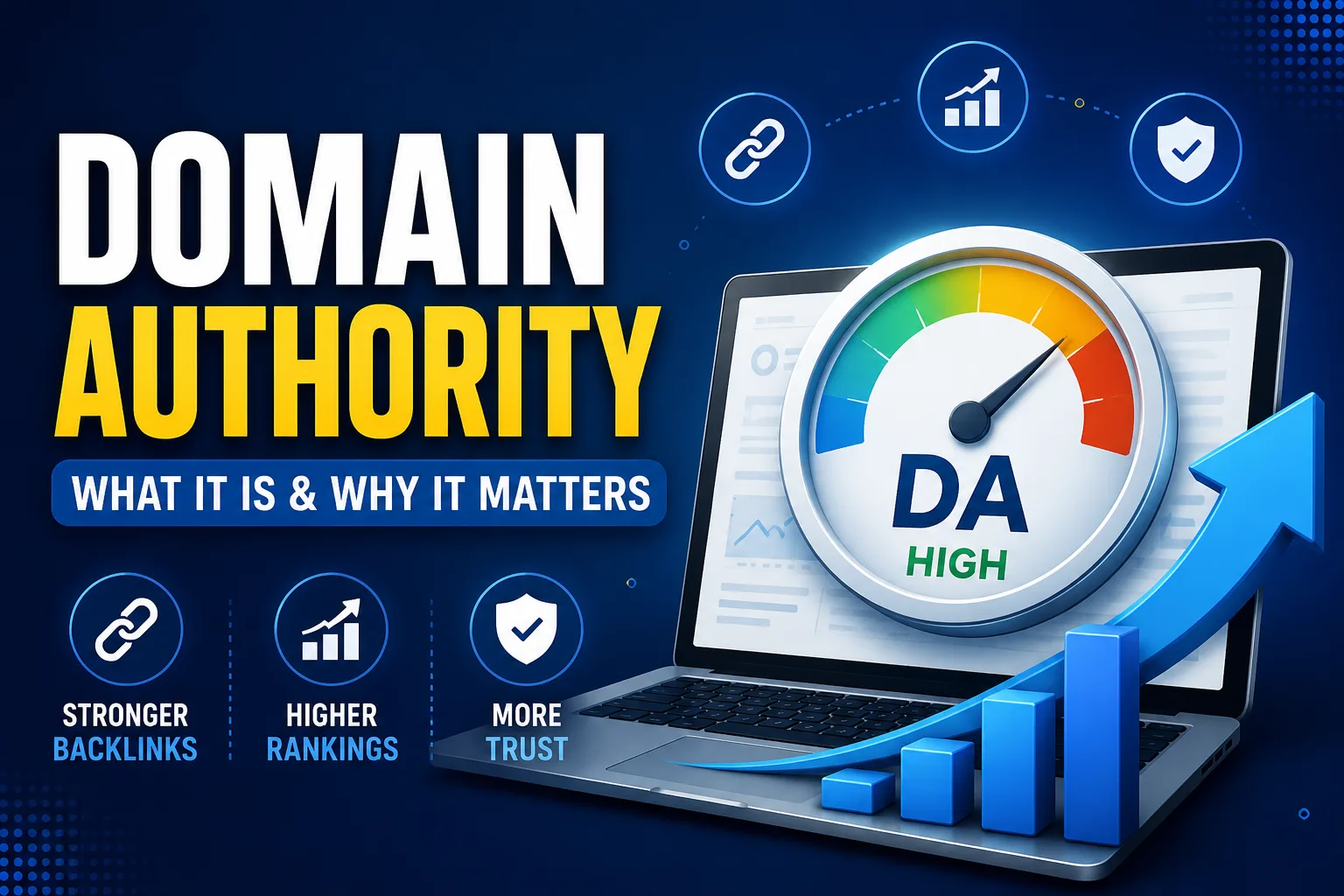
Domain Authority (DA) is a website authority metric developed by Moz.
It predicts how likely a domain is to rank in search engine results compared with other websites. The score is generally measured on a scale from 1 to 100.
A higher score usually indicates that a website has a stronger backlink profile and greater overall link authority compared with websites with lower scores.
For example:
- A new website may have a DA of 1–10.
- A growing business website may have a DA of 15–40.
- An established website may have a much higher DA.
- Large, highly trusted websites may score very high.
However, you should not treat DA as a direct Google ranking score.
Important: Google does not use Moz’s Domain Authority score as a ranking factor
Google does not look at your Moz DA score and decide where to rank your website.
DA is a third-party SEO metric created by Moz. Other SEO platforms use their own metrics, such as:
- Domain Rating (DR) from Ahrefs
- Authority Score from Semrush
- Trust Flow and Citation Flow from Majestic
These metrics use different data and calculations. Therefore, your website may have a different score in different SEO tools.
The most important thing is not to chase a specific number. Instead, focus on building a website that earns genuine visibility, links, traffic, trust, and relevant rankings.
🚀 Want to learn SEO beyond just Domain Authority?
Build practical skills in SEO, content marketing, Google Ads, social media marketing, analytics, and more with a complete digital marketing program. Explore Digital Discovery Institute and discover how you can build job-ready digital marketing skills through practical learning.
Contact Now →How Does Domain Authority Work?
Domain Authority is primarily connected to the strength of your website’s backlink profile.
A backlink is a link from another website to your website.
For example, imagine you own a furniture store website in Mohali.
A local business magazine publishes an article about furniture stores in the region and links to your website.
That link may help your website because:
- The linking website is relevant to your industry or location.
- The website has its own level of authority.
- The link may send referral traffic.
- Search engines can discover your website through the link.
- The link may contribute to the overall strength of your backlink profile.
However, not every backlink has the same value.
One relevant backlink from a trusted website may be more valuable than hundreds of irrelevant or spammy backlinks.
This is why modern SEO is not simply about collecting as many links as possible.
What Factors Influence Domain Authority?
Different SEO tools use different formulas, but the following factors generally matter when evaluating a website’s authority.
1. Quality of Backlinks
The quality of websites linking to you is extremely important.
A backlink from a trusted, relevant website may be more valuable than many links from low-quality websites.
For example, if you run an e-commerce business selling fitness equipment, a link from a respected fitness publication may be more relevant than a link from an unrelated website created only for publishing links.
Think quality before quantity
A good backlink should ideally be:
- Relevant to your industry
- From a genuine website
- Placed in useful content
- Capable of sending referral traffic
- Earned naturally or through legitimate outreach
Do not assume that a website with a high authority score automatically provides a valuable backlink. You should also evaluate the website’s relevance, content quality, traffic, backlink profile, and signs of spam.
If you’re preparing for SEO interview the visit following posts and learn important interview questions with answers:
- Top 20 Off-Page SEO Interview Questions for Beginners
- Top 20 On-Page SEO Interview Questions for Beginners
2. Referring Domains
A referring domain is a unique website that links to your website.
For example:
- Website A links to you
- Website B links to you
- Website C links to you
You have three referring domains.
Generally, earning links from several relevant and trustworthy websites can be more valuable than receiving hundreds of links from the same website.
This is one reason why SEO professionals often track both:
- Total backlinks
- Total referring domains
A website may have 1,000 backlinks but only 10 referring domains. Another website may have 100 backlinks from 80 different relevant websites.
The second website may have a healthier and more diverse backlink profile.
3. The Authority of Linking Websites
The strength of the websites linking to you can influence your authority metrics.
For example, a backlink from an established industry publication may carry more potential value than a backlink from a brand-new website with no reputation.
However, do not focus only on the numerical score of the linking website.
Always ask:
Would this link make sense for the reader?
If the answer is yes, the link may have genuine value.
4. Relevance of Backlinks
Relevance is one of the most important principles in modern link building.
Suppose you run:
- A digital marketing institute
- A furniture store
- An e-commerce clothing brand
- A local restaurant
The best backlink opportunities will usually come from websites connected to your industry, location, audience, or topic.
For example, a furniture store could potentially earn links from:
- Interior design websites
- Home improvement blogs
- Local business publications
- Architecture websites
- Local news websites
- Home décor communities
A digital marketing training institute may earn relevant links from:
- Education websites
- Career websites
- Marketing publications
- Local business websites
- Industry communities
Relevance helps create a more natural backlink profile.
Why Is Domain Authority Important?
Domain Authority is important because it gives you a useful way to evaluate the overall strength of your website compared with competitors.
It is not a Google ranking factor, but it can still be useful for SEO planning.
1. It Helps You Compare Your Website With Competitors
Suppose your website has a DA of 18.
Your main competitor has a DA of 42.
This does not automatically mean that your competitor will rank higher for every keyword.
However, it may indicate that your competitor has a stronger backlink profile.
You can then study:
- Which websites link to your competitor?
- Which content attracts backlinks?
- Which pages have the most links?
- Are there relevant websites you can also approach?
- Can you create something better or more useful?
This turns Domain Authority into a competitive research tool.
2. It Helps You Evaluate Link-Building Opportunities
Suppose someone offers you a guest post opportunity.
Before accepting it, you can evaluate:
- Website relevance
- Organic traffic
- Content quality
- Referring domains
- Spam signals
- Backlink profile
- Authority metrics
DA, DR, or Authority Score can be useful as part of this evaluation.
But never make a link-building decision based on a single number.
A website with DA 60 may still be a poor link-building opportunity if:
- It has no real traffic.
- Its content is mostly low-quality guest posts.
- It links to hundreds of unrelated websites.
- Its backlink profile appears manipulated.
- It has no relevance to your audience.
It’s also worth remembering that backlinks and organic rankings are only one side of visibility.
3. It Helps You Track SEO Progress
SEO results can take time.
You may improve your website’s:
- Technical SEO
- Content
- Internal linking
- Backlink profile
- Digital PR
- Brand visibility
But rankings and traffic may not improve immediately.
Authority metrics can provide another data point for monitoring your website’s long-term growth.
For example:
Month | DA | Referring Domains | Organic Traffic |
January | 12 | 25 | 500 |
April | 16 | 42 | 1,100 |
July | 21 | 68 | 2,400 |
This does not prove that an increase in DA directly caused an increase in traffic.
However, it may indicate that your website is building a stronger overall SEO foundation.
What Is a Good Domain Authority Score?
There is no universal answer.
A DA of 30 may be excellent for a new local business website.
A DA of 30 may be relatively weak for a large national e-commerce brand.
The better question is:
How does your website compare with the websites ranking for your target keywords?
For example, if the top-ranking websites for your target keyword have:
- DA 15
- DA 20
- DA 24
Then a website with DA 18 may still compete successfully with excellent content and strong relevance.
But if the top results are dominated by websites with significantly stronger backlink profiles, you may need a more serious long-term authority-building strategy.
Do not obsess over a specific number
A website with DA 10 can sometimes outrank a website with DA 70.
Why?
Because Google evaluates individual pages and many other signals, including:
- Search intent
- Content quality
- Relevance
- Page experience
- Technical accessibility
- Links
- Competition
- User needs
A high DA does not guarantee that every page on the website will rank.
Domain Authority vs Domain Rating vs Authority Score
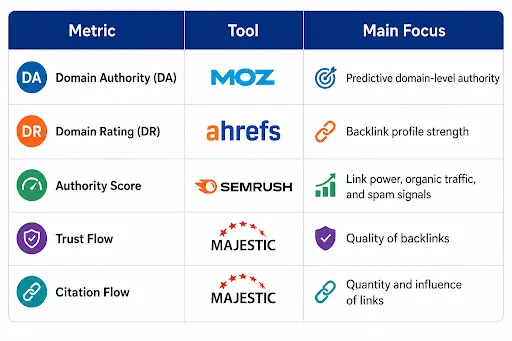
Different SEO tools use different names for similar concepts.
These scores should not be directly compared.
For example, a DA of 40 does not necessarily equal a DR of 40.
Each platform uses its own database and calculation method.
Therefore, choose one primary tool for monitoring your website and use other tools for additional research.
How to Check Your Domain Authority
You can use several SEO tools to check your website’s authority.
1. Moz Domain Authority Checker
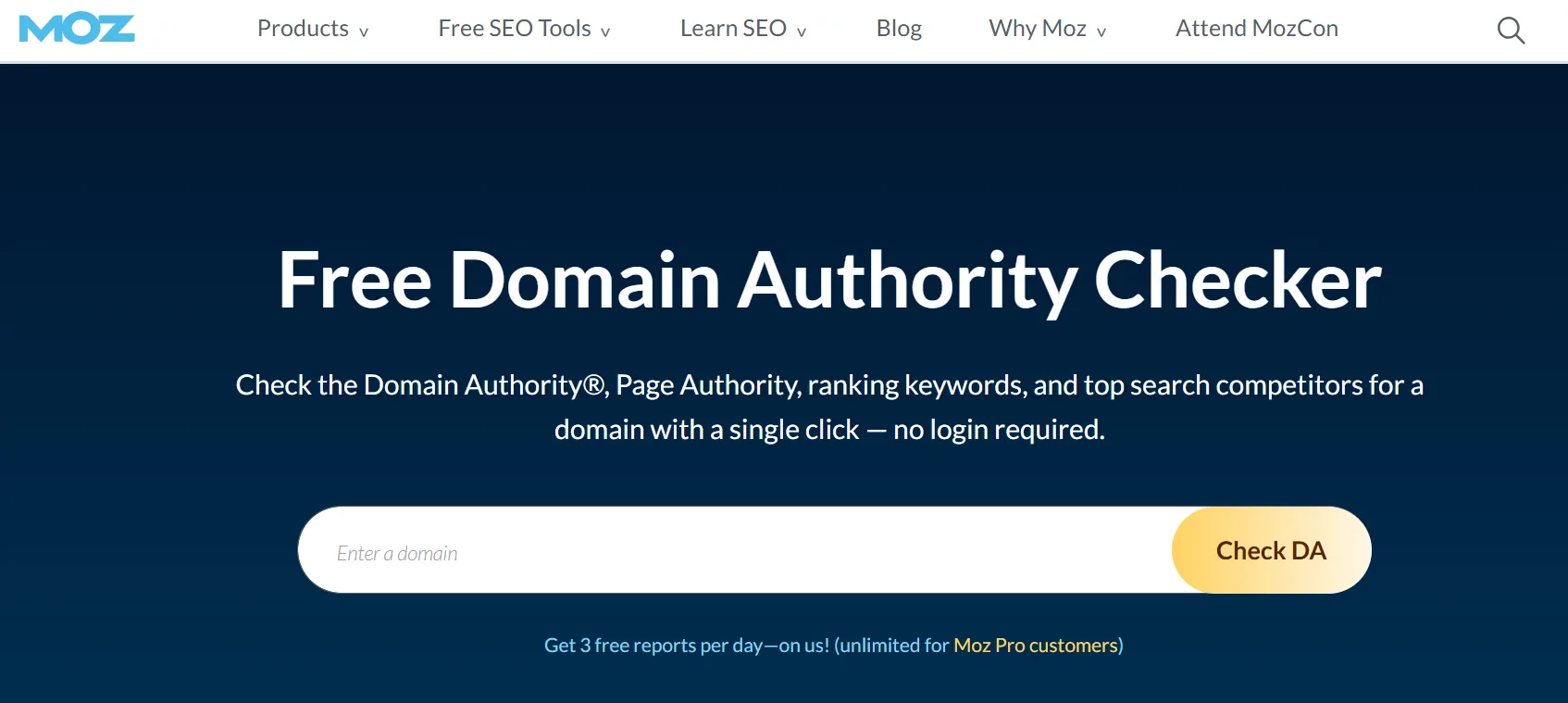
Moz is the company that developed the Domain Authority metric.
You can use its tools to analyse:
- Domain Authority
- Linking domains
- Backlinks
- Top pages
- Link opportunities
This is one of the most direct ways to check DA.
2. Ahrefs

Ahrefs uses its own metric called Domain Rating (DR).
DR measures the relative strength of a website’s backlink profile.
Ahrefs is especially useful for:
- Competitor backlink analysis
- Finding referring domains
- Discovering broken link opportunities
- Finding pages that attract backlinks
- Analysing link-building opportunities
3. Semrush
Semrush uses Authority Score.
It evaluates multiple aspects of a website, including:
- Link strength
- Organic traffic
- Potential spam signals
Semrush can be useful if you want to combine authority analysis with:
- Keyword research
- Competitor research
- Technical SEO
- Backlink audits
- Content analysis
4. Majestic
Majestic focuses heavily on link analysis.
Its commonly used metrics include:
- Trust Flow
- Citation Flow
These metrics can help you understand the quality and quantity of links pointing to a website.
How to Increase Domain Authority
You cannot reliably increase Domain Authority through one quick trick.
The best approach is to build a stronger website over time.
Here is a practical strategy.
Step 1: Create Useful Content
The foundation of authority is useful content.
Create content that genuinely helps your audience.
For example, if you own an e-commerce website selling furniture, you could publish:
- How to choose a sofa for a small living room
- Best materials for dining tables
- How to maintain wooden furniture
- Office furniture buying guides
- Furniture size guides
If you sell digital marketing services, you could publish:
- SEO guides
- Google Ads guides
- Local SEO resources
- Content marketing tutorials
- Digital marketing case studies
The goal is to create content that people can discover, use, share, and reference.
Read complete guide on website content: How to Write Website Content That Actually Works
Step 2: Build Topic Authority
Instead of publishing random articles, create a logical content structure.
For example:
Main Topic: SEO
Supporting content:
- What is SEO?
- What is technical SEO?
- What is on-page SEO?
- What is off-page SEO?
- What are backlinks?
- What is Domain Authority?
- How does internal linking work?
Then connect these related pages using relevant internal links. This helps users navigate your website and helps search engines understand the relationships between your content.
Step 3: Improve Your Internal Linking
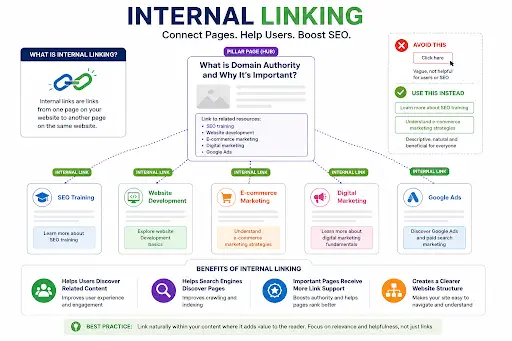
Internal links are links from one page on your website to another page on the same website.
They can help:
- Users discover related content.
- Search engines discover pages.
- Important pages receive more internal link support.
- You create a clearer website structure.
For example, an article about Domain Authority could naturally link to related resources about:
- SEO training
- Website development
- E-commerce marketing
- Digital marketing
- Google Ads
Use descriptive anchor text.
Instead of:
Click here
Use:
learn more about SEO training
or:
understand e-commerce marketing strategies
Your internal links should be natural and genuinely useful to the reader.
Step 4: Earn High-Quality Backlinks
The best backlinks are earned because your content is worth referencing.
You can create link-worthy content such as:
- Original research
- Industry statistics
- Surveys
- Case studies
- Free tools
- Templates
- Detailed guides
- Original data
- Expert interviews
For example, if you publish an original study about local business SEO performance, other websites may reference your findings.
This can create natural backlink opportunities.
Step 5: Use Digital PR
Digital PR can help you earn visibility and backlinks from:
- News websites
- Industry publications
- Business publications
- Expert interviews
- Podcasts
- Online magazines
For a small business, useful digital PR ideas include:
- Sharing original industry data
- Commenting on industry trends
- Publishing expert opinions
- Participating in interviews
- Creating useful local research
Digital PR is often more powerful than simply submitting your website to hundreds of directories.
Step 6: Build Local Authority
If you operate a local business, local SEO can help strengthen your online presence.
Focus on:
- Google Business Profile
- Local citations
- Relevant local websites
- Local news coverage
- Industry directories
- Community partnerships
- Consistent business information
For example, a business operating in Mohali may benefit from relevant local mentions and links from websites covering Mohali, Chandigarh, Punjab, business, education, or its specific industry.
The key word is relevance.
Do not build links from random websites simply because they are located in your city.
Step 7: Fix Broken Backlinks and Lost Links
Sometimes websites link to pages that no longer exist.
You may also lose backlinks when:
- A page is deleted.
- A URL changes.
- A website removes the link.
- A website shuts down.
- A page becomes unavailable.
Regularly checking your backlink profile can help you identify lost opportunities.
You can then:
- Restore the original page.
- Redirect an old URL to a relevant page.
- Contact the website owner.
- Create a better replacement resource.
Step 8: Remove or Manage Harmful Backlinks Carefully
You do not need to panic every time you see a low-quality backlink.
The internet naturally contains many strange or low-quality links.
However, you should pay attention to obvious patterns of manipulation, such as:
- Large-scale spam links
- Automated link networks
- Paid links designed to manipulate rankings
- Links from hacked websites
- Thousands of irrelevant links created suddenly
Do not randomly disavow every low-quality link.
First, understand the situation and follow Google’s current guidance.
The best long-term strategy is to avoid deliberately building manipulative links.
Want to Learn SEO and Digital Marketing Practically?
Understanding Domain Authority is only one part of becoming a successful digital marketer.
To build real-world skills, you need to understand how SEO, content marketing, Google Ads, social media marketing, analytics, website development, and AI-powered marketing work together.
At Digital Discovery Institute, Mohali, you can learn digital marketing through a practical, career-focused program designed to help you understand how digital marketing works in the real world.
Whether you are a student, career switcher, freelancer, business owner, or aspiring digital marketer, the right training can help you move beyond theory and start working on real campaigns and projects.
👉 Explore the Complete Digital Marketing Course at Digital Discovery Institute, Mohali
Build practical skills. Work on real projects. Understand the tools. Learn how digital marketing can help businesses grow.
Your digital marketing career can start with the right skills and the right practical guidance.
Frequently Asked Questions About Domain Authority
What is Domain Authority?
Domain Authority is a third-party SEO metric developed by Moz that predicts how likely a website may be to rank compared with other websites. It is generally measured on a scale from 1 to 100.
Is Domain Authority a Google ranking factor?
No. Google does not use Moz’s Domain Authority score as a direct ranking factor. DA is a third-party metric used by SEO professionals to evaluate the relative strength of a website’s backlink profile.
What is a good Domain Authority score?
There is no universal score that is considered good. A good DA depends on your industry, competitors, website age, and the websites ranking for your target keywords.
How can I increase my Domain Authority?
You can improve your website’s overall authority by earning relevant, high-quality backlinks, publishing valuable content, improving internal linking, building topic authority, earning digital PR coverage, and maintaining a healthy website.
Does a high Domain Authority guarantee higher Google rankings?
No. A high DA does not guarantee rankings. Google evaluates many factors, including relevance, content quality, search intent, technical factors, and links.
What is the difference between DA and DR?
DA is Moz’s metric, while DR is Ahrefs’ metric. Both evaluate aspects of website authority, but they use different data and formulas. Their scores should not be directly compared.
How often should I check my Domain Authority?
You do not need to check it every day. Monthly or quarterly monitoring is usually enough for most small businesses and websites.
Are more backlinks always better?
No. The quality, relevance, and naturalness of backlinks are more important than simply increasing the total number of backlinks.
Can a website with a low DA rank on Google?
Yes. A website with a low DA can rank well, especially for less competitive keywords, highly relevant searches, local searches, and long-tail keywords.
Should I buy backlinks to increase Domain Authority?
You should avoid buying links designed to manipulate search rankings. Focus instead on earning relevant backlinks through valuable content, digital PR, genuine partnerships, and legitimate outreach.