

Table of Contents
- Keyword Research — What It Is and Why It Matters
- Know Your Niche and Get Your Objectives
- Blast Seed Keywords
- Keyword Research Tools
- Evaluate Major Metrics of Keywords
- Find Long-Tail Keywords
- Build Topical Authority with LSI and NLP Keywords
- Competitor Keyword Analysis
- Sort Keywords into Topic Groups
- Prioritise and Map Keywords to Pages
- Refine, Monitor and Revise Your Keyword Strategy
- Conclusion
- Frequently Asked Questions (FAQs)
Every successful digital marketing and SEO strategy will be based on the key-word research. You are either a student just entering the waters of search engine optimisation, a blogger who wants to increase organic traffic, or a business owner who wants to be ranked higher than your competitors, but if you miss the right keywords then your content will live or die on Google.
Our professional faculty at Digital Discovery Institute (DDI) Mohali, one of the most popular institutes of digital marketing in Chandigarh-Mohali Tricity deconstructs the whole process of searching keywords in plain English in this step-by-step guide, using the same tricks that we teach in our hands-on course of search engine optimization.
The people who are planning a career in SEO can visit our SEO Training in Mohali, for example a working course in SEO that will provide you with all the aspects of on-page SEO and link building skills.
Keyword Research: What It Is and Why It Matters

Key-word research is regarded as the research which involves identification and examination of those search terms that are typed by individuals in search engines such as Google in order to seek information, goods or even services. It will tell you precisely what your target audience is looking into of course it will also allow you to produce content that fulfills those queries even more than anyone else.
When done right, the keyword research will assist you:
- Capture targeted organic traffic to the website.
- Decipher the search intent of your audience.
- Set itself apart on valuable search terms.
- Establish topical power in your niche.
- Downspool advertising and focus on organic opportunities.
Our Advice: Keyword research is a continuous exercise according to your audience, competitors, and the Google algorithm evolve, so does your keyword research.
Step 1 - Know Your Niche and Get Your Objectives.
As much as you are about to open any keyword research tool you have to be clear on what you are aiming to succeed. Ask yourself:
- Who is my target audience? (Marketers, owners of businesses and students?)
- What is the issue that I am addressing using my content?
- Is it the local (e.g. Mohali, Chandigarh, Punjab) or national/global traffic?
- Do I want leads, sales, sign-ups or brand awareness?
As an example, in our case at DDI Mohali we are targeting students and professionals that are searching on such keywords as; digital marketing course in Mohali, SEO course Chandigarh, and best digital marketing institute Punjab. Identifying this audience in advance determines all the keywords to be made.
Step 2 - Blast Seed Keywords
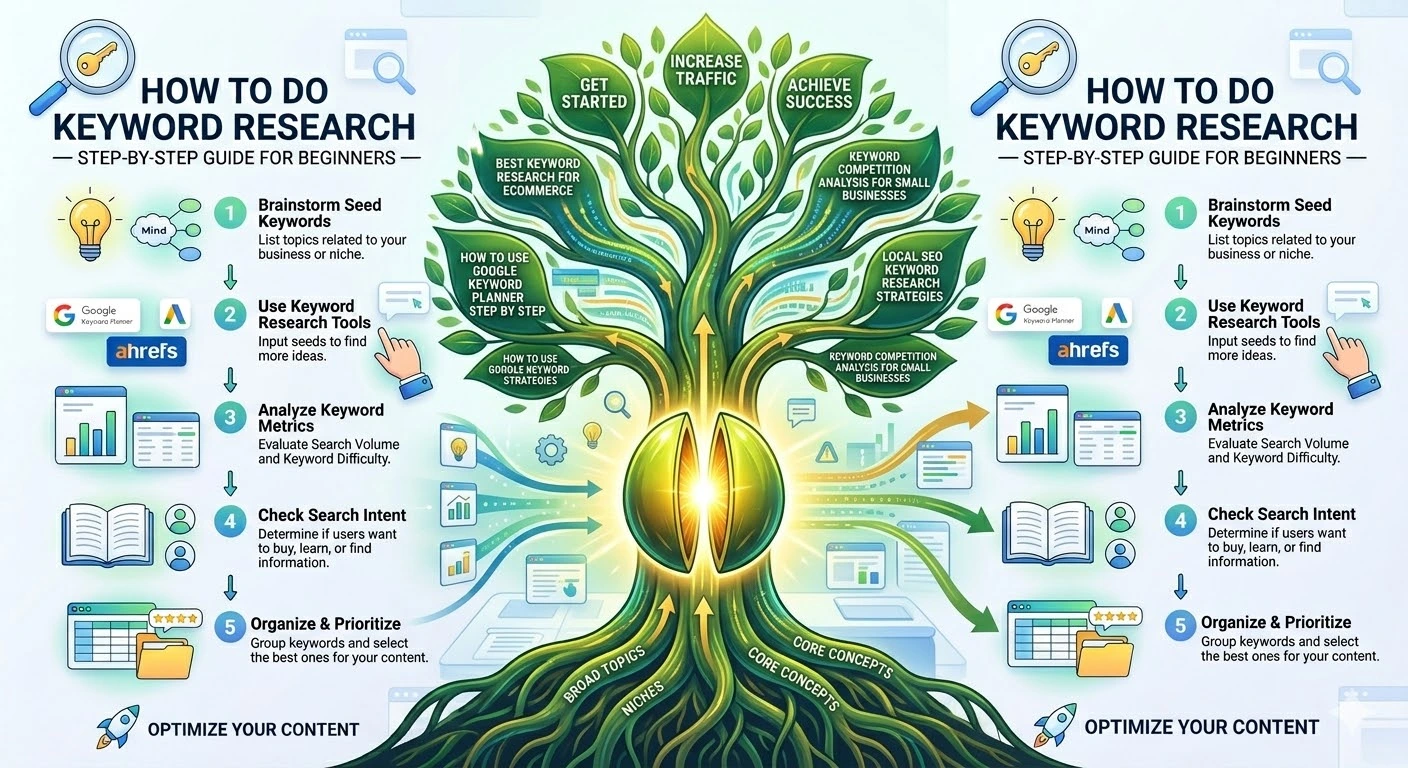
Seed keywords are short phrases, broad, and describe your essential topic. They will open up to you as the hub through which you will open to hundreds of long-tail and LSI keyword opportunities.
Seed-keywords should be generated by how?
- List 5-10 words that can be used to define your business, service or topic.
- Imagine as your customer will do and type in Google?
- Examine the websites of competitors and record the words they include in the headings.
- Instant suggestions on Google with the people also ask and autocomplete features.
Examples of the seed keywords to use in a digital marketing institute:
- digital marketing course
- SEO training
- PPC course
- social media marketing
- beginners guide to key-word research.
- Digital marketing certification.
Step 3 – Keyword Research Tools.
The keywords are not sufficient on their own. You are required to have information in the form of search volume, difficulty of the key word, price per click (CPC), and the trend. These are the best keyword search tools that search engine optimizers employ and those that our Mohali digital marketing course teaches:
Free tools
- Google Keyword Planner — the most reliable free tool; it displays monthly volume of search and the competition level.
- Google Search Console — displays what the existing pages already rank in.
- Google Trends — shows the demand and the increasing key words in real time.
- AnswerThePublic — produces queries of the form of questions based on any seed keyword.
- Free tier (Ubersuggest) provides only the ideas of the keywords, their search volume, and the level of SEO difficulty.
Paid (industry standard) tools.
- Ahrefs — the best search engine in terms of keyword difficulty, backlink, and SERP.
- SEMrush — works well in the analysis of competitor key gaps and PPC studies.
- Moz Keyword Explorer — good when it comes to learning about the aspects of the SERP and potential organic CTR.
- KWFinder — easy to use, clean user interface, and strong keyword difficulty scores.
In our program of teaching students SEO course in Chandigarh, DDI Mohali offers them practical training in all the aforementioned tools. Job-ready graduates and textbook learners differ once they have experience using real tools.
Step 4 — Evaluate Major Metrics of Keywords
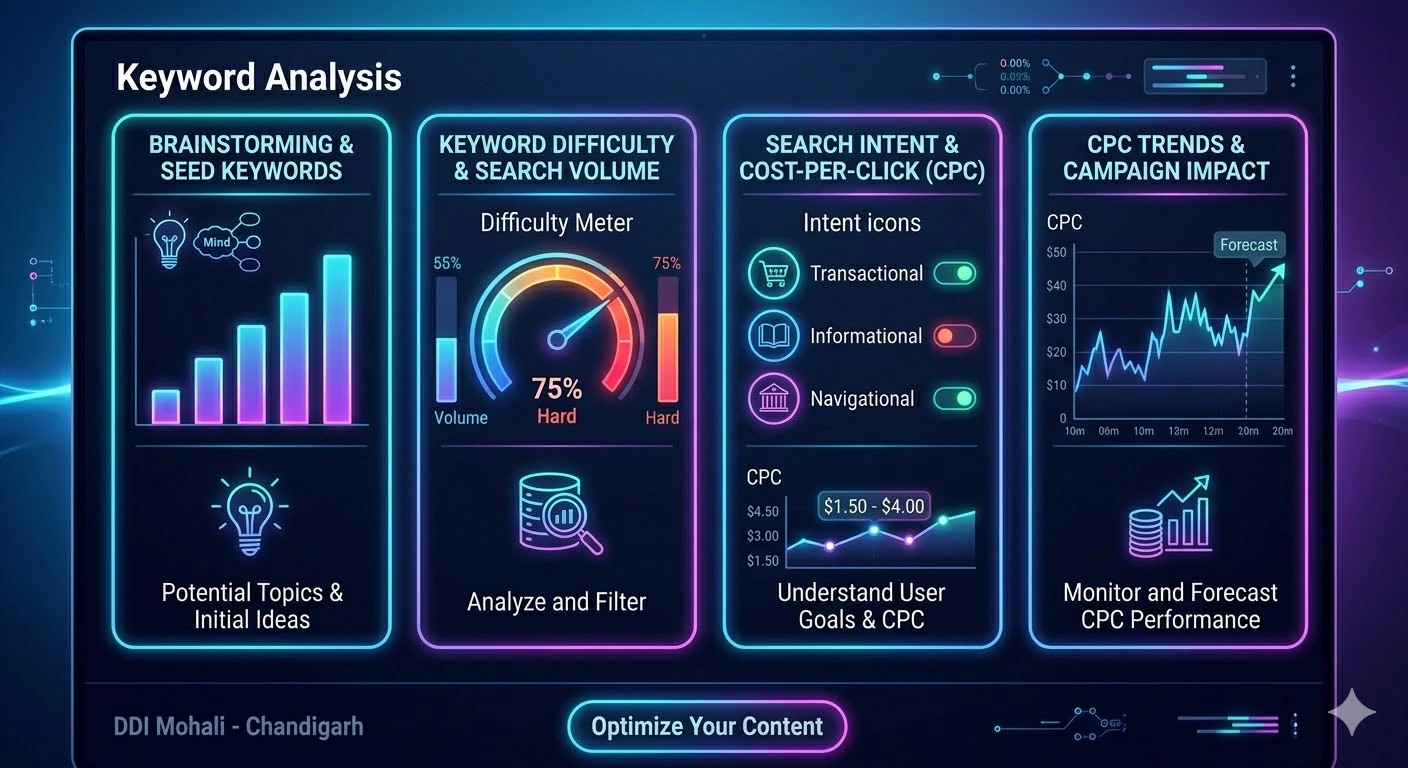
Not all the keywords are worth targeting. There are four main metrics that you need to test all your keywords with before you commit yourself to it:
Search volume
It is the mean monthly number of times the search will be conducted with the aid of a keyword. More volume will end up with more traffic potential; however, high competition also. Beginners ought to strike a balance between large volume terms and less competitive prospects.
Keyword difficulty (KD)
Keywords difficulty or SEO difficulty is a score between 0 and 100 that indicates the difficulty in getting to the first page of Google using the term. The keywords that a new site has to aim at are those with KD less than 30. The established sites have the ability to target KD 50-70 with great content.
Search intent
The significant one is the search intent which most beginners do not put into consideration. Whatever you are searching: It informs you why someone is searching a term:
- Informational intent — user desires to know (e.g. how to do key-word research).
- Navigational intent — user desires to locate a particular site (e.g. DDI Mohali website)
- Commercial intent — user is making comparisons (e.g. best SEO course Mohali)
- Transactional intent — user is willing to purchase/enrol (e.g. Mohali fees digital marketing course)
It is the process of aligning your content with the right intent that makes Google rank your content.
CPC (cost-per-click)
CPC is an indicator of the price adverts get when using a keyword on Google Ads. CPC key words (greater than ₹50) are indicative of great business importance, even in case you are pursuing them organically. One of the major points in our PPC courses in Mohali is this idea.
Would you like to learn how to do paid search and organic search at the same time? Learn how to do PPC with our guide to Courses in PPC in Mohali in order to figure out the role of key word research to drive the two channels.
Ready to become an SEO expert? Take the practical course in digital marketing in DDI Mohali.
Our course includes the use of keywords, on-page optimization, technical optimization, Google Ads among others and includes live projects and promised placement assistance.
Digital Marketing Course Mohali → Explore.
Step 5 — Find Long-Tail Keywords

Long tail key words are longer and more specific, more narrow terms, used in search with almost zero externalities, 4 or more words, with extremely high conversion rates. They are those where the beginning should be and where beginners ought to concentrate their attention first because:
- The level of competition is much reduced.
- The intent of the searcher is quite narrow-focused, as he or she is aware of what he or she desires.
- Long-tail keywords constitute more than 70 percent of all Google searches.
Long-tail keywords vs short keywords:
Short-tail keyword | Long-tail keyword | Why long-tail wins |
SEO course | Mohali best SEO course to beginners. | Reduced KD, increased purchase intention. |
keyword research | how to conduct keyword research step by step free. | Matches word-qualified informational query. |
digital marketing | Mohali 2025 digital marketing course fees. | Local + transactional – extremely high conversion. |
social media | strategy of social media marketing India small business. | Very specific – more placating to rank. |
Step 6 - Build Topical Authority with the LSI and NLP Keywords.
Contextual full-text comparison is done using the aid of Natural Language Processing (NLP) which is utilized by modern Google as opposed to exact matches. That is, you must sprinkle your pages with LSI (Latent Semantic Indexing) keys and NLP serviceable related words across the content – and not simply pass on an abuse of primary keyword.
What are LSI keywords?
LSI keywords are word, phrases that have a conceptual meaning that is similar to your main keyword. They assist Google to comprehend the entire sense of what you have created and authenticate its worth.
Procedure Sample: Assume that your key word is ‘keyword research’, good LSI keywords are:
- search volume analysis
- keyword difficulty score
- organic traffic strategy
- search engine optimisation
- SERP competition analysis
- long-tail keyword strategy
- user search intent
- content gap analysis
- Google Keyword Planner
- topical authority building
NLP terminologies that can be used in the context of this article.
Our faculty of SEO also incorporates NLP-optimised entities and concepts linked to authoritative information about keywords research by Google along with primary and LSI:
- content clusters and key word mapping.
- E-E-A-T signals (Experience, Expertise, Authoritativeness, Trustworthiness)
- featured snippet optimisation.
- People Also Ask (PAA) coverage
- entity-based and semantic search.
- keyword cannibalisation prevention.
- Pillar page and topic cluster strategy.
Hack: SurferSEO, Clearscope or Frase are tools that automatically recognise the NLP and LSI keywords your competitors are targeting on the highest ranking pages of any given query.
Step 7 — Competitor Keyword Analysis

The reverse-engineering of the competitor keyword strategy is one of the quickest methods of identifying high-value keyword opportunities. Here is how to do it:
- The first step is to go to Ahrefs or SEMrush and query the domain of one of the competitors directly.
- Go to the section ‘Organic Keywords’ to view all their ranking keywords.
- Rank by traffic — put keywords that attract the highest number of visitors at the top.
- Narrow down on keyword sense of below 40 to see fast-paying offers.
- The Content Gap tool assists in locating your competitors’ keywords for which you do not hold a top position.
That is the very method that our students learn in the SEO course at DDI Mohali — live competition analysis with real Ahrefs and SEMrush accounts.
Step 8 - Sort Keywords into Topic Groups
After making a master list of 50-200 keywords, the second way is to group them into topic clusters. A topic cluster refers to a cluster of keywords that are related around a single pillar topic.
Structure:
- Pillar page — is a general subject (e.g. it is the complete guide to SEO).
- Cluster pages — each is devoted to a certain subtopic (e.g. how to do keyword research, what is on-page SEO, link building strategies).
- Internal links — link all the cluster pages to the pillar one.
This hierarchy is a signal of topical authority to Google, which improves rankings of all pages in the cluster, rather than that of the pillar drastically.
Step 9 — Prioritise and Map Keywords to Pages
All key words should not be on a new page. The process of establishing the appropriate keyword on the appropriate existing (or planned) page is related to the domain of keyword mapping. Follow this rule:
- Page contains only one main keyword — prevent cannibalisation.
- 2-5 types of secondary and LSI key words/page to complement the key word.
- Transactional keywords — service/product/course pages.
- Blog posts and guides are information items that ought to be included as informatory keywords.
- Local keywords — Local landing pages (e.g. digital marketing course in Mohali)
Lasting on the example that DDI Mohali in its digital marketing training in Punjab page is focused on local transactional keywords, whereas our career in digital marketing guide will be focused on informational career stage queries. The pages are intended to each have a different keyword.
Master the art of keyword research properly — live additional instruments and real projects, as well as expert guidance.
DDI Mohali is the best SEO training in Chandigarh that has a 100 percent practical course, Google certification, and offers placement opportunities to all the students.
Step 10 - Refine, Monitor and Revise on Your Key Word Strategy
Key word research is not a single undertaking. SEO is an endless process of research, release, monitor and optimize. The following is the way to ensure your strategy is fresh:
- Establish Google Search Console in order to track what queries are drawing in traffic and their ranking.
- Weekly upload keyword positions in Ahrefs, SEMrush or the rank tracker of Rank Math.
- Change every 3-6 months because of new searches and changing algorithms.
- Use Google People Also Ask and related search to keep an eye on new keywords groupings.
- Conduct a quarterly content gap review of your 3 most competitive organizations.
It is essential to understand that local SEO is connected with the key word strategy because companies that operate in particular regions are the aim of the key word strategy. In our article on the key considerations in ranking in the local SEO, there is an explanation on why location-based key words are effective in Google Maps and organic search.
Conclusion
Keyword research is not a technical chore reserved for seasoned SEO professionals — it is the single most important habit any aspiring digital marketer can build from day one. As this guide has shown, the process moves in a clear, repeatable arc: define your audience, brainstorm seed keywords, validate them with data, understand what searchers actually want, and organise everything into a topic cluster that Google can reward with rankings.
By working through each of the ten steps above, you now understand how to distinguish a short-tail keyword from a high-converting long-tail phrase, how LSI and NLP keywords build topical authority, and why search intent — not search volume — is the metric that separates content that ranks from content that gets ignored.
Remember, keyword research is never finished. Algorithms evolve, competitors adapt, and new search behaviours emerge every quarter. The marketers and businesses that win in organic search are the ones who treat keyword research as a continuous feedback loop — researching, publishing, tracking rankings in Google Search Console, and refining their strategy every three to six months.
Key takeaways from this guide
- Start with seed keywords and expand using free tools like Google Keyword Planner and Google Trends before investing in paid platforms.
- Always prioritise search intent over raw search volume — a keyword with 500 monthly searches and clear transactional intent is worth more than a 10,000-volume term with mixed intent.
- Long-tail keywords are your fastest path to first-page rankings as a beginner — low competition, high specificity, and strong conversion rates.
- LSI and NLP keywords are not optional extras — they are what signals topical authority to Google and protects your content from being outranked by thinner, less contextual pages.
- Map every keyword to a specific page with a clear purpose; one primary keyword per page prevents cannibalisation and keeps your content strategy scalable.
- Competitor keyword gap analysis in Ahrefs or SEMrush is the single fastest way to find untapped, high-value keyword opportunities in your niche.
At Digital Discovery Institute (DDI) Mohali, keyword research is not taught from a textbook — it is practised on live websites, real competitor domains, and actual client campaigns. Our students graduate with the muscle memory of professional keyword researchers, not just the theory.
Whether your goal is to land a high-paying SEO executive role, launch a freelance digital marketing career, or grow your own business through organic traffic, mastering keyword research is the non-negotiable first step. Every other SEO skill — on-page optimisation, technical SEO, local SEO, PPC campaign management, and content marketing — becomes dramatically more effective once you can find and target the right keywords with precision.
If you are ready to move beyond reading about keyword research and start doing it with professional tools and expert mentorship, explore our SEO Training in Mohali and our comprehensive Digital Marketing Course in Mohali. Both programmes include dedicated keyword research modules with live project work, Google Search Console access, and placement support.
Start your keyword research journey the right way.
Join DDI Mohali — the Tricity’s most trusted digital marketing institute — and learn from faculty who practise what they teach, every single day.
Frequently Asked Questions(FAQs)
So what is so simple is the keyword research?
Keywords research is a process of searching and examining the words that people enter into search engines. It also makes you know what your audience wants to see to be able to develop content that will get high positions in Google.
What is the most appropriate free keyword research tool as a beginner?
The most effective free tool is Google Keyword Planner that can be trusted by the beginner. It displays monthly search traffic, competition on key words and CPC using the actual data of Google itself. Good alternatives that are free include Google Search Console and Google Trends.
What is the duration of a keyword research?
In the case of a single blog post, 30-90 minutes of concentrated keyword search is enough. To have a complete website SEO plan and covering 20-50 pages, it will take about 1-2 weeks of extensive research and scheming.
What is the distinction between the primary keyword and LSI keywords?
The key word will be the leading word your page is aiming at (e.g. how to do keyword research). LSI keywords are defined as semantically associated words that provide Google with company (e.g. search volume, key word difficulty, long-tail keywords). It is better to use both to increase your ranking.
What is the meaning of keyword difficulty and what is the best score amongst beginners?
The score out of 0 up to 100 is known as keyword difficulty (KD) and is an indicator of the amount of difficulty it will be to appear on the first page of Google. The novice and new sites should target a key word with a KD of less than 30. Sites with high content can be used to target KD 40-60.
Long-tail keys, what is this and why should newcomers be interested in such long-tail keys?
The long-tail keywords are shorter, more specific keywords (4 or more words long) with less search volume, but higher conversion rates. The beginners, because less competitive, can rank in their favour thus much more quickly and draw highly motivated visitors.
What is search intent and why should it receive attention to improve SEO?
Different purposes of a search query are the reason behind the search query; the user may want to learn (informational), compare (commercial), or buy (transactional). One of the most important agenda aspects of the modern SEO is matching your content to the right purpose.
Is it possible to perform keywords research without paid tools?
Yes. The free version of Google Keyword Planner, Google Search Console, Google Trends, AnswerThePublic, and Ubersuggest will be adequate to the new and middle-level researcher to do a majority of their keyword research on these sites. Advanced competitor analysis requires such paid tools as Ahrefs and SEMrush.
What is the number of keywords to focus on each blog post?
Focal keywords, two or four secondary keywords, and six or ten LSI/NLP keywords per post. Application of more keywords in the context and natural usage is preferable to cramming a few keywords in and out.
Where can I study the keywords research in Mohali on a professional basis?
DDI Mohali provides practical SEO training through which students will be taught how to research the key words using professional programs such as Ahrefs, SEMrush, Moz, and Google Search Console. The course consists of the live work on projects, analysis of competitors, and key-word mapping on the real client websites.
Master key word research and all other SEO skills — join DDI Mohali.
Keywords research and on-page optimization, technical optimization, link building, Google Analytics 4, Google Ads, Meta Ads, AI-based marketing tools and others are all in one program and taught to our students.
Batches: Weekday | Weekend | Online | Industrial Training (6 months)