Key Takeaways
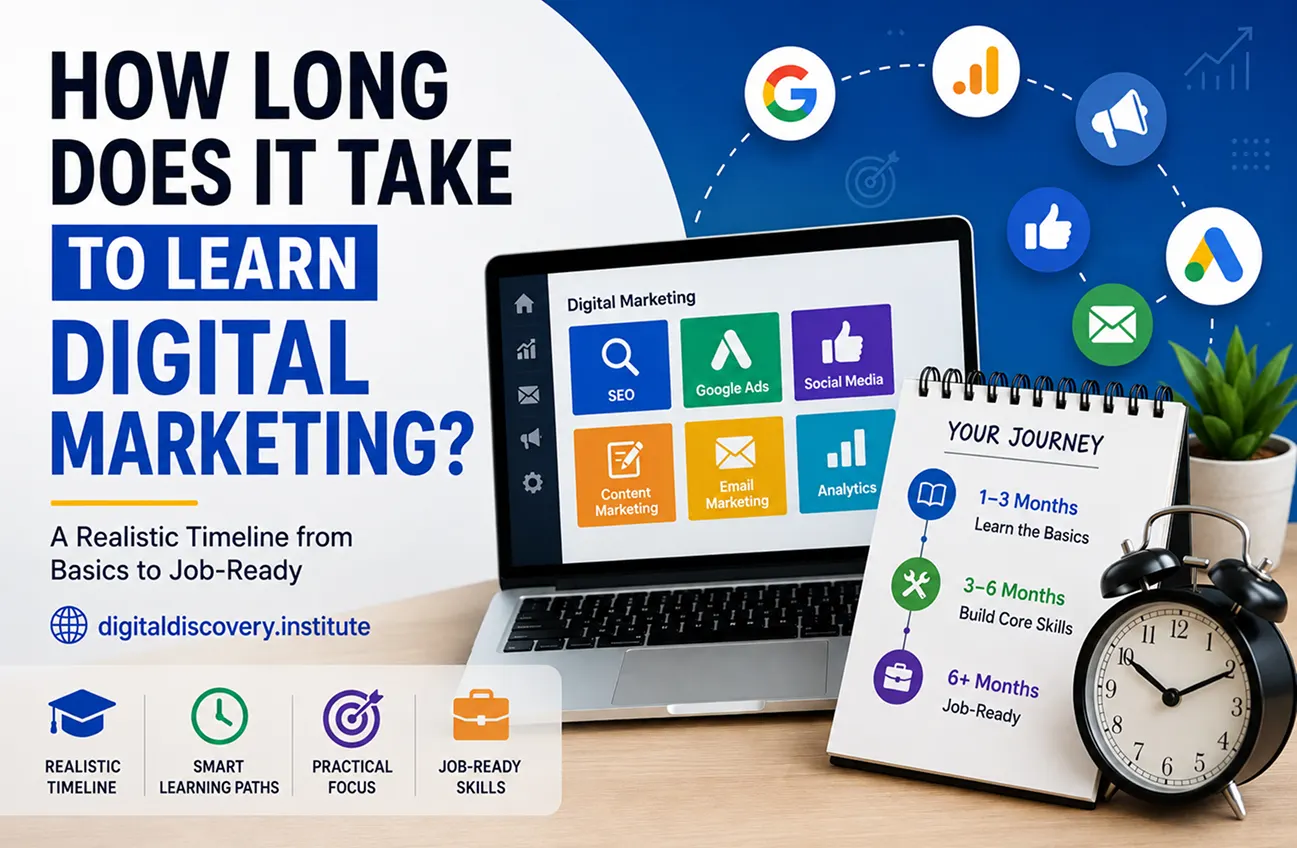
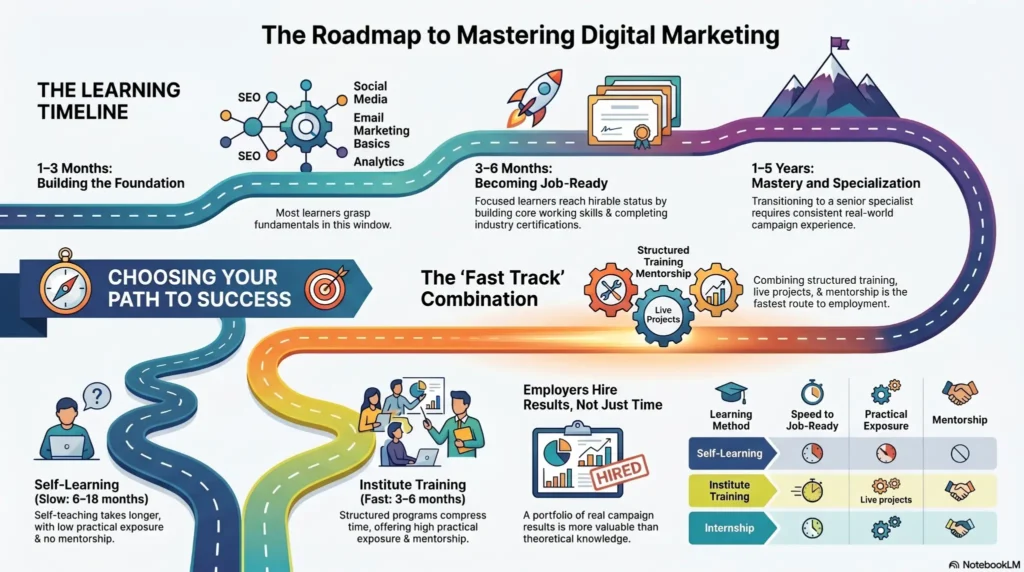
- Most learners grasp the basics in 1–3 months with consistent effort
- Becoming job-ready typically takes 3–6 months depending on learning method and practice
- Time alone does not make you hireable — practical skills, projects, and portfolio work do
- The fastest path combines structured training + live projects + mentorship
- Self-learning is possible but slower without guidance and accountability
- Certificate programmes typically take 2–4 months to complete
“How long does it take to learn digital marketing?”
It is one of the most common questions asked by students, freshers, career switchers, and business owners who want to grow online. And the honest answer is: it depends.
Someone casually watching YouTube videos on weekends will have a very different timeline from someone enrolled in a structured programme, working on live campaigns for 3-4 hours a day.
A student building a blog alongside their coursework will progress faster than someone who only reads theory and never practises.
What you are learning also matters. Understanding the basics of social media is very different from running profitable Google Ads campaigns or doing technical SEO audits. Digital marketing is not one skill, it is a collection of interconnected disciplines, each with its own learning curve.
This guide will give you a realistic picture of how long learning digital marketing actually takes — broken down by goal, method, and skill area — so you can plan your learning path without wasting time or setting yourself up for disappointment.
The Short Answer
Here is a realistic summary before we go deeper:
Goal | Estimated Time |
Understand the basics | 2–4 weeks |
Build core working skills | 1–3 months |
Become job-ready (fresher level) | 3–6 months |
Become a competent specialist | 1–2 years |
Become highly skilled / senior level | 3–5 years |
These timelines assume consistent daily effort — roughly 2–4 hours per day for a full-time learner. Part-time learners studying 1–2 hours a day should expect timelines to stretch accordingly.
What Skills Are Included in Digital Marketing?
Before talking timelines, it helps to understand what you are actually committing to learn. Digital marketing is an umbrella term covering multiple disciplines:
- SEO (Search Engine Optimisation) — Getting websites to rank on Google through keyword research, on-page optimisation, technical improvements, and link building. This is one of the most sought-after and long-lasting skills in the field.
- Google Ads (PPC) — Running paid campaigns on Google Search, YouTube, and the Display Network. Involves budgeting, targeting, ad copywriting, and campaign optimisation.
- Social Media Marketing — Building audiences, creating platform-specific content, running paid campaigns, and engaging communities on platforms like Instagram, LinkedIn, Facebook, and YouTube.
- Content Marketing — Creating valuable content – blogs, videos, infographics — to attract and retain a target audience. Deeply connected with SEO and brand building.
- Email Marketing — Designing automated campaigns, building subscriber lists, writing copy that converts, and measuring performance. One of the highest-ROI channels in digital marketing.
- Analytics — Using tools like Google Analytics 4 (GA4) and Search Console to measure performance, track conversions, and make data-driven decisions.
- AI Tools — Using platforms like ChatGPT, Gemini, Jasper, and Canva AI to accelerate content creation, keyword research, reporting, and campaign ideation.
Most entry-level roles require working knowledge across several of these areas. Specialist roles go deep into one or two. Learn more: essential digital marketing skills
Learning Digital Marketing on Your Own
Typical timeline: 6–18 months to reach job-ready level
Self-teaching is absolutely possible. Many working digital marketers started exactly this way — reading blogs, watching YouTube, experimenting with their own websites, and piecing together knowledge from free resources.
Advantages:
- Completely free or very low cost
- Learn at your own pace
- No fixed schedule
- Develop a resourceful mindset
Disadvantages:
- No structured sequence — easy to learn random things out of order
- No one to correct your mistakes or give feedback
- Hard to know what to prioritise
- Easy to get discouraged when results are slow
- No accountability
- Takes significantly longer without mentorship
- Difficult to build a portfolio without guidance
The biggest challenge with self-learning is not a lack of information — the internet has more digital marketing content than you could consume in a lifetime. The challenge is knowing what to learn, in what order, and how to apply it correctly. Without a structured path, many self-learners spend months on the wrong things and plateau before they develop job-ready skills.
If you choose self-learning, focus on building projects alongside your study. Do not let a week pass without hands-on practice.
Learning Through Free Online Platforms
Typical timeline: 3–6 months to cover core topics
Several authoritative platforms offer free, high-quality digital marketing courses. These are genuinely useful — not just for beginners, but as ongoing references for working professionals.
- Google Skillshop — Free certification courses for Google Ads, Google Analytics, YouTube, and more. The Google Ads and GA4 certifications are recognised by employers and worth completing early in your learning journey.
- Google Search Central — The official documentation for how Google Search works. Essential reading for anyone learning SEO. The SEO Starter Guide is a particularly strong foundation.
- HubSpot Academy — Free courses and certifications in content marketing, email marketing, inbound marketing, and social media. The content and inbound marketing courses are among the best freely available.
- Meta Blueprint — Free learning from Meta covering Facebook and Instagram advertising, business tools, and campaign management. Useful for anyone running paid social campaigns.
- Google Analytics Academy — Focused training on GA4. Completing this alongside real practice on a live GA4 property significantly accelerates analytics learning.
Strengths of free platforms: Authoritative content, recognised certifications, self-paced, globally respected.
Limitations: They teach platforms, not strategy. You will understand how to use Google Ads, for example, but not necessarily how to build a profitable campaign strategy from scratch for a specific type of business. Free resources also lack mentorship, peer interaction, and accountability which are some of the most powerful accelerators of learning.
Learning Through a Digital Marketing Institute
Typical timeline: 3–6 months (structured programme)
A quality digital marketing institute compresses the learning curve significantly. Instead of figuring out what to learn and in what order, you follow a curriculum designed to take you from beginner to job-ready in a defined timeframe.
What makes institute training effective when it is done well:
- Structured sequence — You learn skills in the right order, building on what came before
- Mentorship — Experienced trainers spot errors in your thinking before they become habits
- Accountability — Fixed schedules, assignments, and deadlines keep progress consistent
- Peer learning — Working alongside other students accelerates understanding
- Industry tools — Exposure to the actual tools used in professional environments
- Portfolio building — Many good institutes incorporate live projects into the curriculum
It is worth noting that quality varies considerably across institutes. The key differentiator is not the certificate you receive at the end — it is whether the programme makes you capable of doing real work by the time you finish. Look for institutes that prioritise practical application over theory alone.
Learning Through Internships
Typical timeline: 3–6 months for meaningful experience
An internship at a digital agency or in-house marketing team is one of the most effective ways to learn — but only if you are placed in a role where you actually execute campaigns, not just observe them.
What good internships offer:
- Real business challenges you cannot simulate in a classroom
- Direct feedback from experienced professionals
- Exposure to team workflows, client communication, and reporting
- Genuine portfolio material
What to watch for:
- Some internships offer only administrative tasks with limited learning
- Learning is passive unless you actively ask questions and take ownership
- Without foundational knowledge going in, you may struggle to contribute meaningfully
The best scenario is entering an internship after you have built foundational skills — so you can apply and deepen what you know rather than starting from scratch in a professional environment. DDI’s Internship Programme is designed with this sequence in mind.
Learning Through Live Projects
This is one of the most underrated accelerators in digital marketing education — and one of the most important.
There is a fundamental difference between understanding a concept and being able to execute it under real conditions. Live projects create that gap-closing experience.
What live project work actually looks like:
- Keyword research for a real website — not a hypothetical one. You deal with actual competition, search volumes, and keyword gaps.
- Running a Google Ads campaign with a real budget — making decisions under pressure, watching where money goes, optimising based on actual data.
- Writing and optimising blog content — publishing it, tracking rankings, iterating based on performance.
- Managing a social media account — creating content calendars, posting consistently, responding to engagement, tracking growth.
- Setting up and reading Google Analytics — not a demo account, but a live property where the numbers mean something.
Live projects teach things that lectures and videos cannot: how to handle messy, incomplete data; how to make judgment calls when there is no clear textbook answer; how to communicate results to someone who cares about outcomes, not process.
Learners who complete live projects alongside structured training consistently become job-ready faster than those who study theory alone. They also have something concrete to show in interviews — real results from real campaigns.
Which Learning Method Is Fastest?
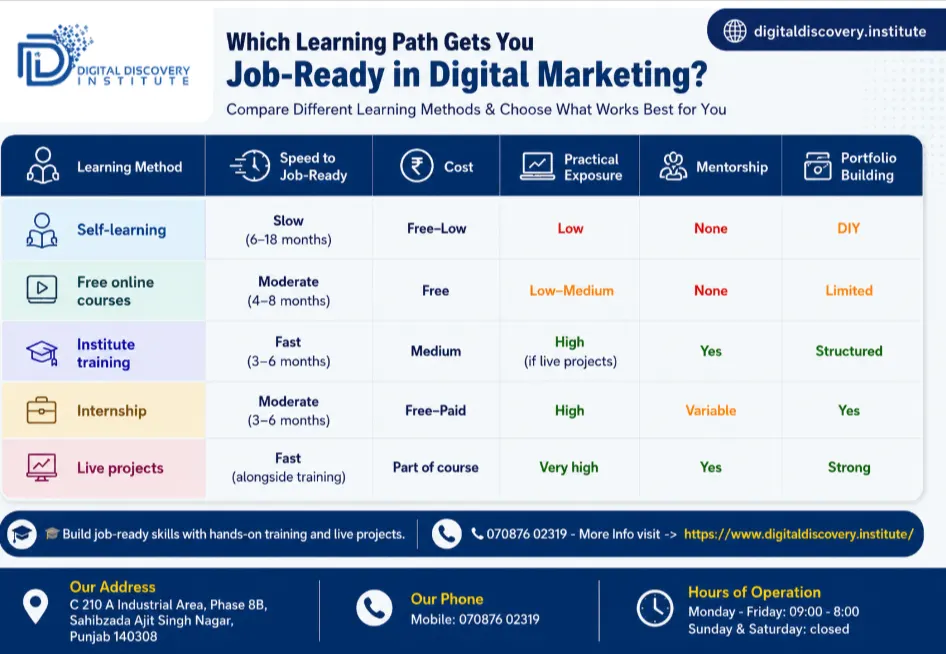
The fastest path to job-readiness consistently involves combining structured institute training with live project work and mentorship. This combination addresses the three biggest barriers beginners face: not knowing what to prioritise, not practising enough, and not getting feedback on their work.
Can You Learn Digital Marketing in 3 Months?
Short answer: Yes — with the right conditions.
Three months is enough time to build a strong foundation across the core digital marketing skills if you are learning in a structured, focused way. Many short-term programmes and bootcamps are designed on exactly this timeline for good reason.
What you can realistically achieve in 3 months with structured, daily practice:
- Solid understanding of SEO fundamentals and basic on-page optimisation
- Working knowledge of Google Ads — search campaigns, targeting, basic bid strategies
- Social media marketing basics — content planning, organic growth, paid campaign setup
- An introduction to email marketing, content writing, and Google Analytics
- At least one or two certifications (Google Ads, HubSpot Content Marketing)
- A small but real portfolio of project work
What you will likely not have after 3 months:
- Deep SEO expertise with track record of ranking improvements
- Advanced Google Ads management with complex budgets
- Specialist-level skills in any single channel
Three months is a realistic timeline to become hirable at a fresher or junior level, provided you have been doing live work throughout not just absorbing content. It is not a realistic timeline to become a senior specialist.
The conditions required:
- 3-4 hours of focused learning and practice every day
- A structured curriculum (not random self-study)
- Access to real tools and accounts
- Consistent feedback from a mentor or trainer
Can You Learn Digital Marketing in 6 Months?
Six months is the timeline most learners genuinely become job-ready — if they use the time well.
By the six-month mark, a focused learner with structured training and practical experience should have:
- A clear understanding of the full digital marketing landscape
- Hands-on experience with SEO, Google Ads, social media, email, and analytics
- At least 2–3 professional certifications
- A portfolio showing real campaign work and measurable results
- Enough vocabulary, context, and problem-solving ability to perform well in interviews
Six months also allows time to specialise. While building broad knowledge in the first 3 months, the next 3 months can go deeper into one or two channels: SEO and content, for example, or Google Ads and analytics which is exactly what employers in specialist roles look for.
For career switchers and fresh graduates, six months of focused learning is a realistic and achievable window to become competitive in the job market.
What Matters More Than Time?
A candidate who spent 12 months loosely studying digital marketing with nothing to show for it will lose to a candidate who spent 4 months in structured training, worked on three live campaigns, and can talk clearly about what they did, what happened, and what they would do differently next time.
The things that actually make you hireable:
- Portfolio: Real campaigns you executed. Even small-scale work on a personal blog, a friend’s business, or a social media account counts if you track results and can explain them.
- Certifications: Google Ads, HubSpot, Meta Blueprint, and GA4 certifications signal commitment and basic competence. They are not sufficient on their own but support your case.
- Problem-solving ability: Can you look at a website, identify what is holding back its search performance, and explain what you would fix? Can you look at an ad campaign and diagnose why the click-through rate is low? This kind of applied thinking is what separates strong candidates from those who only read about marketing.
- Communication: Marketers who can present their thinking clearly both in writing and conversation stand out at every level of hiring.
- Consistency: Showing that you have worked at this regularly, not just binge-studied the week before applying, is a signal employers value.
How Digital Discovery Institute Helps Students Learn Faster
Digital Discovery Institute was built around a simple insight: most people who fail to become job-ready digital marketers do not fail because they lack intelligence or talent. They fail because they had no structure, no feedback, and no real practice.
DDI’s Diploma in Digital Marketing addresses this directly. The programme covers all core digital marketing skills – SEO, Google Ads, Social Media Marketing, Content Marketing, Email Marketing, Analytics, and AI tools – in a structured sequence designed for beginners. Each module builds on the last.
What sets the learning experience apart:
- Experienced industry trainers who have worked on real campaigns and bring that context into every session – not just textbook explanations, but an understanding of how things actually work in practice.
- Live project work embedded throughout the curriculum, not bolted on at the end. Students work on actual campaigns, real keyword research, live ad accounts, and measurable content – building a portfolio while they learn.
- Hands-on assignments that force application rather than passive absorption. Each concept is practised, not just noted.
- Exposure to industry tools – the same platforms and software you will use in a professional role from day one.
- Placement support to help students bridge the gap between completing training and starting their career.
The result is a learning path where most students develop real, demonstrable digital marketing skills within 3-4 months and are positioned to be job-competitive within the course duration.
You can view the full course syllabus here or read reviews from current and past students to understand what the experience actually looks like.
If you are in the Chandigarh-Mohali region, DDI also offers industrial training and internship programmes that complement the core learning with real-world exposure.
Conclusion
Most learners can build strong digital marketing fundamentals within 3 months when learning through a structured programme with consistent daily practice. By 4-6 months, with live project work, certifications, and mentorship, the majority of focused learners are genuinely competitive at the fresher and junior level.
Getting to a specialist or senior level – where you are managing large budgets, leading strategy, or running your own agency takes 2-5 years of real-world experience. That is not a failure of education; it is simply the nature of expertise in any field.
The variables that matter most:
- How many hours you practise per day
- Whether you are learning in a structured or unstructured way
- Whether you work on live projects or only study theory
- Whether you have mentorship and feedback
- Whether you specialise or stay entirely general
If you are serious about building a digital marketing career, the time you invest now particularly in structured learning and live practice will compound significantly over the years ahead.
Frequently Asked Questions (FAQs)
How many months does it take to learn digital marketing?
Most people develop working knowledge in 1-3 months and reach job-ready level in 3-6 months, depending on how many hours they practise daily and whether they have structured guidance. Purely theoretical learning takes longer to translate into real skills.
Can I learn digital marketing in 3 months?
Yes – with 3–4 hours of structured, daily practice. Three months is enough to cover core skills (SEO, Google Ads, social media, email marketing, and analytics), complete industry certifications, and build a basic portfolio. You will not be a specialist in 3 months, but you can be hirable at a junior level.
Can I learn digital marketing in 6 months?
Yes, and 6 months is actually the more comfortable timeline for most learners. By the 6-month mark, a focused learner with structured training and live project experience should have a solid portfolio, 2–3 certifications, and enough applied knowledge to interview confidently for junior and mid-level roles.
What is the best way to learn digital marketing quickly?
Combine structured training with live project practice and mentorship. This combination addresses the three biggest learning barriers: not knowing what to prioritise, not practising enough, and not getting feedback on your work. It consistently produces faster progress than self-learning alone.
Do I need a degree to learn digital marketing?
No. Digital marketing is a skills-first field. What matters most is your ability to execute campaigns and demonstrate results. Certifications (Google Ads, HubSpot, Meta Blueprint) and a strong portfolio of real project work carry far more weight with employers than formal academic qualifications in this field.
What is the digital marketing course duration in India?
Short-term certification programmes typically run 2-4 months. Comprehensive diploma programmes run 4-6 months. Full postgraduate or degree programmes extend to 1-2 years. For most students looking to become job-ready quickly, a 3-6 month structured diploma programme offers the best balance of depth and speed.
How long does it take to become a digital marketer?
Becoming a working digital marketer at the fresher level takes 3-6 months with the right training. Becoming a confident, capable specialist takes 1-2 years. Reaching senior or strategic levels takes 3-5 years of real campaign experience. Each stage builds on the last.
Is digital marketing hard to learn?
Digital marketing is learnable for most people – it does not require coding, a specific degree, or exceptional technical ability. What it requires is consistency, curiosity, and a willingness to practise on real campaigns. The technical aspects (like GA4 setup or Google Ads bidding) can feel challenging at first but become intuitive with hands-on practice.