Someone recently asked us: “My website ranks well on Google, but my competitor keeps coming up when my customers ask ChatGPT. What am I doing wrong?”
This question is coming up in almost every conversation we have these days with business owners in Mohali, freelancers, and fresh graduates who just started their digital marketing careers in chandigarh.
The short answer is that they are not doing anything wrong with SEO. They are just not doing GEO yet.
And that distinction matters a lot in 2026.
What's Actually Different: SEO vs GEO
Let’s be clear upfront. This is not an either/or conversation.
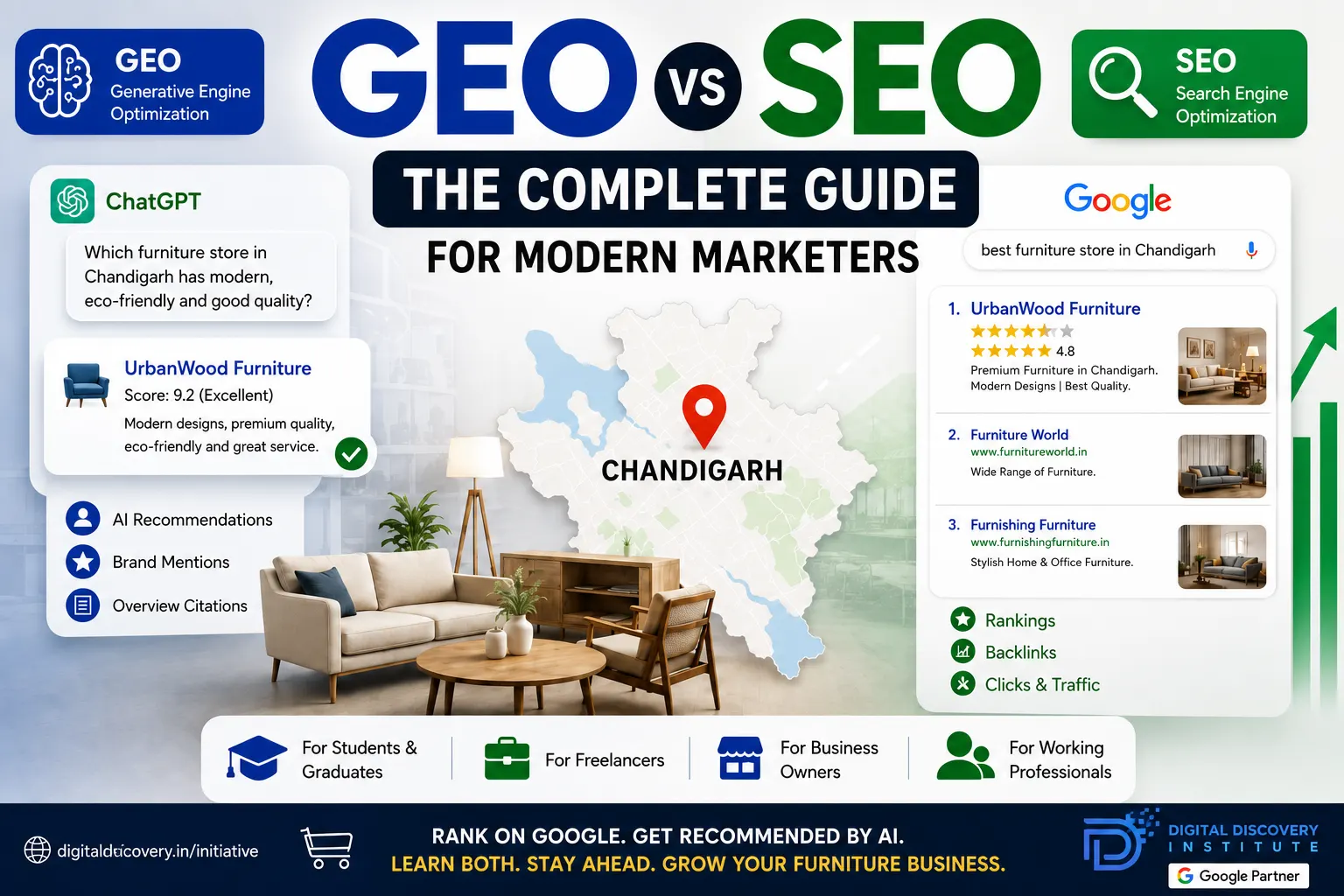
SEO (Search Engine Optimization) is the practice of optimising your website to rank on Google, Bing, and other traditional search engines. You write content, build links, fix technical issues, and climb the rankings. When someone searches, they see a list of links and click one.
GEO (Generative Engine Optimization) is the practice of optimising your presence so that AI tools – ChatGPT, Gemini, Perplexity, Microsoft Copilot – mention your business by name when users ask relevant questions. No link list. No clicking. Just a direct recommendation.
Here’s the key difference in practice:
A student in Patiala Goggles “best digital marketing course in Mohali” → sees a page of results → clicks a few links → compares options.
That same student asks ChatGPT: “Which digital marketing institute in Mohali has good placement support?” → ChatGPT gives 2-3 names directly → student contacts one of them.
Same customer. Very different journey. Very different outcome for businesses that have or haven’t done their GEO work.
Why This Matters for You Specifically
Let’s talk about who is reading this and why this should concern them directly.
If you’re a graduate or student entering the job market: employers and clients in 2026 expect digital marketers to understand how AI search works. Knowing only traditional SEO is like knowing only how to run newspaper ads. It’s a foundation but not enough on its own. Learning GEO alongside SEO puts you ahead of 90% of fresh graduates.
If you’re a freelancer offering SEO or digital marketing services: your clients will start asking about AI search visibility within months if they haven’t already. Freelancers who can audit a business for GEO readiness and implement fixes will charge significantly more and retain clients longer. This is a real skill gap in the market right now.
If you’re a business owner in Mohali, Chandigarh, or anywhere in Punjab your customers are changing how they search. A salon owner in Sector 8 Chandigarh, a coaching institute in Zirakpur, a real estate agent in Mohali Phase 7 all of them are losing potential customers to competitors who appear in AI answers. GEO is the difference.
If you’re a working professional in marketing or communications: understanding GEO makes you more valuable to your organisation. Marketing managers who can guide their teams on AI search strategy are in high demand, and that gap between demand and supply is wide right now.
The 3 Things SEO and GEO Have in Common
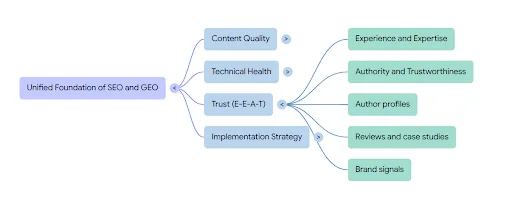
Most businesses get confused because SEO and GEO sound like completely separate disciplines. They are not. They share the same foundation.
- Content Quality Still Wins Both SEO and GEO reward content that genuinely answers questions. Thin, stuffed, or copied content fails in both. The standard has just gotten higher.
- Technical Health Matters A slow, poorly indexed website hurts your Google rankings AND makes it harder for AI engines to crawl and trust your content. Fix your Core Web Vitals, and you improve both.
- Trust is Everything Google’s E-E-A-T (Experience, Expertise, Authority, Trustworthiness) framework guides both traditional ranking and AI citation decisions. A business that demonstrates real expertise through author profiles, reviews, case studies, and consistent brand signals — performs better in both environments.
This is why a strong SEO foundation makes GEO easier, not redundant. If you’re starting from scratch, the right order is: build your SEO fundamentals first, then layer GEO on top.
Where They Diverge: The 3 Key Differences
- The User Never Visits Your Website In traditional SEO, a ranking gets you a click. In GEO, the AI extracts your information and presents it directly. This means your content needs to be structured so it can be quoted or summarised accurately not just indexed.
- Brand Mentions Matter More Than Backlinks SEO places enormous weight on backlinks who links to you. GEO places weight on brand mentions across the web even without links. If your institute name is appearing in student blogs, education forums, and social media posts, AI engines register that as authority.
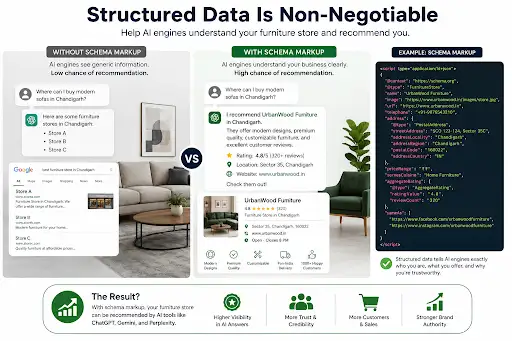
- Structured Data Is Non-Negotiable A website can rank on Google without Schema markup. But in the GEO world, Schema markup is how you tell AI engines what your business is, what it offers, and why it should be recommended. It is no longer optional.
What This Means for Learning Digital Marketing Today
Here’s what we tell every student and professional who walks into our digital marketing course in Mohali: the fundamentals are permanent, but the channels evolve.
Ten years ago, nobody talked about Instagram marketing. Five years ago, voice search was the next big thing. Today, AI search is the real shift. And the professionals who build their understanding of why things work – not just which tool is trending are the ones who adapt quickly every time.
That is exactly why our diploma in digital marketing curriculum covers AI search alongside traditional SEO, Google Ads, social media, and analytics. Because the market is not waiting.
If you want to go deeper on the full GEO strategy picture – how AI engines work, what signals they trust, and the 10 strategies that are working right now – our guide covers everything: The Complete Guide to Generative Engine Optimization (GEO) in 2026.
A Practical Starting Point for everyone
Students and graduates Start by understanding SEO deeply technical, on-page, off-page. Then add GEO concepts to your portfolio. This combination is rare and valuable. Our SEO training course is built to give you both.
Freelancers: Audit 2-3 of your existing clients for GEO readiness. Check whether their key pages start with direct answers, whether they have Schema markup, and whether their Google Business Profile is fully optimised. Then position yourself as the person who fixes it.
Business owners: Don’t wait for your SEO to be “perfect” before starting GEO. Begin with one step: get 20 new, detailed Google Reviews this month. It is the single highest-impact GEO action that also improves your local SEO simultaneously.
Working professionals: Bring this conversation to your team. Ask: “If a customer asked ChatGPT about our product category, would we appear?” Most marketing teams have not asked this question yet. Being the person who raises it puts you ahead.
SEO is not dying. Anyone telling you that is wrong.
But SEO alone is no longer enough. The businesses and professionals who understand both — who can rank on Google and get recommended by AI are the ones building durable, future-proof digital visibility.
The good news? You do not need to master everything at once. The skills overlap. The principles are the same. It’s the same game, with a new playing field added on top.
Start learning both. Start now.
Interested in building these skills from scratch or upskilling your current knowledge? Explore our digital marketing courses in Chandigarh or book a free counselling session to find the right programme for your goals.
Frequently Asked Questions (FAQs)
Is GEO replacing SEO?
No. GEO is not replacing SEO. Even actually it’s a compliment.
SEO helps your business appear in Google search results, while GEO helps your business get recommended directly by AI platforms like ChatGPT, Gemini, and Perplexity.
For example, a furniture store in Chandigarh still needs SEO to rank for searches like “best furniture store in Chandigarh.” But GEO helps that same store appear when someone asks ChatGPT:
“Which furniture store in Chandigarh offers premium wooden furniture with home delivery?”
Businesses that invest in both SEO and GEO will have the strongest visibility in 2026 and beyond.
Can local businesses in Chandigarh really benefit from GEO?
Absolutely.
Local businesses may benefit even more than large national brands because AI searches are often highly specific and location-based.
Examples include:
- “Best modular kitchen provider in Chandigarh.”
- “Recommended furniture showroom near Sector 34 Chandigarh.”
- “Which salon in Mohali is known for bridal makeup?”
- “Top interior designer in Panchkula for luxury homes.”
If your business has strong reviews, structured data, local citations, and authoritative content, AI tools are more likely to recommend you directly.
What types of Chandigarh businesses should start GEO first?
Businesses that rely heavily on trust, reviews, and local recommendations should prioritize GEO immediately.
This includes:
✅ Furniture Stores
✅ Real Estate Consultants
✅ Interior Designers
✅ Coaching Institutes
✅ Restaurants and Cafes
✅ Doctors and Clinics
✅ Salons and Spas
✅ Architects
✅ Immigration Consultants
✅ Home Service Businesses
If customers frequently ask friends, Google, or AI tools for recommendations in your category, GEO matters for your business.
My business already ranks on Google. Do I still need GEO?
Yes.
Ranking on Google only helps if customers use Google.
Increasingly, customers in Chandigarh and Mohali are asking AI assistants questions such as:
“Which furniture showroom in Chandigarh has the best customer reviews?”
“Recommend a digital marketing institute in Mohali with placement support.”
“Who is the best real estate consultant for investment properties in New Chandigarh?”
If your business isn’t part of these AI recommendations, competitors may capture leads you never even knew existed.
What is the fastest GEO win for a local Chandigarh business?
For most local businesses, the highest-impact starting point is improving your online trust signals.
Focus on:
- Collecting detailed Google reviews from real customers.
- Adding Local Business Schema to your website.
- Keeping your business information consistent across directories.
- Publishing helpful local content.
- Building brand mentions on local websites and social media.
For many Chandigarh businesses, simply increasing review quality and implementing Schema markup can significantly improve AI visibility.
Can a small furniture store in Chandigarh compete with national furniture brands using GEO?
Yes, and this is where GEO creates one of the biggest opportunities.
AI engines often prefer highly relevant local recommendations over national brands for local intent searches.
For example:
“Best solid wood furniture store near Sector 35 Chandigarh.”
A trusted local showroom with excellent reviews, detailed product information, and proper Schema markup can be recommended ahead of large e-commerce marketplaces because it better matches the user’s location and intent.
How do I know if my business is visible in AI search results?
A simple test is to ask AI tools the same questions your customers would ask.
Examples:
- “Best furniture stores in Chandigarh for premium sofas.”
- “Top digital marketing institute in Mohali for practical training.”
- “Recommended interior designers in Chandigarh for modern homes.”
If your business is not mentioned, that is your GEO baseline and an opportunity for improvement.
Is GEO important only for online businesses?
No.
In fact, local offline businesses often benefit the most because AI recommendations heavily favor trusted local providers.
A furniture showroom in Sector 34 Chandigarh, a salon in Mohali, or a dentist in Panchkula can all gain new customers through AI recommendations even without spending heavily on advertising.
The businesses that become the trusted answer will increasingly win the customer.