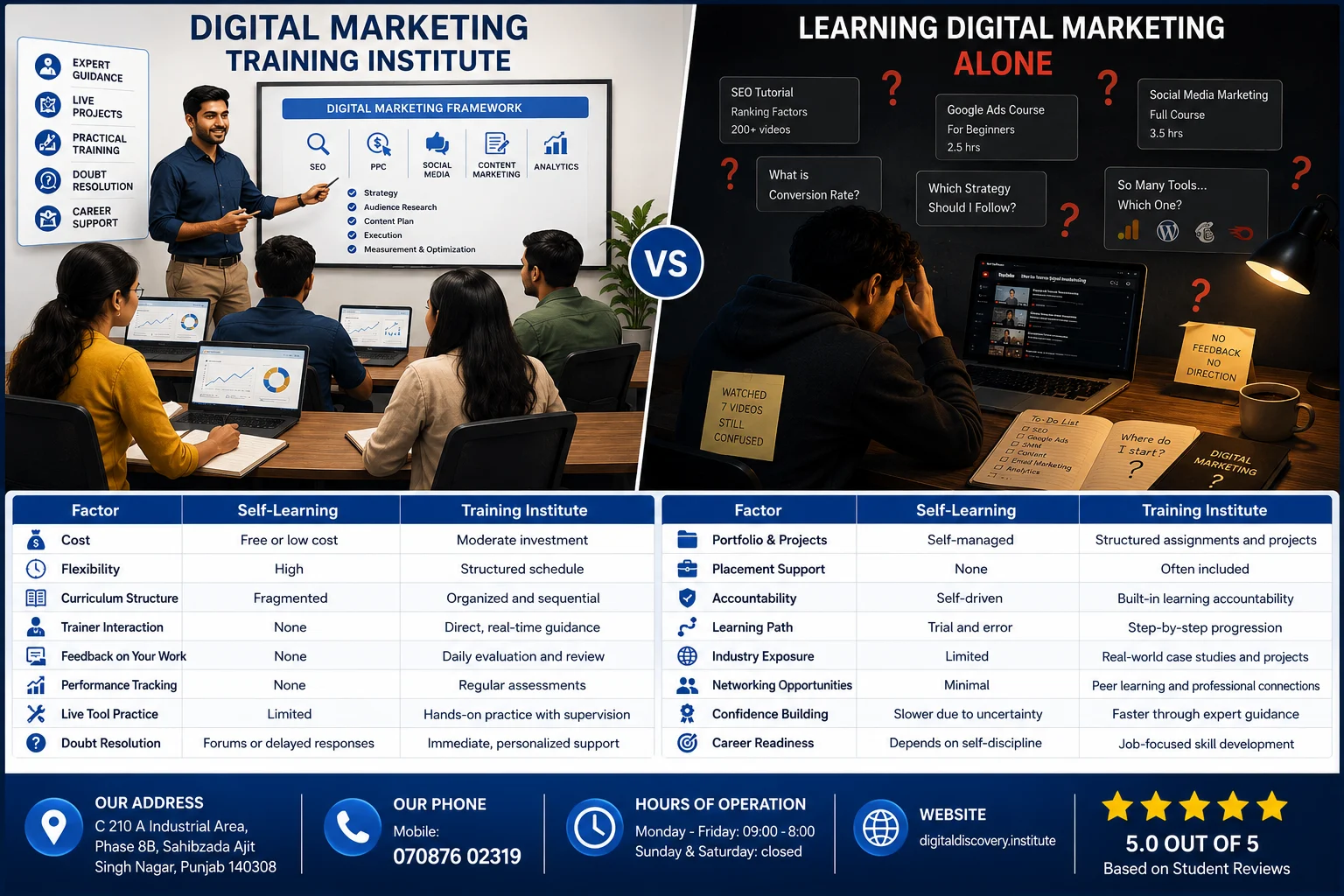
You open YouTube, search “how to learn digital marketing,” and three hours later you have watched seven videos, taken zero notes, and feel more confused than when you started. Sound familiar? That moment is exactly where the self-learning vs structured training debate begins – and this guide gives you the honest answer
Table of Contents
- Can You Really Learn Digital Marketing on Your Own?
- What You Can Learn for Free Online
- Free Resources Worth Your Time
- Where Self-Learning Starts to Break Down
- The Interaction Gap Nobody Talks About
- The Role of Daily Performance Tracking
- What a Training Institute Actually Gives You
- The Expert Trainer Advantage
- Self-Learning vs Training Institute: Side-by-Side
- So, Which One Wins?
- FAQs
Can You Really Learn Digital Marketing on Your Own?
Yes – you can. Let’s be honest about that upfront.
The internet is filled with genuinely useful content on SEO, Google Ads, social media marketing, content writing, and more. Thousands of people have started their digital marketing journey through YouTube videos, free courses, and blogs. Some have even built careers from it.
But here’s the question that matters more: How far can self-learning actually take you?
Because learning the theory of digital marketing and being able to execute, optimise, and get results are two very different things. This article breaks down exactly what self-learning gives you, where it starts to fall short, and what a structured training institute with experienced trainers brings to the table that no YouTube video ever can.
What You Can Learn for Free Online
Self-learning works. For building a foundation, it works really well.
Here is everything that is genuinely available to you online — for free or at very low cost:
Conceptual Knowledge You can learn what SEO is, how Google Ads work, what content marketing means, and how the social media algorithm functions. YouTube channels like Neil Patel, Ahrefs, and Semrush publish detailed tutorials that cover fundamentals clearly.
Free Certifications Google offers free certifications through Google Skillshop — including Google Ads, Google Analytics, and Search Console.
Meta Blueprint covers Facebook and Instagram advertising.
HubSpot Academy offers certifications in content marketing, email marketing, and inbound strategy. These are legitimate, recognised credentials.
- Tool Familiarity Through free trials and tutorials, you can learn to navigate tools like Google Search Console, Meta Ads Manager, Canva, Mailchimp, and basic keyword research tools.
- Industry Blogs and Communities Moz, Search Engine Journal, Neil Patel’s blog, and HubSpot’s resource library are updated regularly. Reddit communities like r/SEO and r/digital_marketing also provide real-world discussions and problem-solving.
So yes — the raw information is out there. You can spend months consuming it and feel genuinely knowledgeable.
Free Resources Worth Your Time
If you are starting out, these are among the most reliable:
- Google Skillshop — Google Ads, Analytics, and Search certifications (free)
- Meta Blueprint — Facebook and Instagram advertising fundamentals (free)
- HubSpot Academy — Content, email, and inbound marketing (free)
- Semrush Academy — SEO and competitive research (free)
- YouTube: Neil Patel, Ahrefs, Brian Dean — Practical video tutorials
- Coursera / Udemy — Paid but affordable structured courses
These are solid starting points. But once you move past theory into execution, a very common problem begins to surface.
Where Self-Learning Starts to Break Down
Here is the part most “learn digital marketing for free” articles skip.
- Information overload. The internet does not teach you in sequence. You find one video on SEO, another contradicts it, a third introduces a tool you have never heard of. Without a structured curriculum, self-learners often feel busy but not actually progressing.
- No feedback loop. You can watch a tutorial on running a Google Ads campaign. But when your campaign goes live and the results are poor, who tells you why? What did you set up wrong? Was it the bidding strategy, the ad copy, the audience targeting, or the landing page? Without someone to review your work, you are guessing.
- Theory without practice. Most free content teaches you what to do but not how to think about a problem. Real digital marketing requires judgment — and judgment only develops through guided practice.
- No accountability. When you are learning alone, there is no deadline, no structure, and no one checking whether you are actually practising what you learned. Most self-learners plateau or quit within the first few months.
The Interaction Gap Nobody Talks About
This is the real difference. And it is significant.
When you watch a YouTube video, the information flows in one direction. You cannot ask a follow-up question. You cannot say “I tried this and it did not work — why?” You cannot have someone look at your actual campaign, your actual website, your actual content, and tell you what is wrong.
A training institute creates a two-way interaction that self-learning simply cannot replicate. In a live classroom or one-to-one session, a trainer can:
- Answer your specific question in real time
- Correct a mistake before it becomes a habit
- Adjust the explanation based on how you are understanding it
- Show you live examples using real tools, real accounts, real data
- Challenge you with scenarios that push your thinking
This back-and-forth is how skills actually develop. It is not about the content — it is about the conversation around the content.
“Based on working with students across experience levels, I have consistently seen that the ones who progress fastest are not the ones who consumed the most content — they are the ones who asked the most questions and got direct answers.”
The Role of Daily Performance Tracking
One thing that separates a training institute from any online course – free or paid — is structured, daily performance evaluation and experienced trainers and teaching style.
When you learn alone, no one is measuring your progress. You might feel confident after watching a tutorial, but confidence and competence are different things. There is no external check on whether you have actually understood, retained, or can apply what you learned.
In a quality training institute, this changes completely:
- Daily task assignments. You are given real exercises — write an ad copy, audit this website’s SEO, set up this email sequence — and your output is reviewed.
- Trainer assessment. An experienced trainer evaluates your work and tells you specifically what is strong, what is weak, and what needs correction. Not a generic quiz. A real human evaluation.
- Progress benchmarking. Your performance is tracked over days and weeks. You can see where you started, where you are now, and what still needs work.
- Mistake correction in real time. When you develop a bad habit — and every learner does — a trainer catches it early. Left unchecked in self-learning, that bad habit gets reinforced every time you practise.
This daily feedback loop is something no algorithm, no video, and no online course can provide. It is the difference between practising correctly and practising the wrong thing repeatedly.
Beyond YouTube: What an Digital Marketing Institute Actually Teaches You
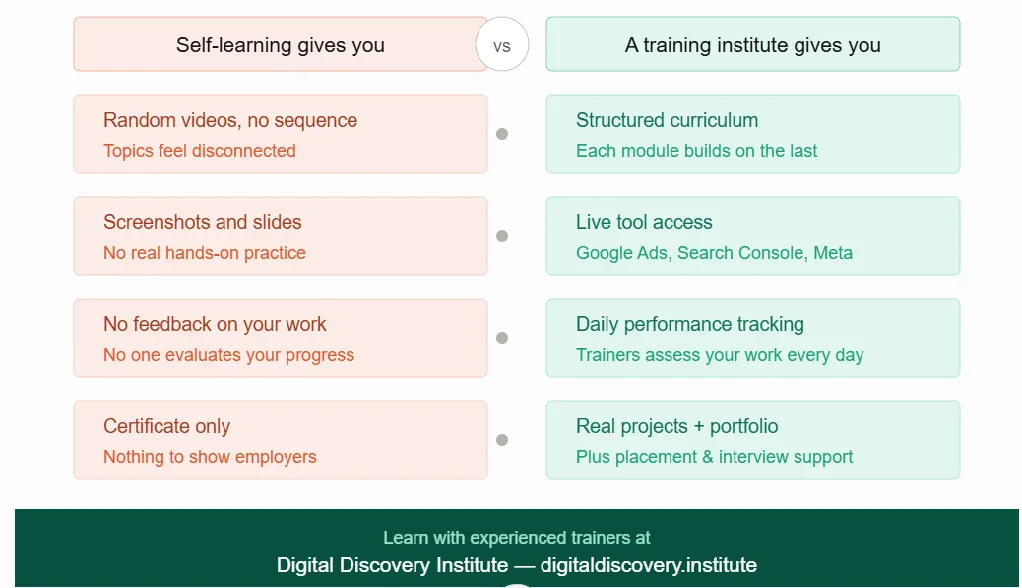
A training institute is more than a classroom. When you join a structured programme, topics are taught in a logical sequence — each module building on the last — so you never find yourself watching random videos trying to connect dots that were never meant to be connected.
You work directly inside real platforms. Google Ads accounts, Search Console, Meta Business Manager — not just screenshots in a slideshow, but live tools with an experienced eye watching over your shoulder. That hands-on exposure builds the kind of confidence that theory alone never does.
Good institutes also assign industry-relevant projects — real or simulated client work — so by the time you finish, you have a portfolio to show, not just a certificate to frame.
Add to that placement support, interview preparation, and peer learning from classmates who challenge and push you, and the gap between self-learning and structured training becomes very clear.
If you are based in Chandigarh, Mohali, Panchkula, or Zirakpur, Digital Discovery Institute offers a comprehensive Diploma in Digital Marketing covering SEO, Google Ads, social media, content writing, email marketing, and more – with expert trainer, live projects, and placement support built in.
The Expert Trainer Advantage
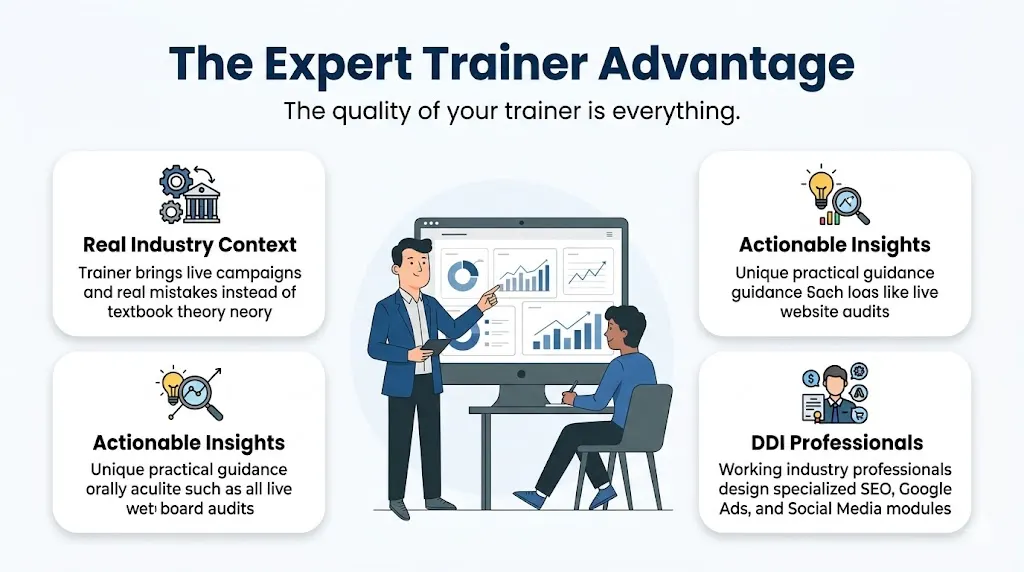
Not all training is equal. The quality of your trainer is everything.
An experienced digital marketing trainer does not just teach from a textbook. They bring live industry experience — campaigns they have run, mistakes they have made and corrected, trends they have seen shift over the years. That context changes how the knowledge lands.
When a trainer says “I have seen this exact bidding strategy fail for this type of campaign,” that insight cannot be found in any YouTube tutorial. When they walk you through an actual audit of a real website, pointing out issues and explaining why they matter, you learn faster and retain more.
At Digital Discovery Institute, trainers are working professionals with hands-on industry experience not just educators. This means students get exposure to how digital marketing is actually practised, not just how it is theoretically described. Courses like the SEO Training Course, Google Ads Course, and Social Media Marketing Course are designed and delivered by people who use these tools professionally.
Self-Learning vs Training Institute
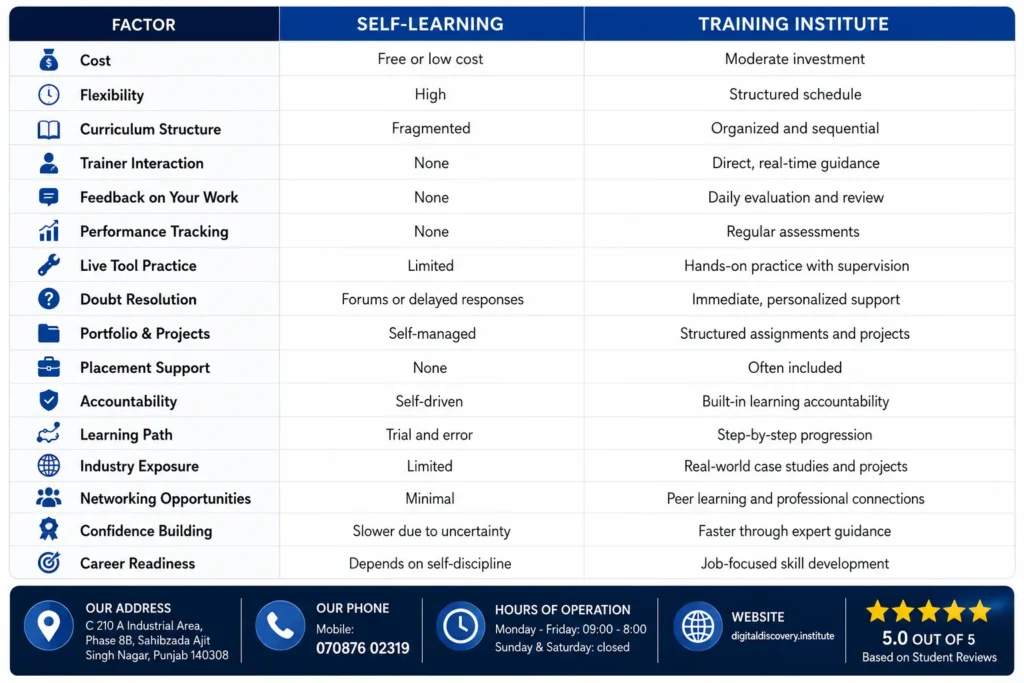
So, Which One Wins?
Both have a role. That is the honest answer.
Self-learning is a great way to explore digital marketing, understand the basics, and decide if this is the direction you want to go. The free resources available today are genuinely good. If you are simply curious or need surface-level knowledge for a small project, self-learning may be enough.
But if you are serious – if you want to build a career in digital marketing, get hired, grow a business, or run campaigns that actually produce results – then self-learning alone will take you only so far. The interaction gap, the absence of daily feedback, and the lack of structured performance tracking are real limitations that eventually slow everyone down.
A good training institute does not replace your curiosity or your effort. It multiplies both by giving them direction, structure, and expert guidance at every step.
If you are ready to move from consuming content to actually building skills, explore the digital marketing courses at Digital Discovery Institute. Whether you are in Chandigarh, Mohali, or anywhere across India, their programmes are designed to take you from learner to practitioner with the trainer support and accountability that makes it stick.
Frequently Asked Questions (FAQs)
Can I learn digital marketing on my own without a course?
Yes, the basics are accessible through free resources like Google Skillshop, HubSpot Academy, and YouTube. However, without structured guidance and feedback, most self-learners find it difficult to progress beyond foundational knowledge.
How long does it take to learn digital marketing on your own?
It varies widely. With consistent effort, you can cover the basics in 3–6 months. However, gaining practical, job-ready skills typically takes longer without structured training and real-world feedback.
Is a digital marketing course from an institute worth it?
Yes, particularly if you want career outcomes. An institute provides structured learning, expert trainers, live practice, daily assessments, and placement support that self-learning cannot replicate.
What is the difference between self-learning and institute training in digital marketing?
The core difference is interaction and feedback. Self-learning gives you information. A training institute gives you guided practice, daily performance evaluation, real-time doubt resolution, and accountability all of which are critical to developing actual skills.
Can I get a job in digital marketing through self-learning alone?
It is possible but harder. Most employers look for demonstrated skills and structured training. A certification from a recognised institute, combined with a portfolio from live projects, significantly improves your chances.
What should I look for in a digital marketing training institute?
Look for experienced trainers with industry backgrounds, a comprehensive and updated curriculum, hands-on project work, placement support, and transparent student reviews.
Is Digital Discovery Institute good for digital marketing training?
Digital Discovery Institute offers trainer-led, practical digital marketing programmes across multiple specialisations – SEO, Google Ads, social media, content writing, and more with placement assistance and live project exposure. They operate across major cities in India including Chandigarh, Mohali, Delhi, and beyond.