
Table of Contents
Introduction
Ranking well on Google has nothing to do with chance or how old your site is. Success sticks around when you keep at just one task: managing on-page SEO. Each piece you handle right there on the webpage – think title tags or how pages connect internally – tells search engines exactly what your content offers and who might want it.
Inside DDI Mohali – ranked among the leading digital marketing schools across Chandigarh-Mohali Tricity – on-page SEO becomes hands-on work, not theory. Live sites become classrooms where each item from this list gets tested by learners. Real campaign results flow in directly from SEO Discovery, the working agency behind the institute.
One step at a time, this list breaks down every on-page SEO detail – exactly what lifts pages into top spots or leaves them buried far behind. If you’re diving into SEO training in Mohali – or fixing up your own website – save this page and move through each point slowly. Thirty elements, nothing more, nothing less.
On Page SEO Explained?
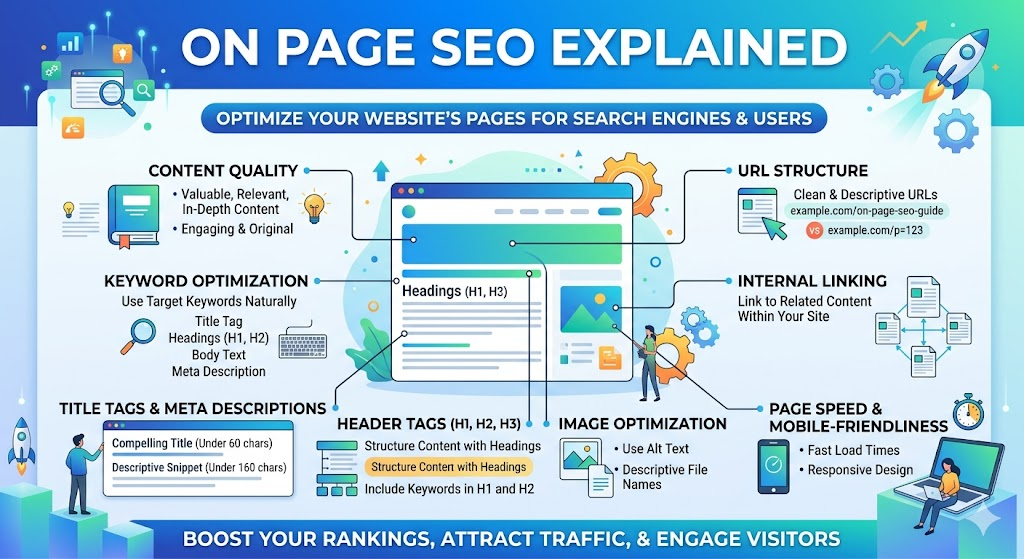
A website’s position in search results often depends on tweaks made right inside the page itself. These changes count as on-page SEO, sometimes known as on-site work. Instead of focusing elsewhere, effort goes straight into the elements people see while browsing. Hidden pieces matter too, like what lives in the code behind the scenes. Think titles up top, summaries under them, plus how headings are structured down the page. Words get placed with care where they’ll do the most good. Pictures go through adjustments so machines understand them better. Links between pages on the same site play a role as well. All these parts combine without shouting about it, just doing their job quietly.
Here’s a twist. On-page SEO sits right in your hands, not tangled up in outside factors like backlinks or site performance hiccups. Because of that grip, marketers often land here first when shaping strategy.
On-page SEO works together with local SEO ranking factors and paid channels like Google Ads to form a complete search visibility strategy.
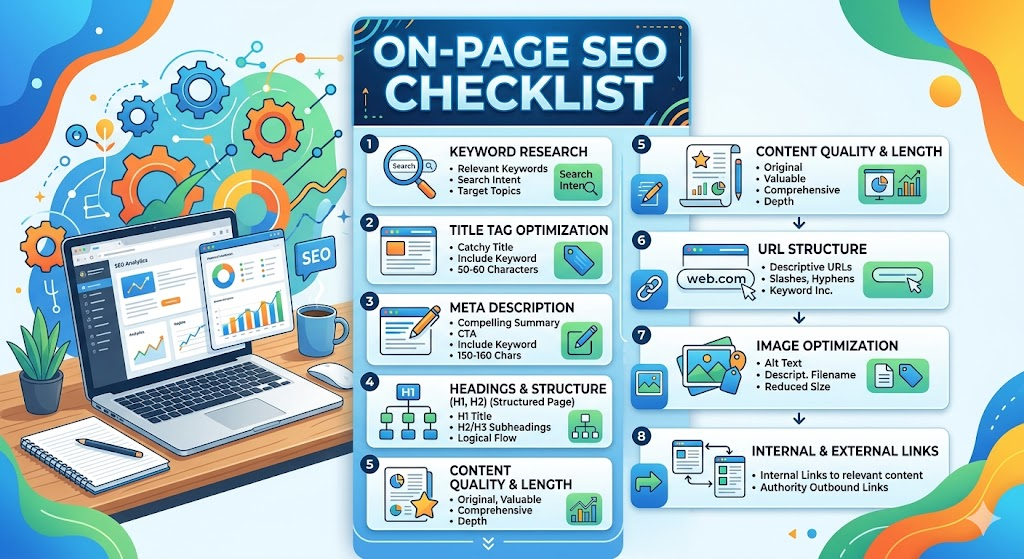
The Complete On-Page SEO Checklist — 30 Factors
# | Factor | What to do |
A — Keyword Strategy | ||
1 | Primary keyword placement | Start strong by placing your main keyword early in the page text. When it fits the flow, readers notice without effort. Slip it into a natural thought near the beginning instead of forcing it. Context makes it work better than awkward insertion ever could. A smooth start builds quiet trust right away. |
2 | Keyword research foundation | Start by picking a single main term per page – then weave in two to four related phrases that feel natural. Tools like Ahrefs or SEMrush help check how often people search for those words, plus how tough they might be to rank for. Google Keyword Planner works too when testing demand ahead of drafting. |
3 | Search intent alignment | Starting off strong means knowing what people actually want when they type something into a search box. Sometimes they’re looking to learn, sometimes to find a place, maybe weighing options, or ready to act. Writing great words isn’t enough if those words miss that target. Pages flop in rankings most often because of this gap – style doesn’t matter without alignment. |
4 | Incorporate LSI and NLP keywords | Out there among words that fit together – like context, meaning, topic clusters – a pattern shows up. Think of phrases tied by idea, not just repetition: semantic links, related concepts, natural language clues. These pieces help machines grasp what matters. Instead of tallying terms, systems now notice how ideas connect. Machines read between lines using syntax, intent, word relationships. Relevance comes from structure, nuance, surrounding info. What counts is clarity shaped by usage, not frequency. Behind the scenes, logic follows threads beyond exact matches. |
5 | Keyword cannibalisation check | One page, one main keyword – keep it that way. Find overlapping targets using Google Search Console. Where duplicates pop up, merge those pages or reshape their purpose. Competition between your own content slows visibility. Adjust headings, refresh angles, so each stands apart. Clarity grows when intent stays unique per page. Watch search data shift once overlaps disappear. |
B — Title Tag and Meta Description | ||
6 | SEO title tag | Title tags work best when short. Usually keep the main keyword up front. Focus on what the reader needs most. A strong title pulls more clicks. More clicks can help rankings too. |
7 | Meta description | A fresh take on crafting meta descriptions begins here – focus lands on the main keyword paired with real user benefit. Even if search engines don’t rank by this snippet alone, it pulls more clicks straight from results pages. Notice how clarity gets priority without fluff crowding the message. Each version shapes meaning differently, yet keeps intent sharp. The right phrasing can quietly outperform others just by being understood faster. |
8 | Title tag uniqueness | Page titles ought to differ – repeating them muddies signals for search systems. When each title stands apart, clarity follows instead of mixed messages piling up. |
9 | Power words in title | One study after another shows number-filled titles beat plain ones. Brackets? They pull more clicks too. Action terms like Complete work hard in search results. Step-by-Step pulls attention, again and again. Even year tags such as 2025 make a difference. These choices consistently rise above average headlines. |
C — URL Structure | ||
10 | SEO-friendly URL | Words in web addresses work better when they’re clear and brief. Hyphens help break them apart neatly – like this example shows. Skip digits or extra bits stuck on the end unless truly needed. A clean path like /on-page-seo-checklist beats messy ones every time. Meaning matters more than length. |
11 | URL depth | Three or more steps down from the main page? That’s where search engines start paying less attention. Important stuff works better up closer – think domain.com/category/page-name instead. |
D — Header Tags H1 to H6 | ||
12 | H1 tag | One clear heading at the top sets the topic. This main header includes the key term people search for. Its presence tells both visitors and systems what the content covers. A strong match between this line and the subject boosts recognition. Nothing else on the page carries quite the same weight here – except maybe the title shown in tabs. |
13 | H2 And H3 Structure | Start with big headings for major parts instead of small ones. Break down those areas using slightly smaller titles underneath them. Work related words into the top-level labels without forcing it. Structure your headings in a clear order so visitors plus search engines understand the flow. Ending here feels right. |
14 | Keyword Appears in One H2 | When Google sees an H2 tag, it pays close attention. One of those headings should carry your main keyword – or something very near to it – only if it fits well. Forced placement disrupts flow, so skip that. Let structure guide where it lands. |
E — Expertise Experience Trustworthiness | ||
15 | Content depth and word count | Length matters only when it matches what readers already find useful. Top results set the bar – check them first. Tools such as Ahrefs Content Gap show how deep others go. Being thorough beats being long. Fill every gap they leave open. |
16 | E-E-A-T signals | Start strong by showing you know your stuff. A real person wrote this, one who has done the work, lived it, maybe even failed at it before getting it right. Their name sits up front, along with when they put these thoughts down on paper. Links point outward, not to fill space but because facts need homes. Organizations back some claims, not all – some come straight from dirt-under-the-nails moments. Dates anchor ideas in time, so nothing feels frozen or guessed. Google notices these details, yes, but readers do too, quietly, without saying a word. |
17 | Figuring things out firsthand, using numbers gathered by observation | Truth lives in numbers few actually gather. When pages show real stats – ones dug up firsthand – they pull in links like magnets. Case studies built from scratch? They climb search results without begging. Data no one else owns becomes a quiet advantage. Share what only you have seen, not what others already said. |
18 | Content freshness | Pages need checking now and then so facts stay accurate. When dates change, Google tends to favor newer details – especially if timing matters. Slap on a “Last Updated” tag near the top. Every few months, swap out old numbers with fresh ones. Keeping things current just makes sense. Updates like that? They quietly build trust. |
19 | Featured snippet optimisation | A solid answer sits right under a bold heading, clear and ready. Numbered points might work well there instead of long blocks of text. Sometimes short lines compare ideas better than dense paragraphs. A quick list after the main question catches attention fast. Search engines notice when responses follow this pattern closely. Getting that top result spot often means organizing details just so. |
20 | Readability and formatting | Short chunks of text help people stay on a page longer. Break things into pieces – two to four lines work best. Bullet points guide eyes without effort. White space gives breathing room between ideas. When words stand out clearly, they grab attention naturally. Key phrases need weight – use bold for that job. Long blocks push readers away fast. Simple layout keeps them reading, slowly, steadily. |
F — Image Optimization | ||
21 | Alt text | A picture needs a clear description if someone can’t see it. When it makes sense, slip the main word into that description. Screen readers rely on these details so people know what’s shown. Google also checks them when sorting images found online. |
22 | Image file name | Start with clear names for your picture files prior to upload – think seo-tips-guide.webp instead of DSC_1023.png. Picture labels help search tools understand what the content is about. A meaningful title gives context at a glance. Files labeled properly support better visibility online. |
23 | Image compression | Lagging page speed? Tiny files help. Shrink every image below 100KB whenever you can. Switching to WebP often makes that easier. Bulky pictures drag down Core Web Vitals more than almost anything else. |
G — Internal Linking and Site Structure | ||
24 | Internal links | Pages should include between three and seven internal links that fit naturally within the content. Because they help spread authority, linking to related pages supports how search engines understand your site. When anchors contain clear, meaningful terms, users plus systems grasp what to expect. Following a logical path built by these connections makes navigation smoother overall. Structure matters more when each link reflects the destination’s core idea. |
25 | Topic cluster structure | Start by connecting every subtopic page directly to a main topic page – use the same linking words each time. That move tells search engines you know your stuff about the full subject. It also happens to be the quickest method to lift visibility across all related topics. |
26 | Broken link audit | Start by running your site through Screaming Frog or Ahrefs Site Audit to spot broken internal links. Fixing them isn’t just cleanup – it saves crawl space so search engines can focus on what matters. When visitors hit dead ends, they leave fast, which signals trouble to algorithms. These hiccups pile up, dragging down visibility over time. |
H — Technical On Page Elements | ||
27 | Schema markup | Structured data, like JSON-LD, fits different pages – articles, FAQs, how-tos, products, or local businesses. When used correctly, it helps search engines display richer snippets. These enhanced listings often lead to more clicks from search results. |
28 | Page experience signals | Start fast. Largest thing on screen loads within two and a half seconds. Interaction delays stay under two hundred milliseconds. Pages avoid sudden layout shifts – jumping elements score less than point one. Check results through Google’s speed tool. Review field data inside Search Console’s performance section. |
29 | Mobile optimisation | Most of the time, what shows up on phones decides your site’s spot in search results. Try checking how it looks using Google’s tool made just for that. Pages shaped by responsive layouts tend to work better across devices. Text you can actually read matters more than people think. Buttons sized right keep fingers from missing them. |
30 | Canonical tags | One page copies another? Point search engines to the right one using a canonical tag. When these tags are wrong – or missing – Google gets confused about what counts. That mix-up spreads rankings thin across similar URLs instead of focusing strength where it belongs. |
At DDI Mohali, the students start working on the on-page SEO checklist on real client websites from the second week of training. The students get to use Ahrefs and Screaming Frog, SurferSEO, and Google Search Console. They do audits with real traffic data, not just look at theory slides.
- The students do live site audits from the first day
- The course includes on-page SEO, Technical SEO, and Link Building altogether
- The Google certifications are included in the course
- We provide one hundred percent placement support. The classes are available on weekdays, weekends, or online. There is also a six-month industrial training option.
What to Fix First Based on What Matters Most
Some of the thirty elements matter more than others. To decide where to start with on-page SEO, focus shifts based on impact rather than checklist order
Tier 1 — Starting off strong
- Starting off strong, title tags, along with H1s, pack a serious punch. These tweaks take little time yet deliver big results. Not every fix needs hours – this one just needs attention. A small shift here often leads to clearer outcomes elsewhere. Done right, they guide both users and systems without extra noise. Effort stays low while impact climbs fast. Most overlook them, though that’s changing now
- Wrong search purpose means no ranking is possible, even if everything else is perfect. What people look for must match your page, or it will never show up
- Start off by putting the main word right up front – title tags love it there. Slide that same term into your top heading without fuss. Right after opening lines, weave it naturally into early sentences. Tuck it clean inside web addresses too, so links feel complete
- Core Web Vitals influence search rankings
Tier 2 — Building Authority Over Time
- Pages connect through links that spread trust across a site while grouping related topics together. Explore PPC courses in Mohali alongside SEO for full-funnel reach.
- Expertise shows through a writer’s clear experience on the topic. Because trust builds when sources back up claims. Original research adds weight without needing flashy terms. What matters most is how evidence fits together naturally
- Featured snippet optimisation – structured Q&A format in content
- A boost in clicks often follows clear schema signals. Rich snippets appear when structured data guides search engines. Pages gain visibility through precise annotations instead of vague hints. Clarity in code leads to better listings sometimes. Search tools reward accuracy with extra space on results pages
Tier 3 — Ongoing Maintenance
- Every three months, swap out old numbers. Rotate stale bits of info each quarter. Toss updated stats into the mix every few weeks. Swap in new details while pulling worn parts aside. Refresh chunks that feel dated around week thirteen. Slide fresh figures in when the calendar flips again
- Monthly broken link check using Screaming Frog or Ahrefs
- Every time a picture goes up, it gets squeezed smaller without losing quality. Alongside that, descriptive labels are automatically tagged. This happens each upload, no exceptions. The system handles shrinking files while attaching readable notes for screens. Compression works hand in hand with tagging, silently. Fresh images? They’re treated the same way. Nothing slips through empty-handed
You now know what you need to fix. What if you could fix this problem on than ten live client websites with help from an expert every step of the way?
The Digital Discovery Institute in Mohali teaches SEO professionals how to do their job through campaigns at SEO Discovery. SEO Discovery is the parent agency of the institute. It helps clients in India, the United States of America, the United Kingdom, and Australia. Every part of this checklist is used in a live environment, not a fake one.
📍 Phase 8B, Mohali
📲 You can call us at +91-70876 02319 or send an email to training@seodiscovery.com
⏱ We have courses that are twelve weeks long, and you can pay for them in installments. We also have a free demo class so you can try it out.
Using This On-Page SEO Checklist
Start each new page by running it against the checklist. This is how learners in DDI Mohali handle live projects for real clients:
- Start by checking what people type into search engines. See what they really want when they look up certain words. Match your main terms with their needs. Include extra phrases that support the topic naturally
- Start strong by putting the main keyword up front – title, heading one, opening line, web address. Work related words into sentences without forcing them. Let context guide where they fit best. Flow matters more than checklist stuffing. Words should feel part of the thought, not inserted. Match search intent by speaking like a person who knows the topic. Skip tricks. Write so it reads right the first time. Repeat only if it helps clarity. Trust that relevance shows when ideas connect. Anchor each paragraph around meaning, not keywords. Stay sharp but natural. That balance keeps readers moving forward
- Start by describing each image clearly for screen readers. Squeeze file sizes without losing quality to speed things up. Swap older formats out for WebP where possible. Jump between related pages using quiet, helpful links. Wrap it up with a short summary that shows what the page is about
- Start by adding schema markup. Then make sure the site works well on phones and tablets too. After that, confirm the canonical tags are correct
- Submit site to Google Search Console after publishing check core web vitals regularly monitor keyword positions each week
- Every month, take a look at dead links. Content gets old – swap it out when needed. Peek at rival spots on search results to dodge overlap
Now more than ever, knowing the impact of AI on SEO matters. Because of Google’s Search Generative Experience, pages that show real expertise, trustworthiness, and solid structure tend to stand out – everything this checklist helps you build. What counts shows up here.
Track all your on-page changes and their impact using Google Analytics 4 for marketers – the data will show you which optimisations are actually moving rankings and traffic.
Conclusion
Most people think on-page SEO ends after publishing. Yet consistency turns it into something stronger than routine. Those who follow a steady process keep showing up in search results. Others scramble each time rankings drop without understanding the pattern behind it. Whether you are following an SEO course in Chandigarh or managing a live site, that steady process is what separates consistent rankers from everyone else.
This guide walks through each part of an optimised web page – matching keywords to user goals, shaping title tags, handling Core Web Vitals, using schema markup, setting up canonical tags. One element alone won’t carry the load. Picture strong content paired with a weak headline – it fades. Imagine spotless code chasing a keyword people don’t mean – no conversions happen. All pieces here tie together, which is exactly what makes steady, step-by-step work beat quick patches every time.
Lately, Google pays closer attention to signs of real-world know-how, skill, reputation, and reliability. Slotting keywords neatly into text just does not cut it anymore. People checking site quality look for proof that someone actually lived through what they write about. They ask if the writer truly understands the topic deep down. Is this webpage someone you would rely on when facts matter. Build these qualities into each article from the start. Trying to add them afterward misses the point entirely.
When AI changes how search works, thanks to tools like Google’s new features, only certain pages stay strong. These are the ones made solid from within – built around one main idea, linked smartly inside, filled with natural language terms that match user intent, plus real expertise shown clearly. Each point here feeds into making that base unshakable. Quick fixes fall apart instead.
Frequently Asked Questions
What is on-page SEO in simple terms?
A single web page gets stronger in search results when tweaks happen right where visitors see them. Title tags shape how it shows up at the top of searches. Words inside matter, but so does how they’re arranged through headers. Pictures play a role too, especially when named well and sized properly. Moving around the site becomes smoother with smart internal connections between pages. How fast it loads counts just as much as whether phones handle it easily.
How many on-page SEO factors does Google actually use?
A web page’s title tag matters more than most think. What users expect when they type a query shapes how well a page performs. Good content goes beyond surface details, offering real clarity. Google checks loading speed, interactivity, and visual stability – part of its core experience metrics. Links pointing within a site help spread authority where it counts. Around three dozen ranking inputs live right on the page itself. Though hundreds exist overall, only some make daily work meaningful. Every item here reflects what experienced optimizers actually adjust.
What is the difference between on-page SEO and off-page SEO?
Every page works better when its words, headings, tags, and links line up with what people search. Outside attention shows trust, especially through links from other sites pointing back. Without solid structure inside the page, external efforts fall short. Fixing what’s visible comes before chasing outside approval. Pair this foundation with our social media marketing courses for a complete digital strategy.
How important is keyword density in 2025?
Outdated idea? That old keyword density number everyone quotes. Today’s search engines grasp meaning through context-aware tech instead of counting repeats. Start strong – tuck your main term into the headline, opening header, and early sentences without forcing it. Layer related concepts behind the scenes by weaving in semantically linked phrases across the piece. Relevance now grows from how ideas connect, not just what words show up.
E E A T Explained — Relevance For On Page SEO?
What Google looks at when judging page quality is baked into E-E-A-T: that means Expertise, Experience, Authoriativeness and Trust, while being seen as dependable. Pages get weighed on this scale since human reviewers apply it to decide ranking worth. Show who wrote the piece, back claims with fresh findings, point to reliable sources, share personal involvement instead of just theory. These elements feed directly into how solid a page seems.
Meta Description Impact on Rankings?
A good meta description won’t directly boost your spot on Google. Still, it grabs attention in search results, which means more people might click through. When clicks go up, that activity can quietly influence how high a page ranks later.
Schema Markup and Rich Results Explained?
Hidden details in a webpage’s code, built with JSON-LD, clarify its meaning to search engines. When Google understands the context, it might show extra features like stars, step-by-step guides, or quick answers. These additions often appear under regular links. Seeing them can make more people click through without changing anything else. Results shift when machines grasp intent beyond keywords.
How Often to Update On-Page SEO?
Every few months, give your pages a complete checkup. Refresh what you write once each season. Broken links? Look for them every month without fail. Each week, track how fast your site feels and where it shows up in searches – use Search Console plus tools that follow ranks.
Tools SEO Professionals Use for On-Page Optimization?
Out there among SEO tools, you’ll find Screaming Frog crawling sites. Moving on, keyword checks happen through Ahrefs instead of SEMrush. Performance tracking leans on Google Search Console for indexing clues. Content shaping gets help from SurferSEO rather than Clearscope. Speed tests come alive using Google PageSpeed Insights. Structured data? Validators built around Schema.org handle that piece. Each tool fits a different slot in the workflow.
Learn On-Page SEO In Mohali?
Live website tweaks form the core of DDI Mohali’s SEO classes, with learners diving into on-page fixes via tools like Ahrefs and Screaming Frog. Google Search Console guides real-time monitoring tasks during sessions led by working specialists. SurferSEO shapes content strategies through actual scoring feedback while concepts unfold step-by-step. Audits of rival sites help uncover hidden ranking gaps often missed in standard lessons. Technical deep-dives cover site speed, indexing quirks, and crawl issues using everyday examples. Link-building methods stress quality connections built slowly over relevance tricks. Graduates gain access to job referrals after completing project milestones within the program.
At Digital Discovery Institute in Mohali, students virtually learn on-page SEO. They do not learn from slides. They learn from websites that are live.
They offer things such as:
* SEO Training in Mohali. This includes on-page SEO, technical SEO, building links, and using AI tools
* Diploma in Digital Marketing. This is a complete programme with 40-plus modules that can help you in your career
* 6-Month Industrial Training. In this, you get to work on live projects from agencies, and you also get a stipend for the internship
* Online batches are available all over India
We also give you Google certifications, and they support you to get a job, and you can even attend a free demo class to see how it works.